Most of us grow up believing that every country has one capital city. Simple, straightforward, and fixed. But the world loves breaking rules, and that’s exactly what happens with countries with twin capital cities. In these nations, power, governance, history, and identity are divided between two capitals, each serving a different purpose.
At first, the idea sounds confusing. Why would a country complicate things by splitting its capital? Yet when you dig deeper, these arrangements make perfect sense. From political compromises and colonial legacies to geographic balance and cultural harmony, twin capital systems often exist to solve very real problems.
So what leads a country to choose two capitals instead of one? And how does it actually work in daily life? Let’s explore the fascinating logic, stories, and destinations behind countries with twin capital cities.
What Does It Mean to Have Twin Capital Cities
In countries with twin capital cities, each city holds a specific role. One may serve as the seat of government, housing parliament and executive offices, while the other functions as the judicial capital or administrative hub. Sometimes one capital is symbolic or historic, while the other is practical and modern.
This system allows countries to balance power, avoid overcrowding, respect history, or maintain political stability. Instead of concentrating everything in one city, responsibility is shared.
Have you ever wondered how a country manages its leadership across multiple cities? The answer often lies in compromise rather than convenience.
Why Countries Choose Twin Capitals
There is never just one reason behind dual capitals. In most cases, it’s a mix of history, geography, and politics.
- Colonial legacies where old capitals retained symbolic importance
- Political compromises between rival regions
- Geographic balance between coastal and inland areas
- Overcrowding or space limitations in historic cities
- Economic or administrative efficiency
Rather than weakening a nation, twin capital systems often strengthen unity by acknowledging multiple identities within one country.
Countries With Twin Capital Cities Around the World
Let’s look at some of the most well-known and interesting countries with twin capital cities, and why they chose this unusual setup.
South Africa
South Africa is one of the most famous examples of a country with multiple capitals. It actually has three, but the concept still fits the idea of twin or split capitals.
Pretoria serves as the executive capital, where the president and government offices are located. Cape Town is the legislative capital, home to Parliament. Bloemfontein acts as the judicial capital.
This system was created to balance power after the formation of the Union of South Africa, ensuring no single region dominated governance. Today, it reflects the country’s complex political history and commitment to regional representation. Official tourism details can be found at South Africa Tourism.

The Netherlands
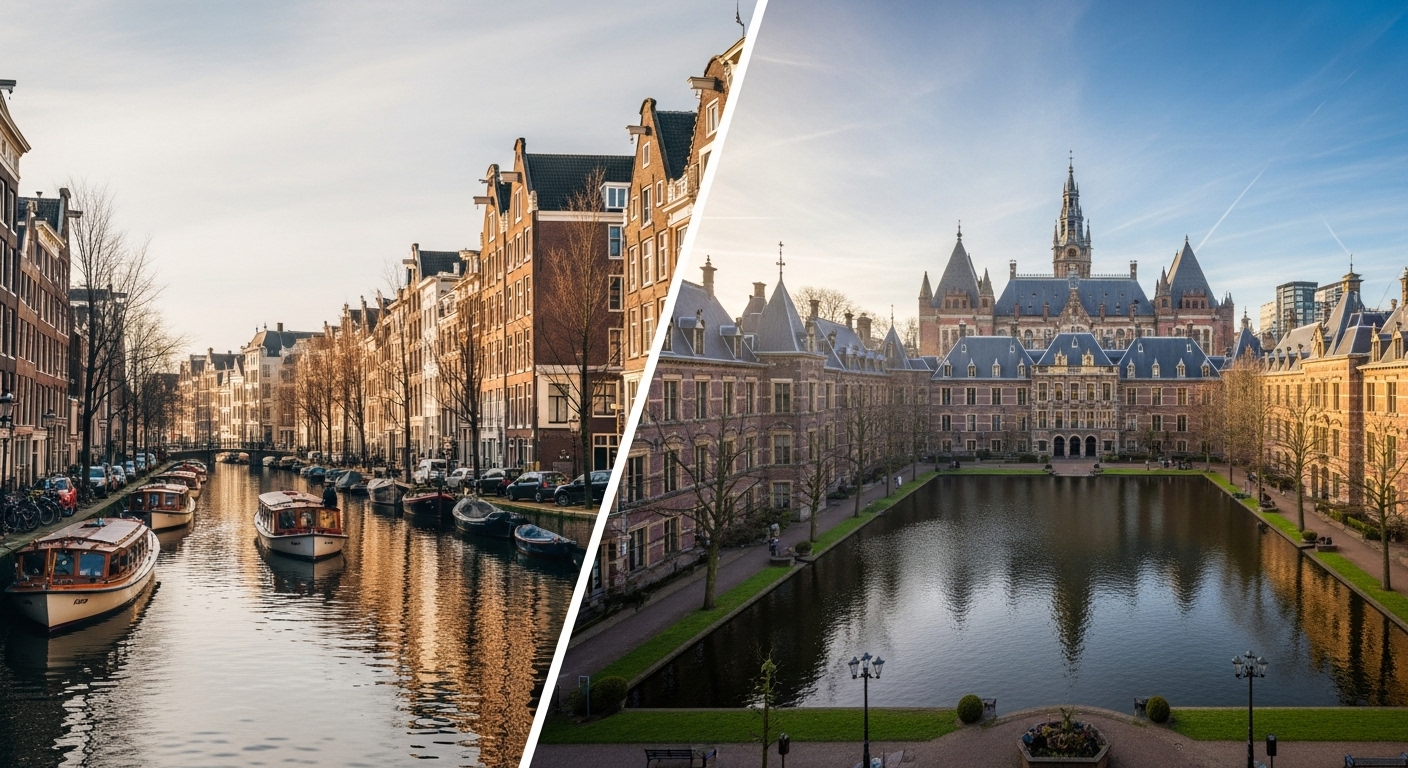
The Netherlands offers a classic example of symbolic versus functional capitals. Amsterdam is the official capital according to the constitution, while The Hague is where the government actually operates.
The royal family, parliament, supreme court, and embassies are all based in The Hague. Amsterdam retains capital status due to historical importance and national identity.
This split allows both cities to thrive in their own roles, preserving tradition while maintaining efficient governance. More details are available at Holland Travel.
Bolivia
Bolivia’s capital system reflects political compromise. Sucre is the constitutional capital and home to the judiciary, while La Paz serves as the seat of government.
La Paz became the administrative capital due to its economic importance, while Sucre retained historical and legal significance. This division helped prevent regional conflict and preserved national unity.
La Paz also holds the title of the world’s highest seat of government, adding another layer of uniqueness to Bolivia’s dual-capital identity.

Malaysia
Malaysia operates with a functional split between Kuala Lumpur and Putrajaya. Kuala Lumpur is the official capital and cultural heart, while Putrajaya serves as the administrative capital.
Putrajaya was developed to ease congestion in Kuala Lumpur and create a modern, purpose-built administrative center. The result is a cleaner separation between governance and commercial life.
Tourism information can be found at Malaysia Travel.
Benin
Benin recognizes Porto-Novo as its official capital, while Cotonou functions as the economic and political center.
Most government institutions and foreign embassies are located in Cotonou, making it the de facto capital. Porto-Novo retains symbolic importance, reflecting the country’s colonial and cultural history.
This setup allows Benin to honor its past while adapting to modern governance needs.
Ivory Coast (Côte d’Ivoire)
Yamoussoukro is the official capital of Ivory Coast, while Abidjan remains the economic and administrative center.
Abidjan’s infrastructure, ports, and population made it too important to abandon as a governing hub. Yamoussoukro, the birthplace of the country’s first president, was designated capital to decentralize power.
This balance highlights how political symbolism and practical governance often coexist.
How Twin Capitals Affect Daily Life
For locals, living in a country with twin capitals often feels completely normal. Government workers may commute between cities, while businesses cluster in economic centers.
For travelers, however, it can be surprising. Many visitors assume the most famous city is the capital, only to discover another city holds that title officially.
Have you ever told someone the wrong capital of a country and later realized the truth was more complicated?
Traveling to Countries With Twin Capital Cities
Visiting countries with twin capital cities offers a richer travel experience. You don’t just explore one center of power and culture — you experience multiple perspectives of the same nation.
Flights via airlines like Emirates and Qatar Airways make it easy to reach major capitals, while accommodations across both cities can be booked through Booking.com or Airbnb.
Some travelers even plan itineraries specifically to visit both capitals, gaining deeper insight into political structure, history, and culture.
Why Twin Capitals Will Continue to Exist
As countries grow and evolve, governance structures adapt. Twin capital systems are often more flexible than single-capital models, especially in nations with diverse regions or historical tensions.
Rather than being outdated, dual capitals often represent modern solutions rooted in respect for history.
Follow us on our social media platforms for more fascinating travel insights, unusual country facts, and destinations that challenge what you think you know about the world. Have you visited a country with twin capitals, or did any of these surprise you?
Catch up on the top stories and travel deals by subscribing to our newsletter!