There’s something magical—almost cinematic—about walking or driving across a road that disappears beneath the sea. The idea that your destination is reachable only for a few fleeting hours each day adds a thrill that few other travel experiences can match. Welcome to the world of tide-dependent islands, where timing isn’t just everything—it’s the key to adventure itself.
Imagine this: You’re waiting by the shore as the tide retreats, revealing a shimmering strip of sand and cobblestone stretching toward an island fortress or a sleepy village. You can almost feel the pulse of the ocean as it grants you passage—for now. The clock starts ticking, and before long, that same road will vanish again beneath the waves. These are not just destinations; they are moments in motion, ruled by the rhythm of nature.
Today, we’re diving into some of the world’s most enchanting tide-dependent islands—from medieval monasteries in France to tiny fishing communities in Scotland, from secret trails in Canada to mysterious islets in Asia. Whether you’re a thrill-seeking traveler or someone who just loves the poetry of landscapes shaped by the sea, this guide will take you across some of the most fascinating causeways on Earth.
The Enchantment of Ephemeral Travel
Let’s start with the obvious question: Why do these tide-dependent islands captivate travelers so deeply? It’s because they combine mystery, danger, and beauty all in one experience. Unlike other destinations that are always accessible, these islands demand patience, planning, and respect for nature’s timing. You can’t just show up whenever you want—you have to sync your watch to the tides.
There’s also something primal about this kind of travel. It makes you acutely aware of your surroundings. You feel the sea breeze shift, the sand dry beneath your feet, and the subtle pull of the moon above. You’re part of an ancient rhythm that has governed life on Earth long before timetables and GPS existed. That’s a rare connection in our hyper-digital world.
1. Mont Saint-Michel, France – The Queen of Tide-Dependent Islands
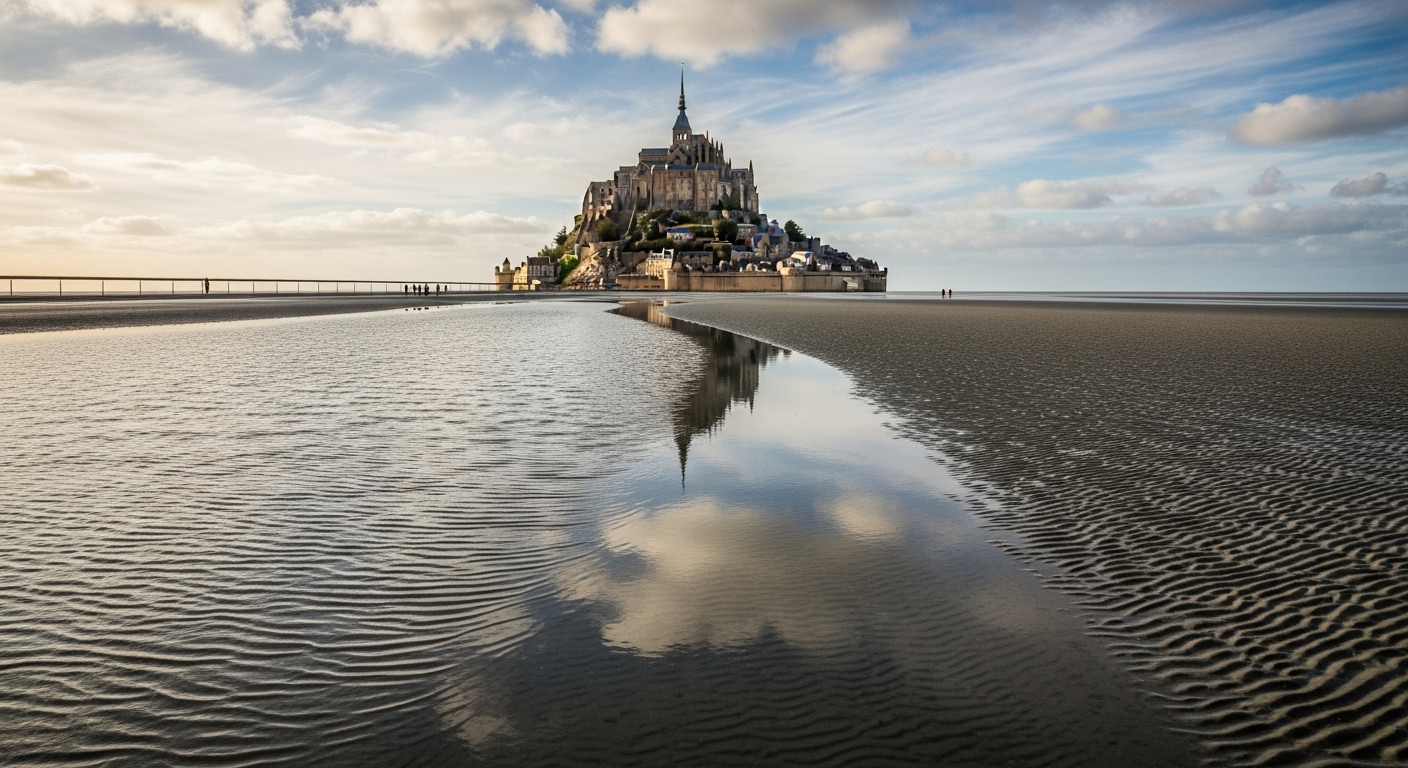
If there were a royal family of tide-dependent islands, Mont Saint-Michel would undoubtedly be the queen. Rising dramatically from the tidal flats of Normandy, this UNESCO World Heritage Site is one of France’s most iconic landmarks. When the tide is out, you can walk or drive across the causeway to reach its medieval walls and spire-topped abbey. But when the tide rushes back, the island becomes completely surrounded by water once again—isolated, mysterious, and majestic.
Travelers are always amazed by how quickly the tide rises here—sometimes at the speed of a galloping horse! That’s why local guides are essential if you want to walk across the sand safely. The sight of Mont Saint-Michel floating above a mirror-like sea is pure magic, especially at sunset when the sky turns gold and violet.
2. St. Michael’s Mount, England – A Cornish Cousin with a Legend
Across the English Channel lies another gem—St. Michael’s Mount in Cornwall. It’s the British counterpart to Mont Saint-Michel, both in name and in spirit. At low tide, a granite causeway appears, allowing visitors to stroll across from the mainland village of Marazion. Once the tide rises, boats take over as the only link to the island.
What makes this place special isn’t just its beauty, but its mythology. According to local legend, a giant named Cormoran once lived here before being slain by a local boy named Jack—hence the famous Cornish tale “Jack the Giant Killer.” Visitors can still explore the medieval castle, subtropical gardens, and small harbor that make this place a dream for photographers and history buffs alike.

3. Lindisfarne, England – The Holy Island of Pilgrims and Poets
Located off the coast of Northumberland, Lindisfarne—also known as Holy Island—is another classic example of a tide-dependent island. Its tidal causeway is open only for a few hours each day, and travelers who miscalculate can find themselves stranded, waiting for the waters to recede again (a rite of passage, some say).
Lindisfarne is steeped in spirituality and serenity. It was the cradle of early Christianity in Britain, home to a famous priory that produced the Lindisfarne Gospels. Today, it draws pilgrims, poets, and peace-seekers. The combination of its ancient ruins, wild coastal scenery, and the soft hush of the tide makes it one of England’s most moving landscapes.
4. Cramond Island, Scotland – Urban Adventure with a Twist
Just a short trip from Edinburgh, Cramond Island sits in the Firth of Forth and offers an unexpectedly wild escape within sight of the city. The tidal walkway leading to the island is flanked by eerie concrete pylons—World War II defenses that make the crossing feel like an otherworldly film set. As with all tide-dependent islands, timing is crucial here. Get it wrong, and you might be watching your return path disappear under the waves!
Once you make it across, you’ll find a quiet landscape of grassy slopes, old bunkers, and seabirds circling above. It’s a great place for a picnic or a reflective walk, especially at sunrise when the light hits the causeway just right.
5. Hayling Island, England – Where Tide and History Meet
In Hampshire, the old Hayling Billy Trail once connected Hayling Island to the mainland by rail. While the rail bridge is gone, the area’s tidal causeways and mudflats remain a haven for walkers and cyclists. The tides here reveal salt marshes teeming with life—perfect for nature photographers and anyone looking to experience a quieter side of England’s coast.
6. Passage du Gois, France – The Daring Road to Noirmoutier
For thrill-seekers, few tide-dependent islands match the drama of the Passage du Gois, a 4.1 km causeway linking mainland France to the island of Noirmoutier. The road is submerged twice daily, and as soon as it reemerges, drivers rush to cross before the sea takes it back. There are even rescue towers along the route for those who misjudge their timing. It’s both exhilarating and humbling—a reminder that nature always has the final say.
7. Tatihou Island, France – A Walk Through Maritime Heritage
Located off the Normandy coast, Tatihou is small but packed with history. Accessible by amphibious vehicles or on foot at low tide, the island hosts a maritime museum, fortifications designed by Vauban, and a nature reserve filled with seabirds. It’s ideal for families or travelers who enjoy slow, immersive exploration.
8. Miquelon-Langlade, Saint Pierre and Miquelon – Canada’s Secret French Isles
Did you know that just off Newfoundland’s coast lies a little slice of France? The twin islands of Miquelon and Langlade are connected by a narrow isthmus that sometimes floods at high tide. This is one of North America’s lesser-known tide-dependent islands, offering a unique mix of French culture, North Atlantic weather, and rugged natural beauty. It’s a dream destination for birdwatchers and adventure photographers alike.
9. Jindo Island, South Korea – The Miracle Sea Road
Every spring, a natural phenomenon occurs near Jindo Island in South Korea: the sea parts, revealing a 2.8 km path that connects the island to a nearby islet. Thousands of visitors walk across this “miracle road,” celebrating with festivals, traditional music, and local food. It’s a striking reminder that tide-dependent islands aren’t just a European phenomenon—they span cultures and continents.

10. Bay of Fundy, Canada – Nature’s Extreme Tide Playground
While not home to a specific island causeway, the Bay of Fundy between Nova Scotia and New Brunswick is famous for having the world’s highest tides. The shifting water levels create temporary islands, hidden caves, and walkable seabeds that appear and vanish daily. It’s a must-visit for anyone fascinated by tidal forces in motion.
Planning Your Tide-Dependent Island Adventure
If this list has you dreaming of your own tide-timed getaway, there are a few key tips to keep in mind:
- Check tide charts in advance: Local visitor centers, coastguard websites, or even hotel staff can help you plan crossings safely.
- Respect nature’s clock: Never underestimate how fast the tide comes in—it’s better to wait than to rush.
- Bring proper footwear: Waterproof boots or sandals are ideal for slippery surfaces and shallow puddles.
- Travel light and smart: Keep essentials in a waterproof bag, and always have a backup plan in case you get stranded (it happens!).
What makes tide-dependent islands so unforgettable isn’t just the journey—it’s the waiting. Standing on the shore, watching the waves retreat, you feel time slow down. In that moment, travel becomes meditation. You’re not chasing a checklist; you’re syncing with the heartbeat of the Earth itself.
So next time you crave something different—something that challenges both your sense of adventure and your patience—consider a trip to one of these incredible places. Just remember: tides wait for no one. Have you ever crossed to a tide-dependent island? Did you make it back before the water rose? Or did you end up waiting it out, enjoying an unplanned coastal adventure? Share your story in the comments below—we’d love to feature your experience in a future post!
And if you enjoyed this deep dive into the world’s most mysterious crossings, follow us on our social media platforms for more inspiring travel stories, hidden destinations, and offbeat itineraries from around the globe. Your next adventure might just be one tide away!
Catch up on the top stories and travel deals by subscribing to our newsletter!