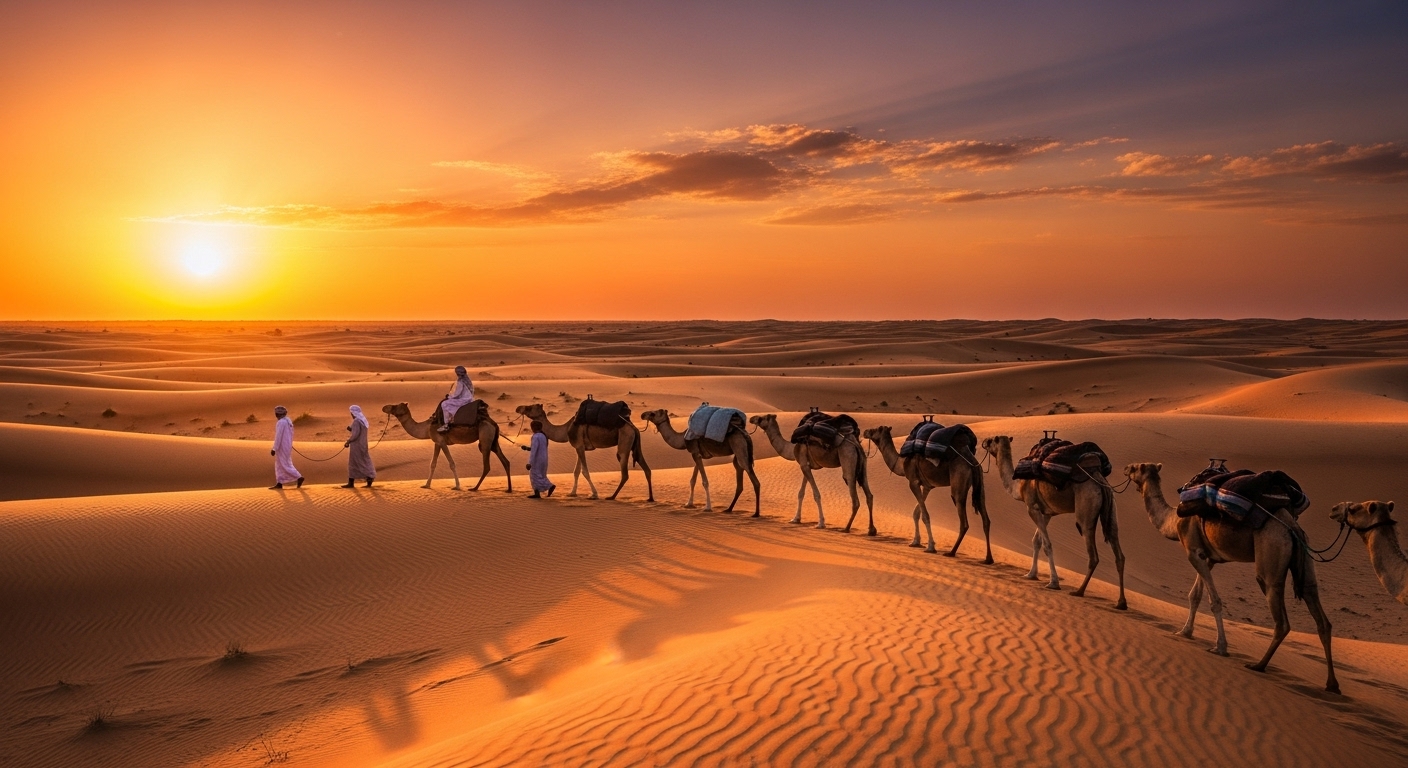
For thousands of years, historic caravan routes connected distant civilizations through deserts, mountains, and seas. These paths carried not only silk, incense, and amber — but also culture, religion, and ideas that shaped the modern world. What if you could trace those same ancient trails today? Imagine walking where merchants once bartered in bustling bazaars or following the dusty trails where camels carried gold and spices across continents.
In this journey through time, we’ll explore how today’s travelers can follow in the footsteps of ancient traders. Whether you’re drawn to the mystique of the Silk Road, the aromatic paths of the Incense Route, or the northern charm of the Amber Road — these legendary trade routes still exist in fragments and can be explored with modern comfort. Are you ready to step into history’s greatest journeys?
The Romance and Reality of the Historic Caravan Routes
It’s one thing to read about the Silk Road in textbooks — it’s another to actually stand on its stones. The historic caravan routes weren’t simple highways. They were living ecosystems — networks of towns, oases, and resting stations where languages mixed, religions spread, and goods transformed empires.
These were the arteries of civilization. The Silk Road, for example, was never a single path. It stretched from China to the Mediterranean, splitting into branches that reached as far north as Mongolia and as far south as India. Traders carried not just silk but ideas — Buddhism, Islam, and technologies like papermaking spread through these routes.
Traveling them today feels like a living museum experience — except you’re walking through deserts, mountains, and bustling towns that have evolved but still remember their past.
The Silk Road: Tracing the World’s Greatest Trade Route
The Silk Road is perhaps the most famous of all historic caravan routes. It connected East and West for over a thousand years, beginning during China’s Han Dynasty (around 130 BCE). The road wasn’t just for silk; it carried jade, spices, furs, and precious metals.
If you dream of tracing it today, start in Xi’an, China — the ancient capital. The city’s Muslim Quarter still echoes with the scents of cumin and chili, much like it did when traders arrived from Central Asia. From there, you can follow the trail through Dunhuang’s desert caves, cross the Taklamakan Desert, and enter the high passes of Kyrgyzstan and Uzbekistan.
Modern travelers often highlight Uzbekistan’s Samarkand and Bukhara — both UNESCO World Heritage sites — for their stunning Islamic architecture and history of trade. Imagine walking past turquoise domes that once guided caravans across endless sand dunes.

The Incense Route: Scents of the Arabian Desert
Before perfumes were bottled, they were carried by camel. The historic caravan routes that formed the Incense Route stretched from Yemen and Oman through Saudi Arabia and into Jordan and Israel. Traders carried frankincense and myrrh — two of the most prized commodities in the ancient world — to temples, markets, and royal courts.
Today, you can still follow parts of this route. In Oman, the city of Salalah remains the source of high-quality frankincense. The Empty Quarter, one of the world’s largest deserts, offers surreal landscapes where caravans once trudged under the blistering sun. Jordan’s Petra — carved into red sandstone — was a major trading hub and a jewel on this route.
For travelers, retracing the Incense Route offers both adventure and introspection. You’ll experience the quiet majesty of the desert, the warmth of Bedouin hospitality, and the echoes of traders who once risked it all for a pouch of fragrant resin.
The Amber Road: A Northern Gem
Far from the dunes of Arabia, another network of historic caravan routes connected Northern Europe — the Amber Road. This route stretched from the Baltic Sea (modern-day Lithuania, Latvia, and Poland) to the Adriatic and the Mediterranean. Amber, the “gold of the North,” was prized for its beauty and mystical properties.
Modern travelers can follow the Amber Road through charming towns like Gdańsk (Poland), Kraków, Vienna, and Venice. Museums along this route showcase amber jewelry and carvings that once made kings and nobles swoon. It’s a journey that blends natural beauty with ancient craftsmanship — perfect for travelers who love culture and history with a touch of magic.
Following the Routes in Today’s World
What’s amazing about these ancient trails is how they’ve adapted to the modern world. Today, trains, highways, and guided tours make it easier to explore the paths that once required months or even years of travel. Many tourism boards have developed “heritage routes” — modern versions of the old caravan trails — allowing travelers to follow these paths without sacrificing comfort.
For instance, you can join Silk Road rail journeys across Central Asia, drive the Incense Route in guided 4×4 tours, or cycle along the Amber Road in Europe. Each experience offers a unique blend of exploration and reflection.
Why Trace Historic Caravan Routes?
Why should modern travelers care about old trade routes? Because they reveal something timeless about humanity. These paths remind us that curiosity, trade, and connection have always driven civilization forward. Walking them connects you to a lineage of explorers, dreamers, and merchants who believed the world was worth knowing.
Besides, these routes are a storyteller’s dream. Every stop — whether a ruined caravanserai in Iran or a seaside village in Croatia — hides layers of history waiting to be uncovered. Even the silence of the desert tells a tale if you listen closely.
How to Plan Your Own Caravan Route Adventure
Here are a few practical tips if you’re inspired to plan your own journey along the historic caravan routes:
- Choose your theme: Do you prefer the desert mystique of the Incense Route or the green plains of the Amber Road?
- Travel sustainably: Support local guides and artisans. These routes thrived on trade — continue that legacy ethically.
- Respect local customs: Many of these routes pass through conservative regions; modest dress and cultural sensitivity are essential.
- Embrace slow travel: Don’t rush. These routes are about discovery — not just ticking destinations off a list.
Voices of the Past: Living Traditions Along the Routes
One of the most magical parts of retracing historic caravan routes is discovering how traditions survive. In Uzbekistan, craftsmen still weave silk using ancient techniques. In Oman, frankincense harvesters climb trees as their ancestors did. In Poland, amber artisans shape glowing resin into modern jewelry.
When you visit these places, you’re not just observing history — you’re participating in it. Every purchase, every conversation, every shared meal adds a modern chapter to these ancient paths.
The historic caravan routes remind us that exploration doesn’t always mean going somewhere new — sometimes it means seeing the old with fresh eyes. These routes may no longer echo with camel bells, but their spirit endures in the people, landscapes, and stories that remain.
Would you ever trace one of these routes yourself? Which would you choose — the Silk, Incense, or Amber? Let us know your thoughts in the comments below — we love hearing from curious travelers like you! And if you enjoyed this journey through time, make sure to follow WentWorld on social media for more travel inspiration, hidden routes, and cultural adventures!
Catch up on the top stories and travel deals by subscribing to our newsletter!