When you think of concrete, you might imagine gray blocks, cold lines, or buildings that seem more fortress than friendly. But what if we told you that the world’s most fascinating architecture — raw, honest, and unpretentiously bold — is built from concrete? Welcome to the world of Brutalist Beauties.
For decades, Brutalism has been misunderstood, dismissed as harsh, soulless, or even ugly. Yet, a quiet renaissance is happening. Travelers, architects, and photographers alike are rediscovering the emotional strength and sculptural grace of these concrete icons. Whether it’s a stark university campus, a geometric apartment complex, or a massive cultural center, each tells a story about ambition, equality, and design for the people.
This isn’t just a history lesson — it’s an invitation to explore cities where Brutalist architecture is not only preserved but celebrated. Let’s wander through concrete jungles that hum with beauty, emotion, and a kind of honesty you can feel through your fingertips.
What Exactly Is Brutalism?
Before diving into the destinations, let’s clear up one thing: “Brutalism” doesn’t come from the word “brutal.” The term actually comes from the French béton brut, meaning “raw concrete.” The name was popularized by architect Le Corbusier, who believed that materials should speak for themselves — unpainted, unpolished, unpretentious. What emerged was a bold architectural style defined by blocky forms, repetitive patterns, and monumental structures that seem to wear their construction proudly on their sleeves.
In essence, Brutalism is architectural honesty. These buildings aren’t hiding behind ornamentation or pretense. Every joint, beam, and shadow is visible — creating forms that are surprisingly poetic once you slow down and look closely.
The Emotional Side of Concrete
It’s easy to dismiss concrete as cold, but in the right light, Brutalist buildings come alive. The rough textures absorb sunlight differently throughout the day, turning gray into gold at sunrise or deep charcoal at dusk. The play of shadow across their surfaces gives them rhythm and movement. They’re not static objects — they breathe, they change, they interact.
Maybe that’s why Brutalism is finding new love among younger generations and travelers with an eye for authenticity. In a world obsessed with gloss and perfection, these Brutalist Beauties stand as reminders that strength and sincerity can also be beautiful.
Brutalist Beauties Around the World
So, where can you experience this architectural poetry firsthand? Let’s take a gentle yet exciting journey through some of the world’s most iconic Brutalist landmarks — from serene cultural spaces to powerful civic monuments that changed the face of modern architecture.
1. London, England – The Barbican Centre
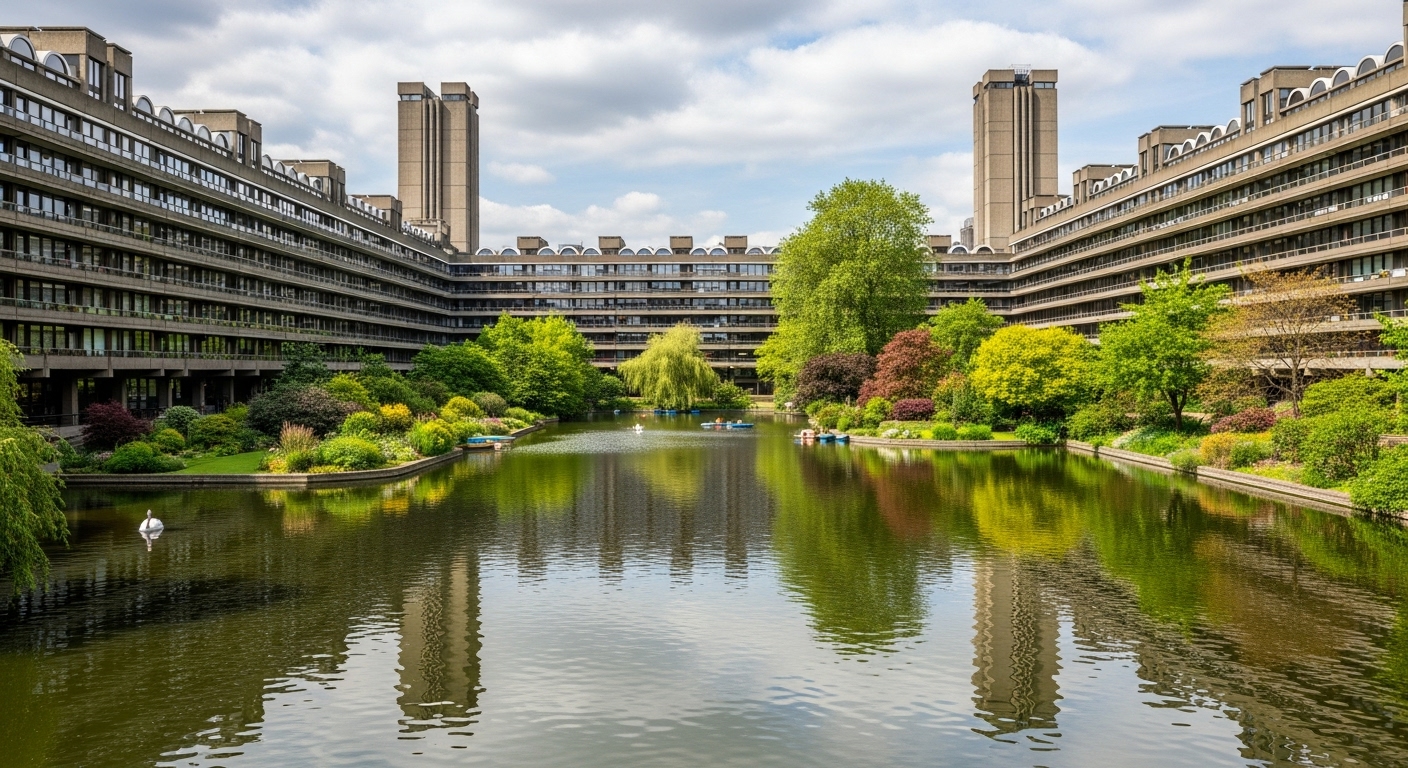
If there’s a single place that embodies the soul of Brutalism, it’s London’s Barbican Centre. Once criticized as an eyesore, it’s now a beloved cultural hub — and a perfect example of how concrete can be elegant and alive. The Barbican’s residential towers, sky bridges, and cascading terraces form an intricate maze, softened by fountains and lush greenery.
Walk its pathways at dusk, and you’ll feel like you’ve stepped into a sci-fi movie set that’s also deeply human. The blend of concrete and water creates a serene contrast that redefines urban calm. Don’t miss the hidden gardens tucked between walls — they show how nature and Brutalism can coexist beautifully.
2. Boston, USA – Boston City Hall
Bold, unapologetic, and defiantly geometric, Boston City Hall is one of America’s most talked-about buildings. Designed in the 1960s to represent openness and democracy, its massive overhangs and layered facades have sparked decades of debate. But whether you love or hate it, you can’t ignore it.
Stand beneath its jutting forms, and you’ll sense the architects’ vision — a government that’s transparent and strong, built for the people. In the age of glass skyscrapers, the weight and gravity of its concrete feels refreshingly honest.
3. Tokyo, Japan – Nakagin Capsule Tower
Though recently dismantled, the Nakagin Capsule Tower remains a global symbol of experimental Brutalism. Designed by Kisho Kurokawa, it consisted of tiny modular pods stacked like building blocks, representing Japan’s post-war optimism and futuristic vision. Travelers still visit the site today to pay homage to this bold, ahead-of-its-time structure.
Each capsule was a self-contained living unit — a precursor to micro-apartments and flexible architecture. Its story reminds us that Brutalism wasn’t static; it was a movement exploring how design could adapt to human life in new, radical ways.
4. Belgrade, Serbia – Western City Gate
Also known as the Genex Tower, this 35-story Brutalist masterpiece is one of Eastern Europe’s most striking structures. Its twin towers are connected by a circular bridge and crowned with a revolving restaurant. Built in the late 1970s, it symbolized Yugoslavia’s technological ambition and modernist dreams.

Standing before it, you can’t help but feel awe at its futuristic silhouette — a blend of science fiction and socialist realism. The Genex Tower is raw, resilient, and quietly beautiful, much like the city it calls home.
5. Paris, France – UNESCO Headquarters
Paris might be known for romantic architecture, but its UNESCO headquarters tell another story — one of global unity and modern idealism. Designed in the 1950s by Marcel Breuer (one of Brutalism’s pioneers), this Y-shaped building embodies simplicity and strength. The exposed concrete walls, rhythmic columns, and integrated art make it both functional and poetic.
As you walk its perimeter, you’ll see how Brutalism in Paris isn’t cold — it’s reflective, thoughtful, and deeply tied to humanistic values. A fitting design for an organization devoted to world heritage.
Why Brutalist Beauties Deserve a Second Look
Let’s be honest — Brutalism isn’t everyone’s cup of tea at first glance. But that’s the beauty of it. These structures challenge you to feel something. They’re not built to be liked instantly. Instead, they invite reflection, much like abstract art or a poem that grows on you over time.
Have you ever found yourself staring at a building longer than you expected, unsure why it captivates you? That’s what a Brutalist Beauty does. It confronts you with its rawness and, paradoxically, its honesty feels comforting in a world full of façades.
In many cities, these buildings were born from a utopian dream — that architecture could uplift society, create equality, and represent strength for all. Knowing that history adds a human layer to the stone-cold surfaces. They’re not just concrete forms; they’re social experiments frozen in time.
Brutalism’s Comeback: Why Now?
Over the past decade, Brutalism has enjoyed a quiet revival. Architects reference it in new designs, fashion shoots feature it as a backdrop, and Instagram is flooded with minimalist photography of concrete patterns. Why the renewed love?
Part of it is nostalgia — a yearning for authenticity. In an age dominated by glass towers and digital perfection, Brutalism’s imperfections feel real. Another reason? Sustainability. Many Brutalist buildings were built to last, and preserving them is far more eco-friendly than demolishing and rebuilding.
Modern architects are even revisiting Brutalism’s core philosophy: that architecture should serve people, not profit. This renewed perspective is transforming how cities approach preservation — from refurbishing housing estates to turning old government buildings into cultural centers.
Traveling the Brutalist World
If you’re a traveler who loves art, design, or history, planning a “Brutalist trail” could be a unique adventure. Cities like London, Berlin, Tokyo, and Belgrade are dotted with concrete treasures waiting to be explored. Even smaller towns may surprise you with forgotten gems — libraries, theaters, and universities with sculptural silhouettes.
Bring a camera and a curious eye. Look at how light interacts with the textures, how plants grow in crevices, and how people move through these spaces. Brutalism is as much about experience as it is about form.
How to Appreciate Brutalism (Even If You Think You Don’t)
Appreciating Brutalist architecture doesn’t mean you have to love every block of concrete. It starts with curiosity. Ask yourself:
- What story was this building trying to tell?
- How does it make me feel — grounded, powerful, overwhelmed?
- Can I find beauty in its rhythm, its shadows, its strength?
Try visiting at different times of day. Morning light can reveal warm tones, while twilight adds drama. Walk around the building — feel the weight, the texture, the silence it holds. Suddenly, you’ll realize that “ugly” is the wrong word. These structures aren’t trying to be pretty — they’re trying to be true.
The Gentle Side of Brutalism
Here’s the truth: Brutalism isn’t brutal. It’s bold, yes, but it’s also tender in its honesty. Once you see past the concrete, you’ll notice how carefully crafted these designs are — the way staircases spiral like sculpture, or how windows frame the sky perfectly. There’s poetry in the precision.
For many, discovering Brutalist architecture is like learning a new language. At first, it feels foreign, even harsh. But the more you immerse yourself, the more meaning you uncover. It’s not about coldness — it’s about clarity, presence, and form meeting function without artifice.
We’d love to know — have you visited any Brutalist landmarks that surprised or moved you? Maybe a university campus, a public library, or a forgotten building that made you see concrete differently?
Share your stories and favorite Brutalist spots in the comments! Let’s celebrate these misunderstood masterpieces together — the Brutalist Beauties that continue to shape our cities and challenge how we define beauty. Don’t forget to follow us on our social media for more travel stories that reveal the unexpected side of architecture, design, and culture around the world.
Catch up on the top stories and travel deals by subscribing to our newsletter!