Have you ever dreamed of standing in three countries at the same time? Imagine placing one foot in France, another in Germany, and stretching your arm into Switzerland — all without needing a single visa stamp. These fascinating spots, known as tri-nation points, are some of the world’s most mind-bending travel experiences. They’re not just about geography — they’re about unity, connection, and the curious thrill of crossing invisible borders with every step.
Whether hidden in dense forests, marked by a monument, or sitting quietly at the edge of a river, tri-nation points exist all over the world. Some are remote and wild, others surprisingly easy to visit. From Europe’s border-hopping landmarks to Africa’s untouched intersections, these are the ultimate places to prove that travel truly knows no bounds.
What Exactly Are Tri-Nation Points?
Tri-nation points, also called tripoints or border tripoints, are geographical spots where the boundaries of three countries meet. There are around 170 recognized tri-points worldwide — each a unique blend of culture, politics, and history. Some are celebrated with obelisks or markers, while others exist only as invisible coordinates on a map.
These points often attract travelers who love geography or offbeat adventures. But beyond the novelty, tri-nation points carry a deeper message — that nations can share space peacefully. Standing on one is like physically touching diplomacy, history, and human cooperation all at once.
Europe: The Continent of Border Crossers
Europe has more tri-nation points than any other continent, thanks to its many neighboring countries. Most of them are easy to access, making them perfect for curious travelers.
1. The Dreiländereck (France–Germany–Switzerland)
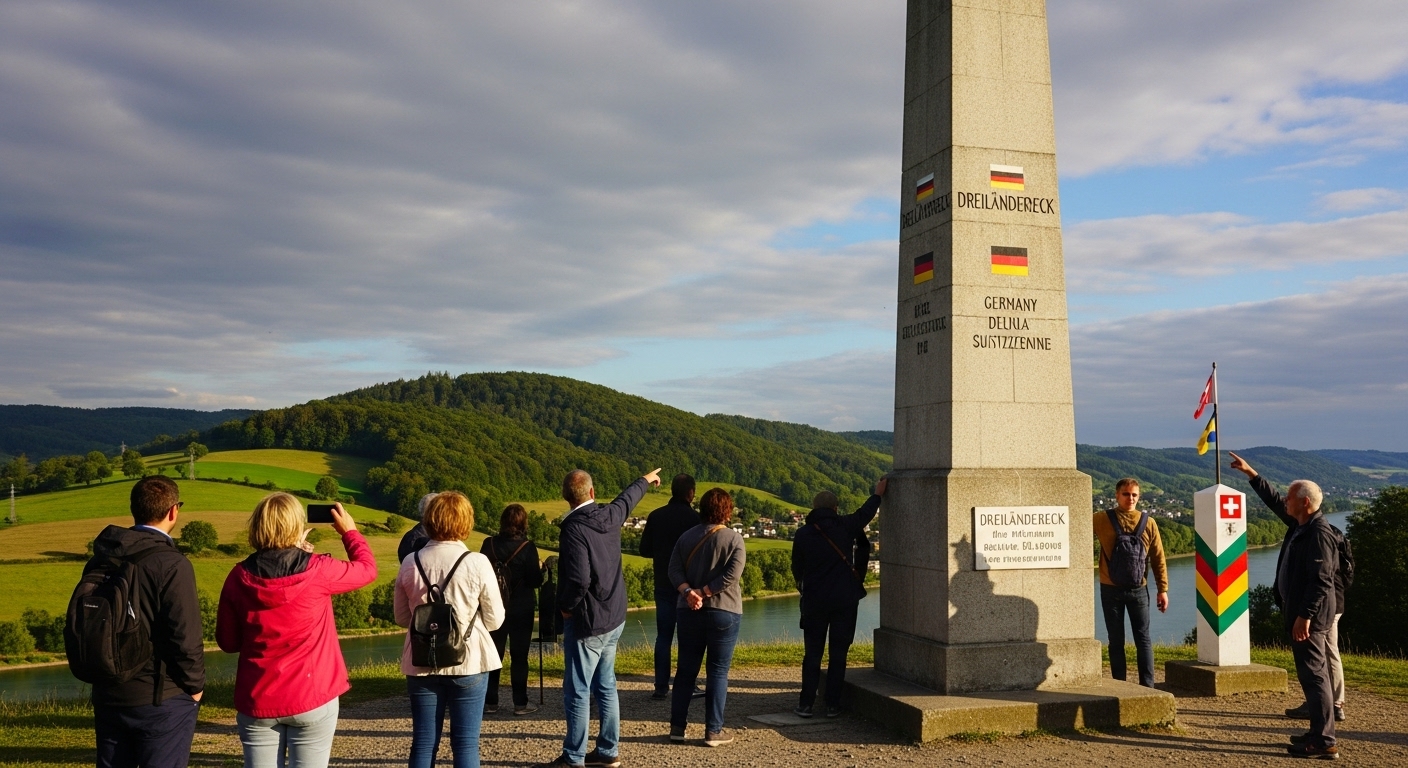
One of the most famous tri-nation points sits where the Rhine River bends near Basel. Known as the Dreiländereck, it features a modern sculpture marking where the three borders meet. You can literally cycle through three countries in an afternoon — stop for a croissant in France, enjoy coffee in Germany, and end with chocolate in Switzerland. It’s the definition of European harmony.
2. The Three-Country Cairn (Finland–Norway–Sweden)
Located deep in Lapland, this marker is a simple concrete tripod — but its location makes it magical. Surrounded by tundra, silence, and reindeer, it’s only reachable by hiking or snowmobile. Travelers who make the trek call it a moment of pure stillness — a place where nature and nations meet.

3. The Dreiländerstein (Austria–Germany–Czech Republic)
Set within peaceful forests, this stone monument symbolizes centuries of shifting borders. Locals often visit for picnics or to celebrate friendship across nations. It’s less about politics and more about community — an invisible line that brings people together.
African Tri-Nation Points: Wild and Remote
In Africa, tri-nation points often lie within national parks or river systems. They’re remote, scenic, and usually untouched by mass tourism — which makes them even more special.
1. Zambia–Zimbabwe–Botswana (Kazungula Point)
This unique meeting spot is surrounded by the Zambezi and Chobe rivers. Standing here feels like balancing between water and wilderness. From one direction, you see elephants crossing the Chobe; from another, the spray of Victoria Falls glimmers in the distance. There’s even the Kazungula Bridge nearby, an engineering feat uniting four nations within sight of one another.
2. Sudan–Eritrea–Ethiopia
In contrast, this tri-point is steeped in history and geopolitics. It lies in rugged highlands where cultures have mixed for millennia. Travelers who reach it say it’s less about geography and more about endurance — a journey to the very edge of maps.
3. Tanzania–Malawi–Mozambique
Set near Lake Malawi, this tri-nation point offers extraordinary scenery — shimmering waters, mountain ridges, and vibrant fishing villages. It’s a place where borders blur under the rhythm of daily life.
Asia’s Cultural Crossroads
Asia’s tri-nation points often sit in breathtaking landscapes — from Himalayan passes to tropical jungles. Many of them also reveal how deeply intertwined Asian cultures are.
1. India–China–Nepal (Lipulekh Pass)
High in the Himalayas, this point is not just a border — it’s a gateway to the spiritual Mount Kailash. Trekking there means walking through ancient trade routes once used by monks and merchants. It’s one of the most dramatic tri-points in the world.
2. Thailand–Laos–Myanmar (Golden Triangle)
Perhaps Asia’s most famous tri-nation point, the Golden Triangle sits at the confluence of the Mekong and Ruak rivers. Once known for opium trade routes, it’s now a serene destination for river cruises, temples, and elephant sanctuaries.
3. China–North Korea–Russia
This remote meeting point at the Tumen River is heavily guarded and not open to tourists, but its symbolic power is immense. Three contrasting worlds — socialist, communist, and capitalist — converge here, separated only by a small stretch of water.
The Americas: Meeting Points with a Twist
The Americas have fewer tri-nation points, but those that exist tell fascinating stories about nature, rivers, and human cooperation.
1. Brazil–Argentina–Paraguay (Triple Frontier)
Overlooking the Iguazú and Paraná rivers, this spot is pure drama. Each country has a monument painted in its national colors, and tourists can see all three at once. Stand on the Brazilian side, and you’ll see Argentina across one river and Paraguay across another — it’s geography made visual.

2. United States–Canada–Mexico
Though not officially meeting at a single point, some conceptual tri-points exist where the three nations’ trade zones align. The idea itself fascinates travelers — a dream of continental unity connected by highways, not walls.
3. Colombia–Peru–Brazil (Amazon Junction)
Deep in the Amazon rainforest lies Leticia, a town where borders dissolve into jungle. Locals speak Spanish, Portuguese, and a blend of both. Visitors can cross between countries by canoe or even footpaths — a peaceful, vibrant tri-nation life unlike anywhere else.
Hidden Tri-Points Few Travelers Know About
Some tri-nation points are so obscure they rarely appear on maps. Yet these secret spots offer pure adventure for those who seek them.
In Europe, the Hungary–Slovakia–Austria tri-point sits in quiet farmland where locals joke about living “in three countries but one village.” In Africa, the Niger–Mali–Burkina Faso point is a dusty track marked only by a single post. And in South America, the Chile–Bolivia–Peru point is perched among Andean peaks where travelers can see three nations and a dozen volcanoes at once.
Would you make the effort to find such places? Many travelers do — not for bragging rights, but for the thrill of knowing they’ve reached the intersection of cultures, history, and landscape.
How to Visit Tri-Nation Points Responsibly
Because many tri-nation points lie in sensitive areas — nature reserves, indigenous lands, or military zones — it’s crucial to visit them respectfully. Here are a few tips:
- Research permissions: Some tri-points require permits or local guides. Always check in advance.
- Stay sustainable: Avoid leaving trash or disturbing wildlife — remember, these spots often sit in untouched ecosystems.
- Support locals: Buy from nearby communities or hire local guides to ensure your trip benefits the region.
- Go prepared: Many points are remote, so carry essentials like water, maps, and emergency gear.
Responsible travel isn’t just about protecting nature — it’s also about respecting the human stories tied to these invisible lines.
Why People Are Drawn to Borders
What makes tri-nation points so compelling? Maybe it’s the symbolic idea that boundaries are man-made, and standing on one challenges that concept. Maybe it’s the chance to see how seamlessly people coexist despite political divisions. Or perhaps it’s simply that human curiosity knows no borders.
When you visit a tri-point, you feel small yet connected to something vast — a reminder that geography can divide maps but never humanity. Many travelers describe it as a “spiritual experience,” a humbling reminder of how fragile and fascinating our world’s design truly is.
Standing at a tri-nation point is like standing at the crossroads of unity. You realize how artificial borders can be — just lines drawn through shared landscapes. From the bustling Dreiländereck to the silent tundra of Lapland, these intersections whisper a powerful truth: our planet is one continuous home.
So, would you add a tri-nation adventure to your travel list? Have you already visited one? Share your experience in the comments — and don’t forget to follow WentWorld on social media for more fascinating stories that connect cultures, countries, and curious travelers just like you.
Catch up on the top stories and travel deals by subscribing to our newsletter!