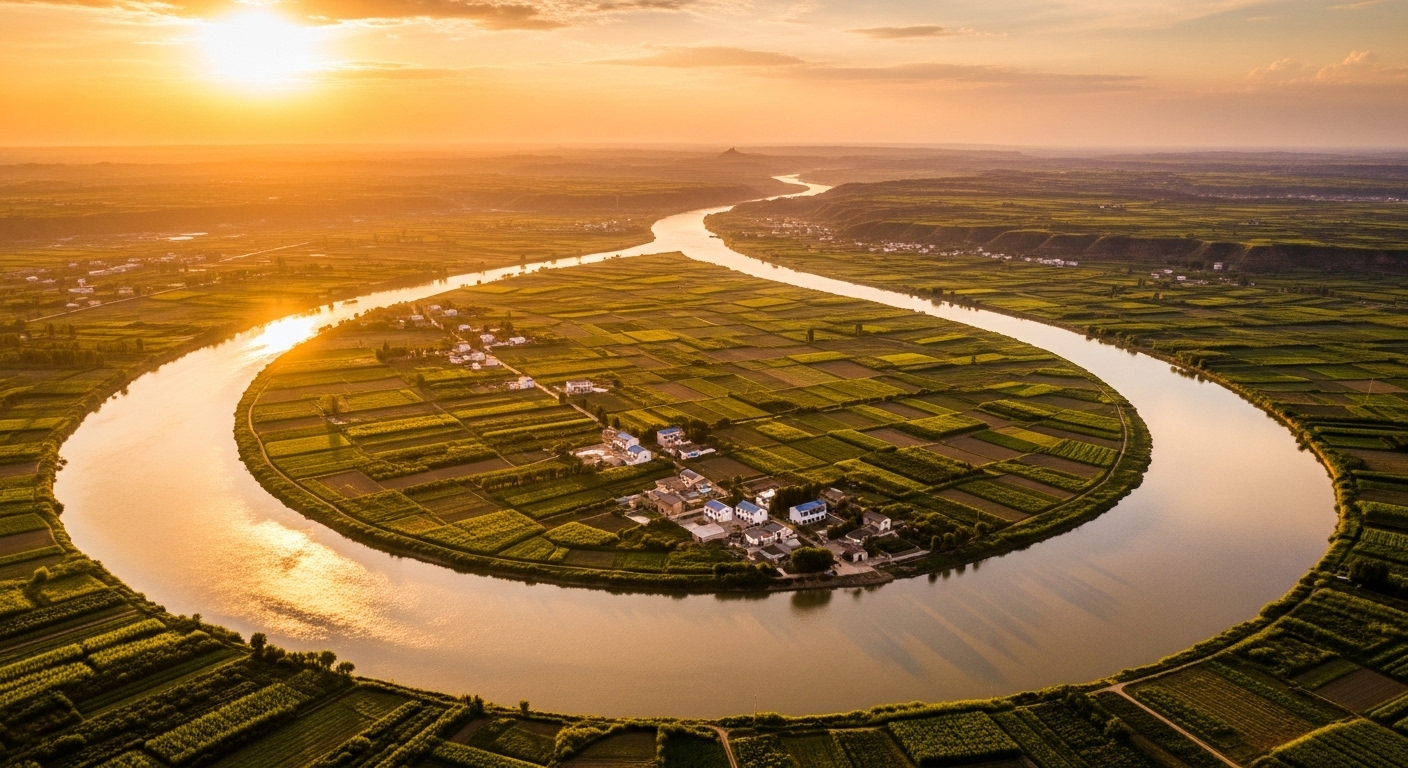
Some rivers don’t just flow through land — they flow through history itself. When we talk about historic rivers that changed course over time, we’re talking about forces of nature so powerful that they reshaped borders, destroyed cities, created new civilizations, and altered destinies without asking for permission. Have you ever wondered how many of today’s coastlines, deserts, and fertile valleys used to look completely different just a few hundred years ago? Or how many ancient cities were abandoned simply because a river decided to move?
It’s easy to think of rivers as stable, predictable features. We map them. We build around them. We rely on them for water, electricity, trade, and life itself. But history tells a very different story. Rivers change. They wander. They flood. They dry. And when they do, everything connected to them changes too.
At WentWorld, we love uncovering stories where geography and human destiny collide. And few topics reveal that connection better than historic rivers that changed course over time. These rivers didn’t just shift water — they shifted empires, economies, cultures, and sometimes entire populations.
As you read, ask yourself: If one river near your hometown changed direction tomorrow, what would happen to your city? Your water supply? Your livelihood?
How and Why Rivers Change Their Course Over Time (H2)
Before diving into specific examples of historic rivers that changed course over time, it’s important to understand why rivers don’t always stay where they are. Rivers are constantly adjusting to gravity, sediment, rainfall, tectonic movement, and human interference. Over decades or centuries, these small changes add up into dramatic transformations.
Flooding is one of the biggest reasons rivers change direction. When heavy rains arrive year after year, rivers overflow their banks and carve new paths across floodplains. Over time, the old channel may dry up while the new one becomes dominant. Earthquakes can suddenly tilt land and redirect entire river systems in a matter of minutes. Sediment buildup can clog a river’s original route and force water to seek a new exit. And in modern times, dams, canals, and large-scale irrigation projects have given humans the power to reshape rivers on massive scales.
Sometimes the change is slow and almost invisible — a few meters each century. Other times it happens in one violent flood that rewrites the map overnight. The result, however, is often the same: cities rise or fall, farmland becomes desert, borders shift, and people are forced to adapt or disappear.
The Yellow River: China’s Sorrow and Savior (H3)
When discussing historic rivers that changed course over time, no river on Earth has done it more dramatically — or more destructively — than China’s Yellow River. Known as the “Cradle of Chinese Civilization,” this river also earned the haunting nickname “China’s Sorrow” due to its frequent catastrophic floods and radical course changes.
Over the last 3,000 years, the Yellow River has changed its main course at least 26 times. Entire provinces have been drowned, and millions of lives have been lost. In 1855, one of its most famous shifts redirected the river northward into the Bohai Sea, completely altering regional trade routes and farmland patterns. Before that, the river emptied far to the south.
What made this river so unstable was its massive sediment load. The river carries fine yellow silt from the Loess Plateau, raising its riverbed higher than the surrounding land. Eventually, the water rises too high and spills into a new direction. Each shift reshaped China’s political, agricultural, and demographic history.
Have you ever lived near a river that floods frequently? Now imagine that same river suddenly abandoning your entire region.
The Indus River: Shaping and Shattering Ancient South Asia
The Indus River is another powerful example of historic rivers that changed course over time. This river gave birth to one of the world’s earliest urban civilizations — the Indus Valley Civilization — with advanced cities like Mohenjo-Daro and Harappa. But shifting river patterns may also have contributed to its decline.

Geological evidence suggests that several ancient tributaries of the Indus changed course or dried up entirely around 1900 BCE. As water supplies moved, fertile lands turned arid. Trade routes collapsed. Agriculture suffered. Communities slowly dispersed. The landscape we see today is very different from the one that once supported a thriving Bronze Age society.
Even in modern times, the Indus continues to drift across its floodplain. Each shift creates winners and losers — some farmers gain fresh fertile soil, while others lose everything to erosion.
The Nile: A River That Stayed Yet Still Shifted Nations
While the Nile River is famous for its relative stability compared to other rivers, it still belongs in any serious discussion on historic rivers that changed course over time. Over thousands of years, its branches, floodplains, and delta channels have constantly shifted across northern Egypt.
Ancient Egyptian cities were often built close to the river’s active channels. When those waterways moved, cities were sometimes abandoned and rebuilt elsewhere. Several ancient ports that once sat on the Nile Delta now lie far inland, buried under desert sands.
The construction of the Aswan High Dam in the 20th century represents one of humanity’s most dramatic interventions into a historic river. It stopped the Nile’s natural flooding cycle, saving Egypt from devastating floods but also ending the natural replenishment of fertile soils downstream.
The Mississippi River: America’s Relentless Moving Giant
The Mississippi River is one of the most studied examples among historic rivers that changed course over time. Over thousands of years, it has naturally switched its route across the American Southeast multiple times, shifting between various channels toward the Gulf of Mexico.
One of its most dangerous tendencies is toward what scientists call a “delta switch.” The river wants to abandon its current path past New Orleans and redirect toward the Atchafalaya River. If that ever happens naturally, it could devastate shipping, industry, and infrastructure across the southern United States.

Because of this, engineers now fight the river using massive control structures to force it to stay in its current route. It’s a rare case where humans are locked in a continuous battle with nature — trying to hold a river in place that desperately wants to move.
The Tigris and Euphrates: Rivers Behind the Rise and Fall of Mesopotamia
The Tigris and Euphrates rivers once watered the fertile heart of Mesopotamia, the birthplace of civilization. Yet these rivers were never stable. Over thousands of years, both rivers shifted their channels repeatedly, leading to abandoned cities and shifting kingdoms.
Ancient maps and clay tablets reveal that once-prosperous ports now sit miles away from modern riverbanks. Irrigation canals dried up as rivers wandered. Agricultural productivity changed with each shift. Political centers had to relocate. The land between the rivers was always alive — but always uncertain.
The Saraswati: A River That Vanished
Perhaps the most mysterious among all historic rivers that changed course over time is the Saraswati River. Mentioned in ancient Indian texts as a mighty river, geological evidence now suggests it once flowed parallel to the Indus before gradually drying and vanishing.
Tectonic shifts are believed to have redirected its feeder rivers thousands of years ago. Without fresh water, the Saraswati gradually faded into a dry riverbed beneath the desert sands of modern-day India and Pakistan. Entire settlements along its banks were abandoned as water disappeared.
Today, satellites can still trace its ghostly path across the land.
When Rivers Change, Borders Change With Them
Rivers are not just natural features — they are political boundaries. When historic rivers that changed course over time moved, they often took national borders with them. The Rio Grande, which forms part of the boundary between the United States and Mexico, has shifted multiple times, creating land disputes and legal chaos.
Entire villages have found themselves suddenly in a different country without ever moving. Laws struggled to keep up with nature’s unpredictable movements. Treaties were rewritten. Wars were avoided — or sparked — by wandering water.
Modern Engineering vs Ancient Waterways
In ancient times, humans mostly adapted to rivers. Today, we attempt to control them. Massive dams, levees, and canals now freeze rivers into artificial positions. While this prevents floods and supports agriculture and electricity, it also traps sediment, destroys ecosystems, and increases long-term risks.
The tragic irony is that in trying to stop rivers from changing, we often make future disasters even worse when control systems fail.
What Would Happen If Your Closest River Changed Direction?
Pause for a moment and imagine this: the river that supplies your city’s water suddenly shifts 20 miles away after a massive flood. What happens to farming? To drinking water? To industry? To property values? To the people who live along the old riverbed? This is not a hypothetical situation. It has happened over and over again throughout history.
This is why understanding historic rivers that changed course over time isn’t just about the past — it’s about preparing for the future. Climate change is increasing flood intensity worldwide. Glaciers are melting. Sea levels are rising. Rivers will move again.
Why These Shifting Rivers Still Matter Today
These rivers remind us that nature is not fixed. Maps lie. Borders lie. What feels permanent today may be temporary tomorrow. Every civilization that ignored this lesson eventually paid a heavy price.
From China’s Yellow River to America’s Mississippi, from the vanished Saraswati to the restless Indus, historic rivers that changed course over time continue to shape our present and warn our future. As travelers, explorers, and curious minds, understanding these stories changes the way we see landscapes. That quiet riverbank might not be as stable as it looks. That ancient ruin might once have sat beside roaring water.
If rivers have the power to rewrite nations, move borders, and change the fate of millions, what other hidden forces are shaping our world right now without us realizing it? We’d love to hear your thoughts. Have you ever seen a river flood, dry up, or change its path? Did it affect your community? Share your experience with us.
And if stories like these spark your curiosity about the world’s hidden forces, make sure you stay connected with WentWorld across our social media platforms for more powerful, mind-expanding explorations.
Catch up on the top stories and travel deals by subscribing to our newsletter!