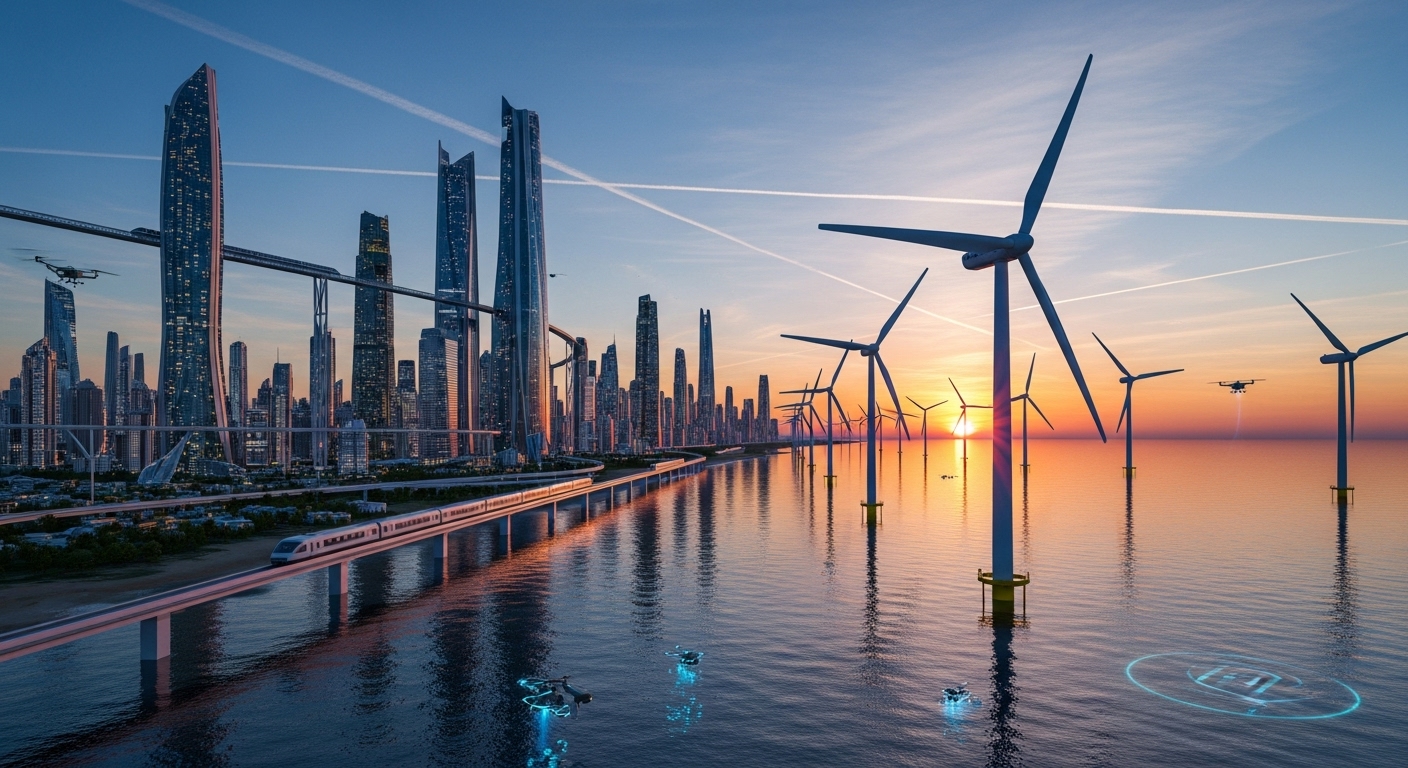
Along the edges of continents where land meets restless water, a quiet revolution is taking shape. Coastal cities powered entirely by wind are no longer science fiction, futuristic art concepts, or experimental models hidden inside research papers. Instead, they are becoming some of the most fascinating living examples of how humanity can coexist with nature without draining it dry. From spinning offshore turbines to entire skylines lit by clean energy, these wind-driven coastal cities represent not only a technological shift but also a psychological one.
For decades, people believed clean energy would always remain a “backup option,” something used when traditional fuels failed. However, the reality unfolding today is far more powerful. Entire coastal communities are now proving that wind can do more than assist. It can fully power daily life. Electricity, transportation, desalination plants, hospitals, communication networks, and even digital infrastructure now run smoothly on nothing but moving air.
So what does it truly mean to live in coastal cities powered entirely by wind? Is this the future of global sustainability, or just an exception made possible by geography? More importantly, could this model reshape how the rest of the world generates power?
The unique advantage coastal cities hold for wind power
Coastal geography provides one of the most reliable wind environments on Earth. Temperature differences between land and ocean create daily wind cycles that rarely stop. As a result, turbines installed near shorelines experience consistent airflow both day and night. Unlike inland wind farms that depend on seasonal pressure systems, coastal winds are remarkably predictable.
Because of this natural stability, coastal cities powered entirely by wind enjoy energy reliability that many inland cities cannot yet match. Furthermore, offshore turbines can reach larger sizes without obstructing residential zones, allowing them to generate massive electricity volumes with fewer visual compromises.
Additionally, saltwater corrosion once limited turbine lifespan. However, modern composite materials and protective coatings now extend turbine durability far beyond earlier limitations.
How entire cities run on nothing but moving air
At first glance, the idea seems almost too simple. Wind rotates turbine blades. Rotational mechanical energy transforms into electrical energy. Power flows into grids. Yet the true complexity lies in balancing storage, demand fluctuation, and weather variability.
Coastal cities powered entirely by wind rely heavily on integrated battery storage systems, hydrogen cells, and smart grids that adjust supply in real time. When wind output surges, excess energy fills massive battery banks or converts into hydrogen through electrolysis. When output dips, stored reserves instantly stabilize the flow.
As a result, homes experience consistent voltage even during calm conditions. Hospitals run uninterrupted. Traffic systems function normally. Even seawater desalination facilities continue supplying fresh water using wind-generated electricity.
Platforms such as National Geographic, Renewable Energy World, IRENA, Denmark Energy Agency, and Siemens Energy continue documenting how these closed-loop systems now operate at citywide scale.
Denmark and the world’s first modern wind-powered coastal cities
Denmark became the global blueprint for coastal cities powered entirely by wind. Cities such as Esbjerg and regions along the Jutland peninsula now operate at near full renewable capacity through massive offshore wind farms.
Decades of investment in turbine research, marine engineering, and grid integration allowed Denmark to transition from fossil fuels to wind leadership faster than any other nation. Importantly, public trust in renewable systems developed alongside technical infrastructure.
Rather than imposing energy transitions from the top, Danish municipalities educated communities from the start. As a result, homeowners now view local turbines as collective assets instead of visual pollution.
What daily life looks like inside a wind-powered coastal city
Life inside coastal cities powered entirely by wind does not feel radically different on the surface. Lights turn on. Trains arrive on schedule. Elevators move smoothly. However, the psychological difference runs deeper.
Residents understand exactly where their electricity comes from. They see turbines on the horizon each morning. They hear their subtle rhythm during evening walks. Consequently, energy consumption becomes personal rather than abstract.
Many residents report increased conservation awareness without the burden of guilt-driven restriction. Instead of sacrificing comfort, they adjust habits out of respect for shared systems. Do people become more responsible when they can physically see the source of their power?

The role of offshore wind farms in urban energy independence
Offshore wind farms serve as the backbone of coastal wind cities. Located miles from shore, these turbine clusters capture stronger and more stable winds than land-based systems. Each tower can generate enough electricity to power thousands of homes.
Modern offshore wind turbines now exceed heights of 250 meters. Blade rotations sweep areas larger than football fields. As turbine size increases, energy output scales exponentially. Therefore, just one offshore wind farm can replace entire fossil fuel power stations without producing smoke, waste, or toxic byproducts.
Economic transformation driven by wind-powered coastlines
The rise of coastal cities powered entirely by wind has completely reshaped local economies. Instead of relying on imported fuel, cities invest in domestic energy production. This keeps capital local and insulates populations from volatile global oil markets.
New employment sectors also explode. Marine engineers, turbine technicians, grid analysts, software operators, battery maintenance experts, and AI energy specialists now form a growing labor ecosystem. Furthermore, ports once used only for shipping now double as turbine assembly zones. This creates long-term industrial stability without sacrificing environmental integrity.
Environmental recovery along renewable coastlines
Perhaps the most astonishing impact appears underwater. The foundations of offshore turbines unintentionally create artificial reefs. Fish populations rebound rapidly around these structures. Marine biodiversity increases instead of declines.
With fossil fuel extraction reduced, oil spills vanish from these coastlines. Coastal air quality improves. Acidic emissions drop dramatically. As a result, respiratory health improves across entire populations.
In many wind-powered coastal regions, childhood asthma rates have declined year after year.
The psychological shift from exploitation to coexistence
For centuries, coastal development revolved around extraction — fishing, drilling, shipping, and tourism. Coastal cities powered entirely by wind represent a psychological pivot from exploitation to coexistence.
Rather than removing resources, wind cities simply borrow motion from the atmosphere without depleting it. This creates a powerful cultural narrative: progress without destruction. Younger generations growing up in these cities develop entirely different environmental expectations. For them, clean power is not innovation. It is normal.
Infrastructure challenges unique to wind-only energy systems
Despite their success, wind-powered coastal cities face real technical challenges. Grid balancing remains complex. Extreme weather puts stress on offshore hardware. Saltwater corrosion still demands continuous maintenance.
Moreover, long-duration storage remains expensive although costs decline each year. While lithium, sodium-ion, and hydrogen cells improve rapidly, seasonal storage still tests extreme-scale implementation. However, ongoing investment continues closing those technical gaps faster than analysts predicted a decade ago.
How wind-powered cities influence global energy politics
Energy independence reshapes diplomacy. Coastal cities powered entirely by wind reduce reliance on imported fuels. As a result, national bargaining positions shift on energy security, trade, and geopolitics.
Instead of defending shipping routes for oil, naval strategy increasingly prioritizes protecting offshore wind assets. Energy infrastructure security now extends into open seas. This silent geopolitical transformation continues largely unnoticed by mainstream media.
The future of transportation inside wind-powered coastal cities
Electric transit thrives inside wind-powered cities. Trams, ferries, buses, and trains operate on locally generated electricity. Ports run hybrid electric cargo equipment. Even aviation now experiments with synthetic fuels produced using wind-generated hydrogen.
As transportation becomes cleaner, urban noise levels drop. Air pollution decreases. Commutes grow healthier instead of hazardous.
Could entirely fossil-free transportation become the next global standard rather than the exception?
The tourism magnet created by carbon-neutral coastlines
Coastal cities powered entirely by wind attract a new category of traveler. Eco-tourists, engineers, students, and conscious explorers flock to witness real-world sustainability rather than conceptual eco-marketing.
Visitors tour offshore wind farms, renewable control centers, and sustainable harbors alongside traditional coastal attractions. For many travelers, the technology becomes as captivating as the beaches.
These cities do not market sustainability as novelty. Instead, they present it as normal living.
Public perception and trust in renewable-only infrastructure
Public trust determines whether wind power scales successfully. Coastal cities achieved this trust through transparency. Residents receive real-time access to grid data. They watch wind speeds, output levels, and battery status.
This visibility eliminates conspiracy thinking and fear of collapse. Instead of mystery, residents see a living system at work. Would broader global adoption accelerate if all energy infrastructure were equally transparent?

Energy resilience during global fuel crises
Whenever global oil markets destabilize, fuel-dependent nations face immediate inflation and shortages. Meanwhile, coastal cities powered entirely by wind remain largely immune to those shocks.
Energy pricing becomes predictable. Heating remains affordable. Food refrigeration continues uninterrupted. As a result, energy sovereignty transforms from political slogan into lived reality.
The limitations that still restrict global replication
Despite success, not every region can immediately adopt full wind dependence. Coastal geography, capital access, grid maturity, political stability, and public trust all influence implementation speed.
Landlocked regions must complement wind with solar, hydro, geothermal, or nuclear. Therefore, wind-only models remain geographically specialized rather than universally applicable.
The cultural symbolism of wind-powered skylines
Skyline silhouettes now include turbine clusters alongside towers and bridges. Rather than industrial intrusion, these structures symbolize responsibility rather than recklessness. Children grow up drawing coastlines dotted with turbines instead of smokestacks. That visual shift shapes cultural identity in subtle but powerful ways.
Coastal cities powered entirely by wind represent far more than electrical engineering success. They reflect humanity’s evolving relationship with energy, environment, and future responsibility. They prove that modern cities can grow without poisoning the air they breathe or the water they touch.
Instead of burning ancient carbon buried for millions of years, these cities borrow momentary movement from the sky itself. In doing so, they demonstrate that progress does not require destruction.
We would love to hear your thoughts. Do you believe coastal cities powered entirely by wind could become the global standard one day? Would you be willing to live in a city powered only by renewable energy? Share your perspective and help shape the conversation. If meaningful innovation stories resonate with you, follow WentWorld on social media for rare global concepts, breakthrough technologies, and future-focused travel and city insights.
Catch up on the top stories and travel deals by subscribing to our newsletter!