What if you could stand in a place where the universe physically touched our planet? Not metaphorically, not through telescopes or museum exhibits — but by walking across land shaped by an object that traveled millions of miles through space before colliding with Earth. Around the world, there are remarkable Countries Where You Can Visit Meteorite Impact Sites, places where ancient cosmic events left permanent scars on the landscape.
These sites are not just geological curiosities. They are time capsules, reminders that Earth exists within a vast and active universe. Some impacts changed local geography, others altered global climate, and a few may have even influenced the course of life itself. Have you ever wondered what it feels like to stand at ground zero of a cosmic collision?
Why Meteorite Impact Sites Matter
Meteorite impacts are rare on a human timescale, but over Earth’s long history, they’ve played a major role in shaping the planet. When large space objects strike Earth, they release energy equivalent to thousands or even millions of nuclear bombs. The results can include massive craters, shock-altered rocks, and long-lasting environmental effects.
Countries Where You Can Visit Meteorite Impact Sites offer something extraordinary: the chance to witness evidence of these ancient events without needing scientific equipment. These places allow us to grasp the scale of cosmic forces and our planet’s resilience.
Standing inside an impact crater often feels surreal. The landscape may look peaceful today, but beneath your feet lies proof of unimaginable violence from space.
United States – Barringer Crater, Arizona
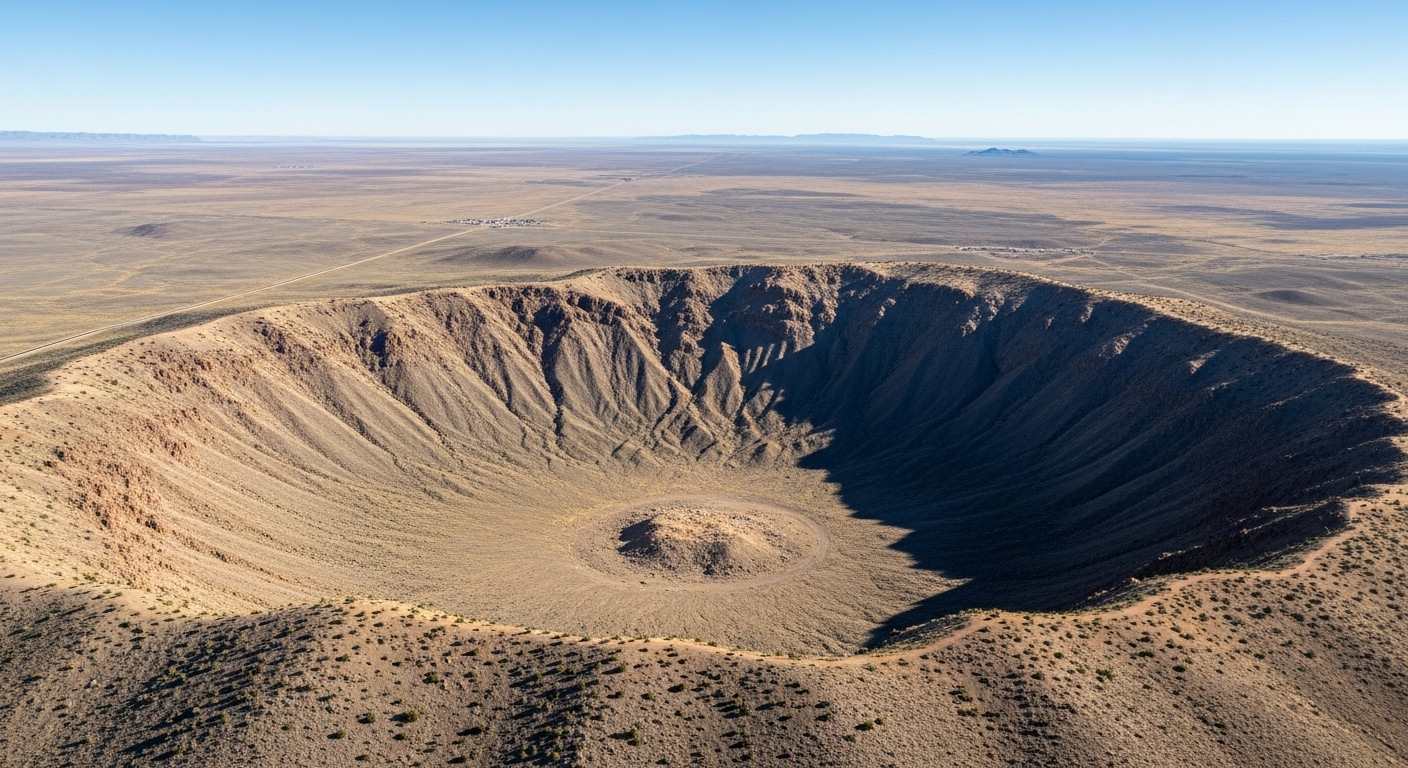
One of the world’s most accessible and well-preserved impact sites is the Barringer Crater, commonly known as Meteor Crater, located in Arizona. Formed about 50,000 years ago, this massive bowl-shaped depression measures over a kilometer wide and about 170 meters deep.
Unlike many older craters that have been eroded or buried, Barringer Crater remains strikingly intact due to Arizona’s dry climate. Visitors can walk along the rim, observe the layered rock formations, and visit an interpretation center explaining the science behind meteorite impacts.
This site is often the first place people visit when exploring meteorite impact locations, and for good reason. It makes the abstract idea of space collisions tangible.
Canada – Sudbury Basin, Ontario
Canada is home to one of the largest known impact structures on Earth: the Sudbury Basin in Ontario. Formed nearly 1.85 billion years ago, this impact event was so massive that it reshaped the region’s geology and contributed to rich mineral deposits.
Unlike smaller craters, Sudbury doesn’t appear as a perfect circle. Erosion, tectonic movement, and time have altered its shape. Today, it hosts cities, forests, and lakes within its boundaries.
The Sudbury Basin demonstrates that meteorite impacts aren’t just dramatic events — they can influence where cities form, where resources are found, and how landscapes evolve.
South Africa – Vredefort Dome
The Vredefort Dome in South Africa is the largest confirmed meteorite impact structure on Earth. Estimated to be over 2 billion years old, the original crater may have been nearly 300 kilometers wide.

Today, erosion has exposed the deep geological layers beneath the impact site, creating a dome-shaped formation visible from above. The area is recognized as a UNESCO World Heritage Site due to its scientific importance.
Walking through the Vredefort Dome feels less like visiting a crater and more like stepping into Earth’s internal history. The rocks themselves tell the story of extreme pressure and heat caused by the impact.
Australia – Wolfe Creek Crater
In the remote Kimberley region of Western Australia lies Wolfe Creek Crater, one of the largest meteorite craters in the world still clearly visible.
Estimated to be around 300,000 years old, Wolfe Creek Crater is nearly a kilometer wide. What makes this site especially fascinating is its cultural significance to Indigenous Australian communities, who have oral traditions describing a star falling from the sky.
The crater’s isolation adds to its impact. Standing at its rim, surrounded by vast wilderness, makes the cosmic origin of the site feel intensely real.

Germany – Nördlinger Ries
Germany’s Nördlinger Ries is a meteorite crater that quietly hosts an entire town within it. Formed about 15 million years ago, the impact created unique rock formations and altered the region’s geology.
The town of Nördlingen was built using stones formed by the impact, meaning residents literally live inside a crater made of cosmic debris. The area offers museums, walking trails, and viewpoints that explain how the impact shaped the region.
Nördlinger Ries shows how humanity adapts to extraordinary geology, turning a cosmic scar into a living community.
Mexico – Chicxulub Impact Site
Perhaps the most famous meteorite impact in Earth’s history is the Chicxulub Crater in Mexico. This impact, which occurred around 66 million years ago, is widely associated with the mass extinction event that wiped out the dinosaurs.
The Chicxulub crater is mostly buried beneath the Yucatán Peninsula and the Gulf of Mexico, making it less visually dramatic than other sites. However, visitors can explore nearby museums, cenotes, and geological exhibits that explain its immense significance.
This site reminds us that meteorite impacts can change the entire course of life on Earth.
What Visiting Impact Sites Feels Like
Visiting meteorite impact sites is different from visiting typical tourist attractions. There’s often a sense of humility that comes from realizing how small human history is compared to cosmic time.
These locations don’t always look dramatic at first glance. Some resemble rolling hills, quiet forests, or desert plains. But knowing what happened there transforms the experience.
Have you ever stood somewhere knowing the ground beneath you was shaped by forces from outer space? It’s a feeling that stays with you.
Tourism, Science, and Preservation
Many Countries Where You Can Visit Meteorite Impact Sites balance tourism with scientific research. Interpretation centers, guided tours, and museums help educate visitors while protecting fragile geological features.
International travel makes these destinations increasingly accessible. Airlines such as Lufthansa and Air Canada connect travelers to regions near major impact sites, allowing science and curiosity to meet tourism.
Preserving these sites is essential. Once damaged, geological evidence cannot be replaced.
Could Earth Face Another Major Impact?
While large meteorite impacts are rare, they are not impossible. Scientists continuously monitor near-Earth objects, tracking potential threats. Exploring ancient impact sites raises an important question: how prepared is modern civilization for another major collision? These sites are reminders of Earth’s vulnerability and resilience.
Countries Where You Can Visit Meteorite Impact Sites allow us to connect with the universe in a direct, physical way. These locations are not just scars — they are chapters in Earth’s story written by the cosmos. If exploring space-meets-Earth destinations fascinates you, follow us on our social media platforms for more unique travel stories that go beyond ordinary maps. And tell us — which meteorite impact site would you most want to visit, and why?
Catch up on the top stories and travel deals by subscribing to our newsletter!