Places where locals navigate by the stars, not maps, feel almost unreal in a world dominated by GPS, smartphones, and satellite navigation. Yet across the globe, communities still look upward for direction, relying on celestial patterns passed down through generations. These places remind us that navigation once depended on memory, observation, and a deep relationship with the natural world.
At WentWorld.com, we’re fascinated by travel experiences that reveal how humans adapted long before digital tools existed. Places where locals navigate by the stars, not maps, are living examples of ancient intelligence that continues to work flawlessly today. Have you ever tried to find your way using nothing but the night sky?
Star navigation isn’t guesswork. It’s a refined system built on centuries of observation, storytelling, and environmental awareness. For many communities, the stars are not just lights in the sky; they are maps, calendars, and companions.
How Star Navigation Actually Works
Celestial navigation relies on recognizing the positions of stars, constellations, the moon, and the sun. Navigators memorize how stars rise and set, how they move across the sky during different seasons, and how their positions align with landmarks or ocean currents.
Instead of fixed coordinates, star navigation uses mental maps. Directions are remembered through stories, songs, and chants that encode navigational knowledge. This method allows navigation even in complete darkness or across vast, featureless landscapes.
Unlike modern maps, this system adapts constantly. The navigator reads wind patterns, wave behavior, cloud formations, and animal movements alongside the stars.
Polynesia: Masters of Ocean Star Navigation
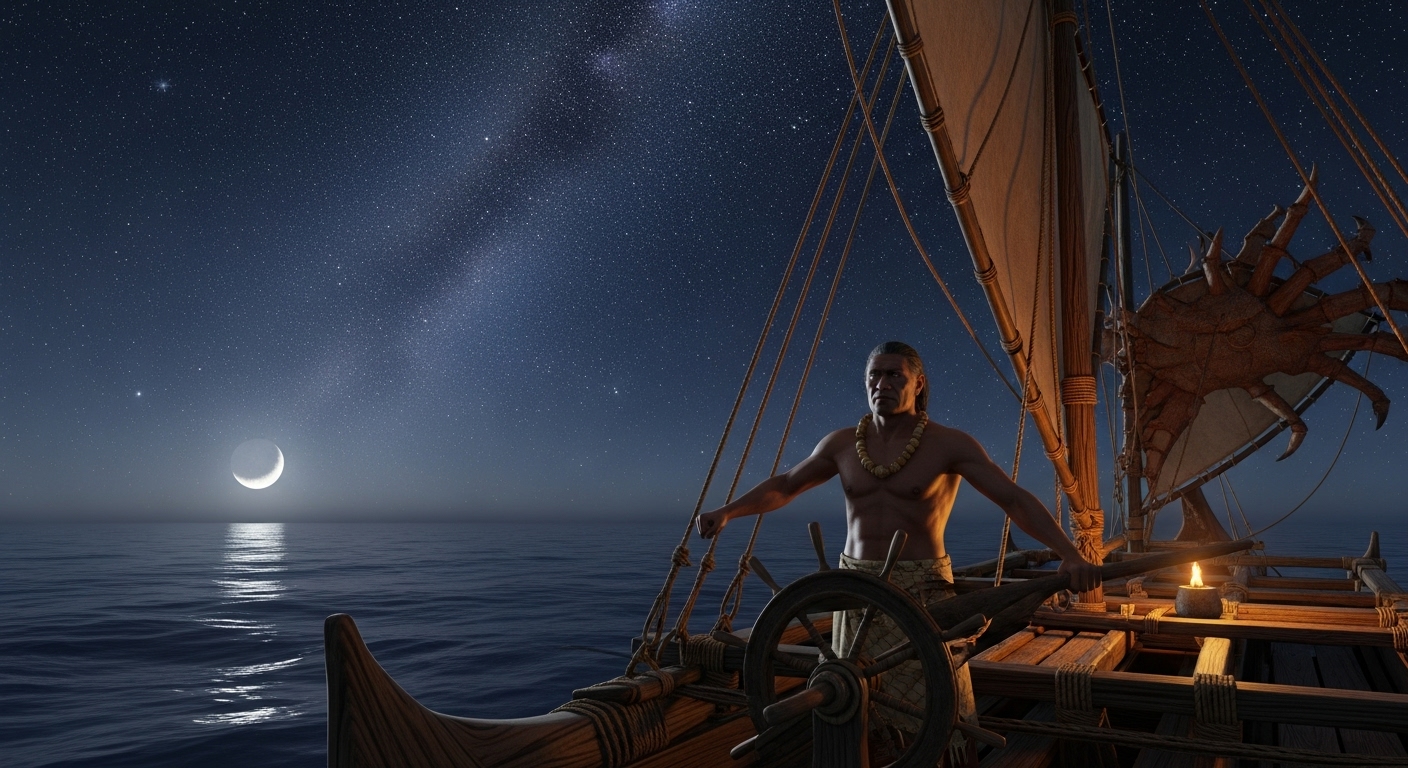
Polynesia is one of the most famous regions where locals navigate by the stars, not maps. For thousands of years, Polynesian voyagers crossed the Pacific Ocean without compasses or charts, traveling between islands separated by thousands of kilometers.
Traditional navigators used star paths, where specific stars rise and set over particular islands. By following these celestial highways, sailors could maintain direction during long ocean voyages.
The revival of this knowledge can be seen through organizations like the Polynesian Voyaging Society, whose canoe Hōkūleʻa has completed global voyages using only traditional navigation techniques. More information is available at hokulea.com.
Would you trust the stars enough to sail across an entire ocean?
Micronesia: Navigation as a Living Tradition
In Micronesia, particularly in the Caroline Islands, star navigation remains a living tradition. Navigators train for years under master teachers who pass knowledge orally, never in written form.
Their system includes star compasses that divide the horizon into directional segments, each associated with rising and setting stars. This method allows precise orientation even when clouds obscure parts of the sky.
According to Encyclopaedia Britannica, Micronesian navigation is one of the most sophisticated non-instrument navigation systems ever documented.
Australian Aboriginal Songlines
Among Aboriginal Australians, navigation is intertwined with culture through songlines. These are oral maps embedded in songs that describe routes across the land, marked by stars, terrain, and sacred sites.
The night sky mirrors these songlines. Constellations correspond to paths on Earth, allowing travelers to navigate vast deserts using celestial cues.
Even today, elders teach younger generations how to read both the land and the sky. Learn more about Aboriginal astronomy via AIATSIS.
The Tuareg of the Sahara Desert
The Tuareg people of North Africa navigate one of the harshest environments on Earth: the Sahara Desert. With few landmarks and constantly shifting dunes, the stars provide reliable guidance.

At night, Tuareg travelers identify key stars and constellations to maintain direction during long caravan journeys. The North Star plays a crucial role, but so do seasonal star patterns.
Navigation is also tied to survival. Understanding the sky helps predict weather changes and seasonal movements.
Inuit Navigation in the Arctic
In the Arctic, Inuit communities traditionally used stars alongside snowdrift patterns, wind direction, and animal behavior. During long polar nights, celestial navigation was essential.
The stars provided orientation when the sun disappeared for months. Inuit knowledge systems emphasize observation and adaptability rather than fixed routes.
This holistic navigation approach demonstrates how humans adapted to extreme environments long before modern tools existed.
Why Star Navigation Still Matters Today
Places where locals navigate by the stars, not maps, preserve knowledge that modern society is at risk of losing. These systems teach patience, awareness, and respect for nature.
In an era of digital dependence, star navigation offers resilience. When technology fails, ancient methods still work.
Would learning these skills change how you experience travel?
Modern Travelers Learning Ancient Skills
Interest in star navigation is growing among travelers, sailors, and survival enthusiasts. Workshops and cultural programs now teach basic celestial navigation to visitors.
These experiences deepen cultural understanding while fostering appreciation for indigenous knowledge systems.
Responsible tourism plays a key role in ensuring this knowledge is respected and preserved.
Challenges in Preserving Celestial Navigation
Urban light pollution, cultural disruption, and modernization threaten star navigation traditions. As younger generations adopt digital tools, ancient knowledge risks fading.
However, community-led education and cultural revival efforts are helping keep these traditions alive.
What It Feels Like to Navigate Without Maps
Travelers who experience star navigation often describe it as humbling and empowering. Without screens, senses sharpen. The sky becomes a guide rather than a backdrop.
Navigation turns into a conversation with nature instead of a mechanical process.
Why These Places Inspire WentWorld.com
At WentWorld.com, we celebrate destinations that challenge how we see the world. Places where locals navigate by the stars, not maps, remind us that innovation didn’t start with technology.
They prove that ancient wisdom still has relevance in modern life.
Would you trust the stars to guide you? Have you experienced traditional navigation methods while traveling? Share your thoughts and stories with us—we love hearing from curious explorers.
Follow WentWorld.com on our social media platforms for more stories about extraordinary cultures, hidden knowledge, and destinations that redefine travel.
Catch up on the top stories and travel deals by subscribing to our newsletter!