Historic ropeways over old town roofs offer a kind of travel experience that feels suspended between centuries. You are not quite walking through history, yet not fully removed from it either. Instead, you glide gently above tiled rooftops, church spires, stone alleys, and marketplaces that have witnessed generations of daily life. These ropeways are more than transportation systems. They are moving viewpoints, storytellers in motion, and living relics of engineering ingenuity.
Long before modern cable cars became tourist attractions, ropeways were built out of necessity. They connected isolated hill towns, eased trade routes, and allowed residents to move across steep terrain without exhausting climbs. Today, they still serve locals, but they also invite travelers to see old towns from a perspective few ever experienced in the past. Have you ever looked down at a medieval square from above and wondered how many lives unfolded there?
In this WentWorld.com journey, we explore some of the most remarkable historic ropeways over old town roofs, uncovering how they came to be, why they still matter, and what makes riding them such a quietly powerful experience.
Why Ropeways Became Part of Old Town Life
Many historic towns were built on hills, cliffs, or uneven terrain for defense, trade advantage, or proximity to water sources. While this made them strategically strong, it also made daily movement difficult. Steep paths, narrow stairways, and long detours were common challenges for residents.
Ropeways offered an elegant solution. They required minimal ground disruption, preserved existing architecture, and could be constructed without altering historic streets. In many cases, ropeways became essential lifelines, carrying goods, food, and people between upper and lower town levels.
What is fascinating is how seamlessly these systems blended into the urban fabric. Rather than dominating the skyline, they often hover quietly above rooftops, becoming part of the visual rhythm of the town. Does modern infrastructure ever integrate this gently anymore?
The Unique Perspective of Old Town Rooflines
Walking through an old town immerses you in details at street level: worn stones, carved doorways, and bustling cafés. Riding a ropeway changes everything. Suddenly, the focus shifts to patterns of rooftops, chimneys, courtyards, and hidden gardens.
From above, you notice how towns were shaped organically rather than planned on grids. Roofs overlap, streets curve unexpectedly, and buildings lean into one another as if sharing secrets. Historic ropeways over old town roofs reveal these patterns in a way no walking tour can.
There is also a quiet intimacy to this view. You are close enough to see laundry lines and flower boxes, yet distant enough to feel like an observer rather than a participant. Have you ever felt like you were floating through someone else’s story?

Lisbon’s Ascensores, Portugal
Lisbon is famous for its hills, and its historic ropeways and funiculars are inseparable from the city’s identity. While some systems run along tracks, others function as aerial ropeways connecting elevated viewpoints with lower neighborhoods.
Gliding above Lisbon’s old town roofs reveals terracotta tiles glowing in sunlight, yellow trams threading through streets, and the Tagus River shimmering in the distance. These ropeways were initially built to help residents navigate the city’s challenging slopes, not to entertain visitors.
Today, they serve both purposes. The city’s commitment to preserving them reflects an understanding that mobility can also be cultural heritage. Airlines like TAP Air Portugal have made Lisbon increasingly accessible, yet these ropeways remain rooted in local life.
Salzburg’s Festungsbahn, Austria
Salzburg’s Festungsbahn is one of the oldest operating ropeways in the world, originally opened in the late 19th century. It connects the old town with Hohensalzburg Fortress, gliding over baroque rooftops and narrow streets.
As the ropeway ascends, the town unfolds beneath you. Church domes, river bends, and clustered houses form a living map of history. The ride is short, yet emotionally rich, offering a sense of rising above centuries of culture.
Institutions like UNESCO recognize Salzburg’s historic center as a World Heritage Site, and the ropeway plays a subtle role in preserving pedestrian life below by reducing foot traffic up the fortress hill.
Mostar’s Ropeway Revival, Bosnia and Herzegovina
Mostar’s old town is defined by its iconic stone bridge and Ottoman-era architecture. For years, access to surrounding hills was limited to steep paths. The revival of ropeway systems in the region has reconnected viewpoints that once shaped daily life.
From above, the red roofs of Mostar contrast beautifully with the emerald Neretva River. The ropeway ride provides a reflective moment, especially in a city marked by resilience and recovery.
Travelers arriving via regional hubs served by airlines such as Lufthansa often describe this aerial view as one of the most moving ways to understand the town’s layered history.

Dubrovnik’s Cable Car, Croatia
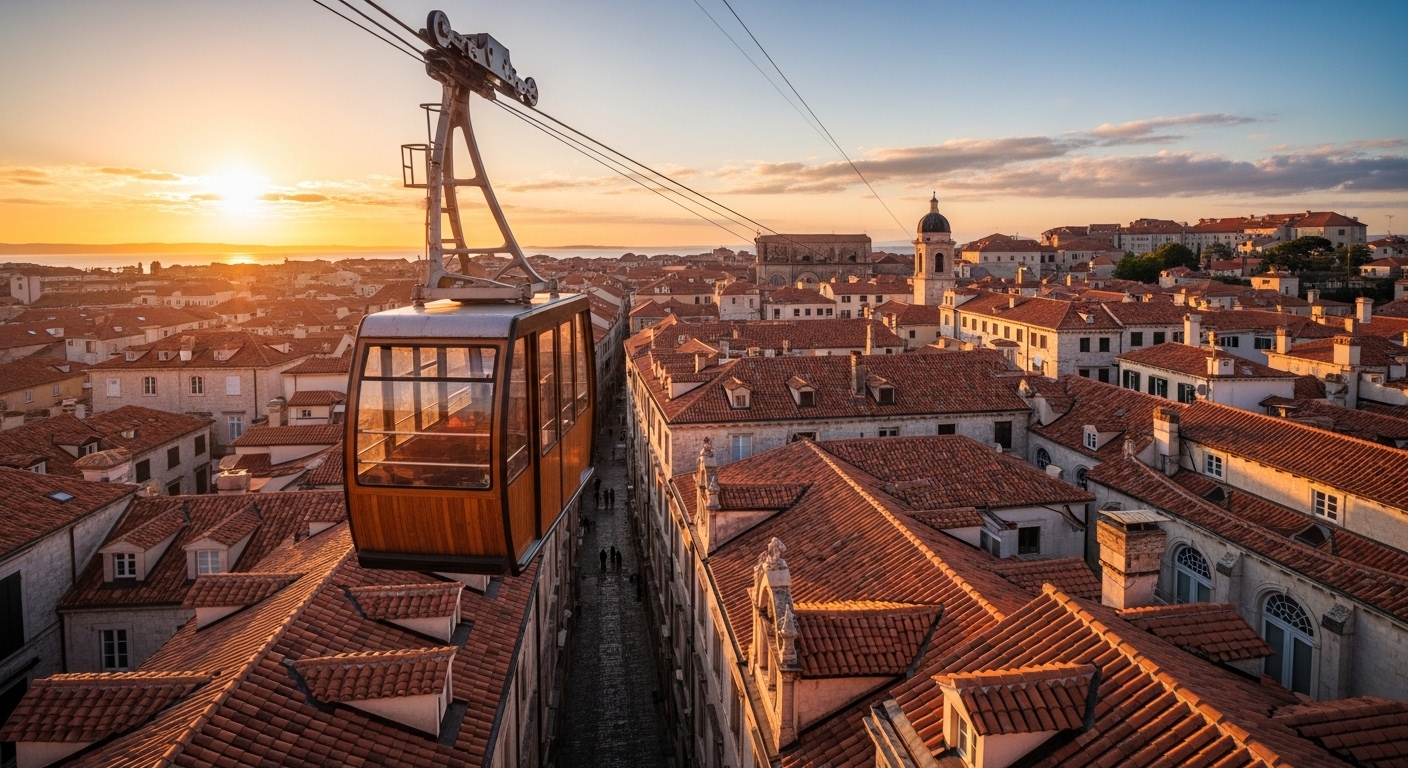
Dubrovnik’s cable car is perhaps one of the most visually dramatic examples of historic ropeways over old town roofs. It climbs Mount Srđ, offering a sweeping view of the walled old town below.
From the cabin, the geometry of the city becomes clear. Rectangular blocks, symmetrical streets, and fortified walls tell a story of careful planning shaped by centuries of maritime power. The Adriatic Sea stretches endlessly beyond, framing the town like a painting.
Although modernized, the cable car traces a historic route that has long connected the city to its defensive high ground. Resources like Lonely Planet often cite this ride as essential, yet few emphasize how deeply it connects past and present.
The Quiet Engineering Genius Behind Ropeways
Historic ropeways were feats of engineering built with limited technology. Designers had to account for wind, weight, terrain, and safety using materials available at the time. Many early systems relied on counterweights, gravity, and manual braking mechanisms.
What is remarkable is how durable these designs have proven to be. With careful maintenance, many ropeways continue to operate safely more than a century later. They stand as reminders that innovation does not always mean replacement.
Do we give enough credit to older technologies that still outperform modern alternatives in sustainability and longevity?
How Ropeways Shape Travel Experiences Today
For modern travelers, historic ropeways over old town roofs offer a slower, more reflective way to explore. Unlike buses or elevators, ropeways create anticipation. The gradual ascent or descent allows time to observe, think, and absorb.
They also reduce physical strain, making historic areas more accessible to a wider range of visitors. This inclusivity helps preserve old towns by minimizing the need for intrusive infrastructure changes.
In many places, ropeways have become symbols of balance between tourism and preservation. They allow access without overwhelming narrow streets below.
Responsible Riding and Preservation
As with all heritage experiences, respect is essential. Ropeways often pass close to private homes, courtyards, and religious buildings. Quiet observation preserves both dignity and atmosphere.
Organizations such as ICOMOS emphasize the importance of protecting historic urban landscapes. Supporting ropeway preservation helps ensure these systems remain part of living towns rather than museum pieces.
Why These Aerial Journeys Stay With Us
Historic ropeways over old town roofs stay in memory because they combine movement with meaning. You are not simply traveling from one point to another. You are tracing routes shaped by geography, necessity, and human creativity.
There is also something deeply human about looking down on rooftops. Roofs shelter lives, stories, and routines. Seeing them from above creates empathy, reminding us that travel is about understanding places, not just seeing them.
Have you ever taken a ride that changed how you felt about a city? Ropeways often do that quietly, without spectacle.
At WentWorld.com, we believe the most powerful travel moments are often the gentlest ones. If this journey through historic ropeways inspired you, we would love to hear your thoughts. Which old town would you want to see from above?
Follow WentWorld.com on our social media platforms for more stories that explore the overlooked, the timeless, and the beautifully human side of travel.
Catch up on the top stories and travel deals by subscribing to our newsletter!