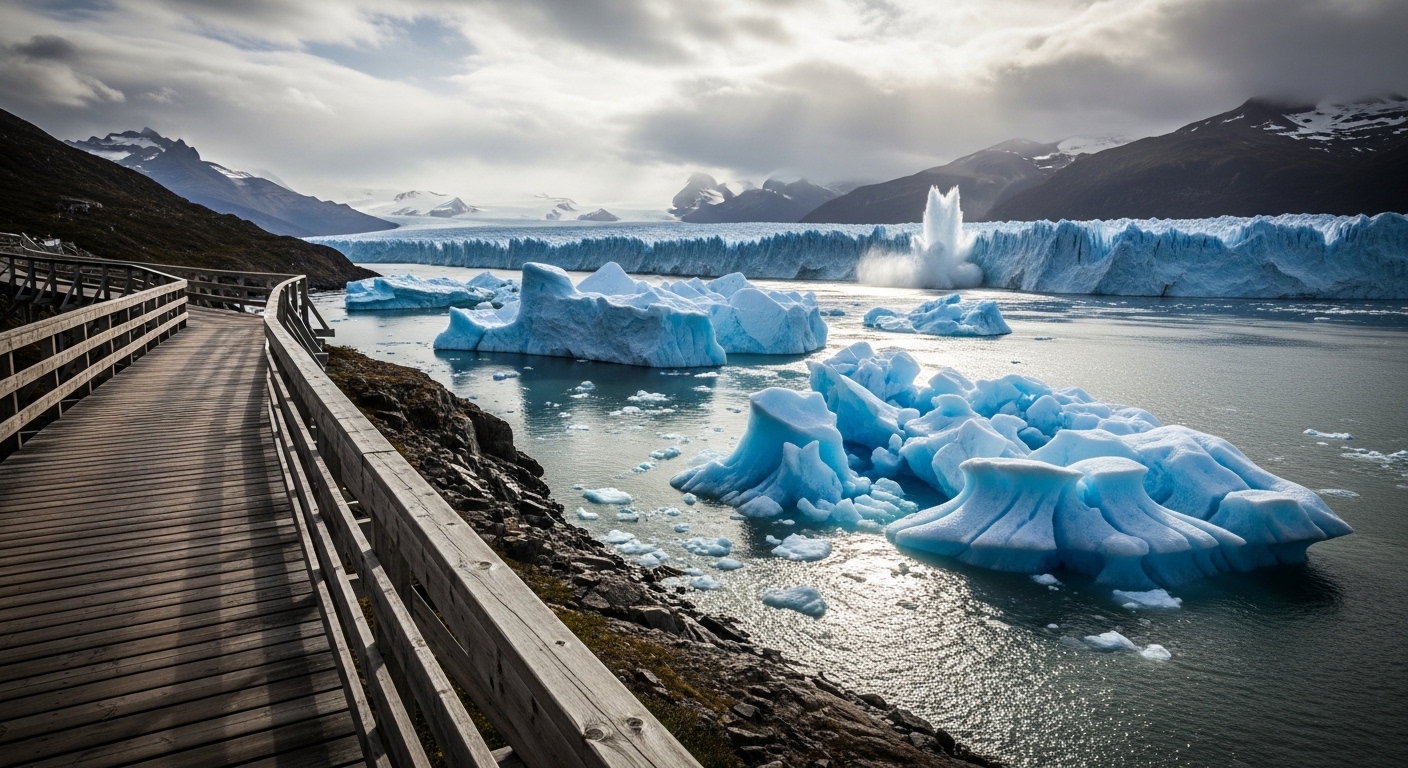
Very few travel experiences make time feel irrelevant. Standing at the edge of an ice fjord, surrounded by silence, you wait as a glacier groans, fractures, and finally releases a massive slab of ice into the sea. Ice fjord boardwalks and calving viewpoints make this possible by offering safe, respectful, and remarkably close access to some of the most powerful natural events on Earth.
Instead of remote expeditions that demand weeks of planning, these carefully designed boardwalks and viewpoints allow everyday travelers to witness glacier calving without disturbing fragile ecosystems. Elevated paths, observation platforms, and viewing decks place visitors close enough to feel the vibration of falling ice. At the same time, they preserve safety and environmental balance. Have you ever watched a landscape reshape itself right in front of you?
Across Arctic and sub-Arctic regions, communities now invest in ice fjord boardwalks and calving viewpoints to educate visitors, support sustainable tourism, and make climate change visible in real time. As a result, these places no longer exist only for scientists or explorers. They now welcome anyone willing to slow down and observe.
Why Ice Fjords Create Such a Powerful Emotional Impact
An ice fjord is not a frozen postcard. Instead, it functions as a constantly changing corridor where glaciers meet the sea. Icebergs crack, roll, collide, and drift away. Deep rumbles echo across the water. Subtle vibrations travel through the ground. Consequently, the experience feels alive rather than static.
What truly defines ice fjord boardwalks and calving viewpoints is the way they encourage patience. Visitors do not rush through these spaces. Rather, they pause, listen, and wait. The environment demands attention, and in return, it offers moments of rare intensity.
In a world built around speed and instant gratification, could travel experiences that require waiting actually feel more meaningful?
The Role of Boardwalks in Protecting Fragile Landscapes
Glacial and Arctic environments remain incredibly sensitive. A single misplaced step can damage tundra plants that take decades to recover. Unregulated access also accelerates erosion and disrupts wildlife habitats. For this reason, boardwalks play a critical role.
Designers elevate most boardwalks above the ground to protect vegetation and stabilize foot traffic. Engineers select materials that withstand extreme cold, seasonal thaw, and shifting terrain. In many regions, planners design structures to be adjusted or relocated as glaciers retreat.
As a result, ice fjord boardwalks and calving viewpoints allow thousands of visitors to experience these landscapes without destroying them. Would you rather see these places preserved carefully or slowly eroded by unmanaged tourism?
Ilulissat Icefjord: A Benchmark for Glacial Access
Among all destinations featuring ice fjord boardwalks and calving viewpoints, Ilulissat Icefjord in western Greenland stands apart. This UNESCO World Heritage Site channels ice from Sermeq Kujalleq, one of the fastest-moving glaciers on Earth.
Here, wooden boardwalks trace the rocky coastline and lead to panoramic viewpoints overlooking Disko Bay. From these platforms, visitors watch enormous icebergs calve and drift slowly toward open water. The sound often arrives before the sight, creating a moment of anticipation that feels almost ceremonial.
Interpretive signs explain glacial movement, Inuit history, and long-term climate data. Information for responsible travel can be found through Visit Greenland, which emphasizes cultural respect and environmental care.
Would you wait in near silence for hours just to witness one moment of ice breaking free?
Alaska’s Glacier Viewpoints: Education Meets Accessibility
Alaska offers some of the most accessible glacier viewing opportunities in the world. Locations such as Kenai Fjords National Park and Glacier Bay combine maintained paths, ranger programs, and boat-accessible viewpoints.
At Exit Glacier near Seward, visitors follow trails marked with historical ice positions. These markers show how far the glacier has retreated over time. Standing beside them creates a powerful contrast between past and present.
The U.S. National Park Service provides extensive educational resources through the National Park Service. Through these efforts, ice fjord boardwalks and calving viewpoints become tools for learning rather than mere attractions.
Patagonia’s Glacial Walkways and Daily Calving Events
In southern Patagonia, glaciers descend from the Andes into bright blue lakes and fjords. Perito Moreno Glacier in Argentina represents one of the most dramatic examples of managed glacial access.
An extensive network of boardwalks and viewing decks allows visitors to observe frequent calving events. Sharp cracks often signal the collapse of massive ice sections into Lago Argentino. Unlike many glaciers, Perito Moreno remains relatively stable, which makes it a unique case study.
Travel guidance for this region often appears on platforms like Lonely Planet, which highlights both accessibility and conservation challenges.
Does seeing ice collapse into water change how you think about climate patterns worldwide?
Norway’s Minimalist Approach to Ice Fjord Viewing
Norway’s northern regions combine dramatic fjords with careful design. Elevated walkways and designated viewpoints allow visitors to approach glaciers without overwhelming the landscape.
Designers prioritize subtlety. Boardwalks blend into rock and snow instead of dominating the view. Strict guidelines also protect wildlife, particularly seals and seabirds.
Official visitor guidance appears through Visit Norway, which promotes low-impact travel and environmental responsibility.
The Waiting Experience: Sound, Stillness, and Scale
Glacier calving follows no schedule. Sometimes visitors wait minutes. At other times, hours pass without movement. The uncertainty becomes part of the experience.
Boardwalks and viewpoints support this waiting by offering benches, wind shelters, and wide platforms. Instead of rushing visitors along, these spaces invite stillness.
In contrast to fast-paced attractions, these places reward patience. Could waiting itself be the most powerful part of witnessing nature?
Making Climate Change Visible Without Explanation
Ice fjords communicate climate change more clearly than statistics ever could. Signs along boardwalks show historical photos, satellite imagery, and future projections. The difference feels immediate and unavoidable.
As ice thins and retreats, visitors see the evidence directly. Therefore, climate change becomes something experienced rather than explained. Ice fjord boardwalks and calving viewpoints transform visitors into witnesses.
Would public conversations around climate shift if more people encountered these landscapes firsthand?
Safety by Design, Not Distance
Calving glaciers generate waves, falling debris, and sudden movement. Because of this, planners position viewing platforms at carefully calculated distances.
Railings, warning systems, and restricted zones protect visitors while preserving proximity. These designs prove that responsible access does not require danger.
The Evolving Future of Ice Fjord Boardwalks and Calving Viewpoints
As glaciers continue to change, access routes must adapt. Some boardwalks now extend farther as ice retreats. Others require relocation due to unstable ground.
Emerging technology may soon add real-time monitoring or augmented interpretation. Nevertheless, the core experience will remain unchanged: waiting quietly as ice meets water.
Ice fjord boardwalks and calving viewpoints remind us that Earth never stands still. Instead, it constantly reshapes itself, often right before our eyes.
Have you ever stood somewhere that made you feel both small and deeply connected at once?
We would love to hear from you. Have you experienced a glacier viewpoint, or does it remain on your travel wish list? Share your thoughts in the comments.
Follow WentWorld.com on our social media platforms for more immersive stories that explore how design, nature, and human curiosity intersect.
Catch up on the top stories and travel deals by subscribing to our newsletter!