Some landscapes are born from beauty. Others are born from necessity. Tsunami evacuation hills turned scenic parks belong firmly to the second category, yet today they stand as some of the most emotionally powerful public spaces in coastal regions. Built to save lives during disasters, these elevated mounds and artificial hills now serve as places of reflection, recreation, and quiet resilience.
At first glance, they may look like ordinary green hills rising gently above neighborhoods. But their purpose is far from ordinary. These hills were designed as emergency shelters, safe havens where entire communities could escape rising waters when every second mattered. Over time, as cities healed and memories settled, many of these evacuation hills evolved into scenic parks. They are no longer just about survival. They are about remembrance, adaptation, and hope.
In this WentWorld.com exploration, we look closely at tsunami evacuation hills turned scenic parks around the world. We explore why they were built, how they function, and what it feels like to stand atop them today. More importantly, we examine how urban planning, memory, and nature can coexist in spaces shaped by both fear and foresight.
Why Tsunami Evacuation Hills Exist
Coastal regions across the world face a unique challenge. They are often densely populated, economically vital, and dangerously exposed to tsunamis. In many low-lying areas, there is simply not enough time to reach distant high ground when a tsunami warning is issued.
This reality led engineers and city planners to develop vertical evacuation solutions. Instead of relying solely on natural hills or tall buildings, they began constructing artificial hills specifically designed to withstand tsunamis. These structures are strategically placed within walking distance of vulnerable neighborhoods.
The concept is simple but powerful. When alarms sound, people run uphill, not away. These hills are built to resist erosion, support large crowds, and remain structurally stable even when surrounded by floodwaters. Would you feel safer knowing that a place designed to protect you is just minutes away?
From Emergency Infrastructure to Public Space
Once constructed, many tsunami evacuation hills stood unused for years. Disasters, thankfully, are not everyday events. This raised an important question for cities: should these massive structures remain dormant, or could they serve a purpose in daily life?
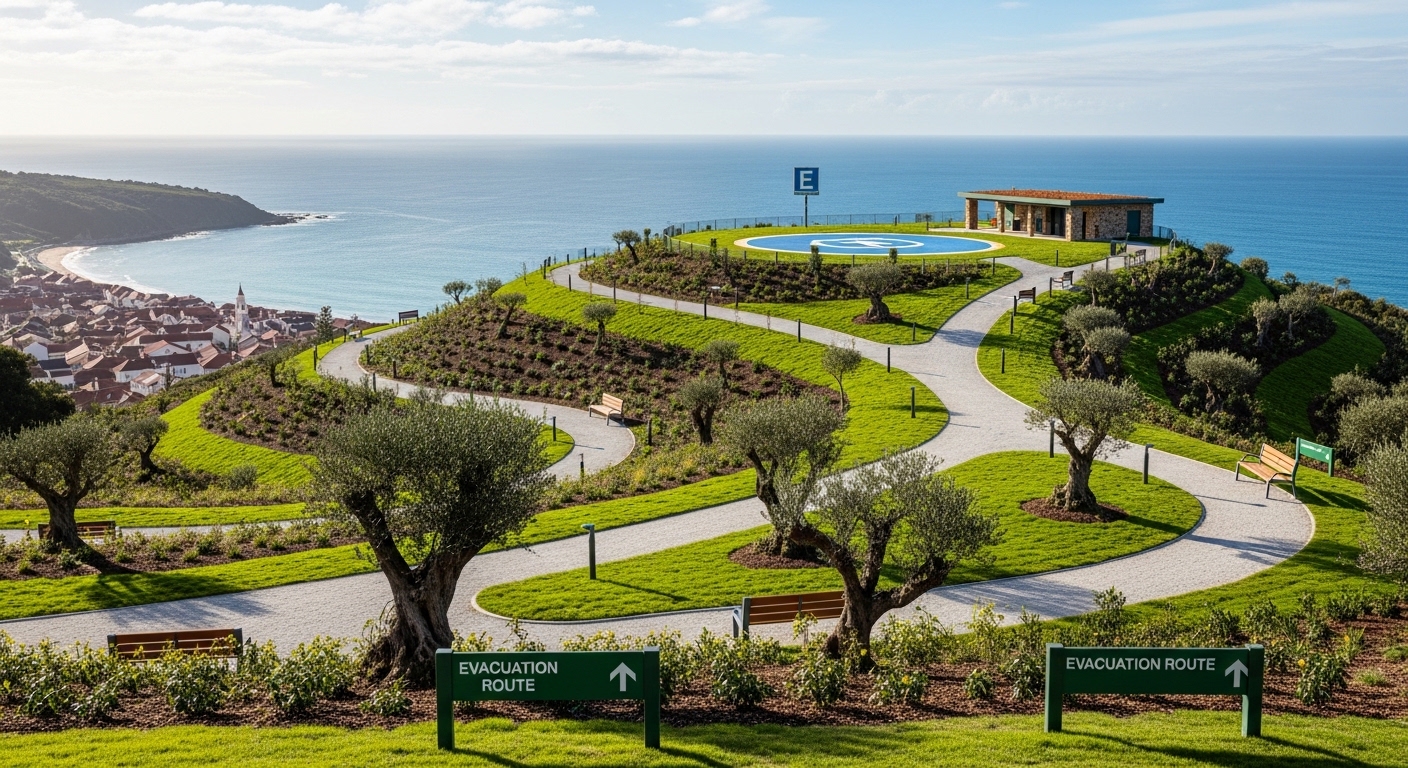
The answer, in many cases, was transformation. City planners began integrating greenery, walking paths, seating areas, and viewpoints into these hills. Over time, they became parks. Children played where evacuation drills once took place. Joggers followed paths designed for rapid ascent. Families gathered on weekends, often unaware of the hill’s original intent.
This dual-purpose design is what makes tsunami evacuation hills turned scenic parks so compelling. They quietly blend safety with serenity. They are always ready, yet never intrusive. Have you ever visited a park without realizing it was built to save lives?

Japan’s Pioneering Approach
Japan is widely recognized as a leader in tsunami preparedness, and tsunami evacuation hills turned scenic parks are most commonly found there. Following the devastating 2011 Tōhoku earthquake and tsunami, Japan invested heavily in innovative disaster mitigation infrastructure.
In coastal towns across Miyagi and Iwate Prefectures, artificial hills were constructed near residential zones. These hills often rise 10 to 15 meters above ground level and are reinforced with concrete cores and deep foundations.
Today, many of these sites are landscaped with cherry trees, grassy slopes, and panoramic platforms overlooking the sea. On calm days, the ocean appears peaceful from above, a stark contrast to the force it once unleashed. The Japan National Tourism Organization provides insights into regional recovery and travel through japan.travel, highlighting how safety and tourism now coexist.
Otsuchi Town’s Green Memorial Hills
Otsuchi Town is one of the most poignant examples of this transformation. After losing a significant portion of its population in 2011, the town rebuilt with resilience at its core. Tsunami evacuation hills were constructed not only as shelters but also as memorial spaces.
These hills are planted with native vegetation and include quiet walking paths that lead to elevated viewpoints. From the top, visitors can see both the rebuilt town and the vast Pacific Ocean beyond. The experience is deeply reflective.
Standing there, one cannot help but think about the people who once fled these shores and those who now live with preparedness woven into daily life. Would you find comfort or unease in such a place?
Indonesia’s Coastal Adaptations
Indonesia, located along the Pacific Ring of Fire, is another region deeply affected by tsunamis. After the 2004 Indian Ocean tsunami, which claimed hundreds of thousands of lives, coastal planning underwent a dramatic shift.
While Indonesia relies more heavily on vertical evacuation buildings, some regions have begun exploring elevated earthworks and landscaped mounds as evacuation points. In Aceh, for example, elevated green spaces double as community gathering areas and emergency shelters.
Organizations such as UN Office for Disaster Risk Reduction have studied these approaches, emphasizing the importance of integrating disaster preparedness into everyday environments rather than isolating it.
Chile’s Coastal Safety Parks
Chile’s long Pacific coastline makes it one of the most tsunami-prone countries in the world. In response, Chilean cities have experimented with elevated coastal parks designed to act as natural buffers and evacuation zones.
In some towns, hills reinforced with retaining walls and vegetation serve as both recreational parks and safe zones. These parks often include signage explaining evacuation routes and tsunami risks, blending education with leisure.
The Chilean government’s approach to disaster education can be explored through resources like ONEMI, which highlights how public awareness is key to survival.
The Psychological Power of Elevated Parks
Beyond their physical function, tsunami evacuation hills turned scenic parks play an important psychological role. Trauma does not disappear when buildings are rebuilt. It lingers in memory, sound, and silence.
By transforming evacuation infrastructure into welcoming public spaces, communities reclaim control over landscapes associated with fear. These hills become places of normalcy rather than reminders of disaster alone.
Psychologists often note that routine interaction with once-threatening environments can reduce long-term anxiety. Sitting on a bench where an evacuation drill once took place can feel empowering. Have you ever revisited a place connected to a difficult memory and found peace instead?
Urban Design That Anticipates the Future
Tsunami evacuation hills are part of a broader movement toward adaptive urban design. Rather than reacting to disasters after they occur, cities are learning to anticipate risk and embed solutions into daily life.
This philosophy aligns with ideas promoted by institutions like World Bank, which advocates for resilient infrastructure that serves communities even in the absence of emergencies.
Scenic parks that double as evacuation zones represent efficient land use. They reduce the need for single-purpose structures and ensure that safety investments provide daily value.

Visiting These Parks as a Traveler
For travelers, visiting tsunami evacuation hills turned scenic parks offers a unique perspective on resilience and innovation. These are not typical tourist attractions. They do not rely on spectacle or grandeur.
Instead, they invite quiet observation. A slow walk. A moment of reflection. From the top, views often stretch across rebuilt towns, fishing harbors, and open seas. It is travel that teaches without lecturing.
When visiting such spaces, respect is essential. These parks are not monuments frozen in time. They are living parts of communities. Keeping noise low, following posted guidelines, and acknowledging local history makes the experience meaningful rather than intrusive.
What These Hills Teach Us About Memory
Memory is complex. Some communities choose monuments and museums. Others choose integration. Tsunami evacuation hills turned scenic parks represent the latter.
They do not isolate memory behind walls. Instead, they weave it into daily routines. Children grow up playing on hills that once symbolized danger. Over time, awareness replaces fear.
This approach raises an interesting question. Is it better to separate spaces of remembrance from everyday life, or to allow them to coexist?
A Quiet Invitation to Preparedness
Perhaps the most remarkable aspect of these parks is how subtly they encourage preparedness. There are often signs explaining evacuation procedures, altitude markers, and directional paths.
Yet nothing feels alarming. The information is there when needed, blending into the environment rather than dominating it. This quiet readiness is what makes tsunami evacuation hills so effective.
They do not demand attention. They earn trust.
Why These Spaces Matter Globally
As climate change increases the frequency and intensity of coastal hazards, the concept of multi-functional safety infrastructure becomes increasingly relevant. Cities worldwide can learn from tsunami evacuation hills turned scenic parks.
They show that safety does not have to be ugly, and preparedness does not have to feel oppressive. With thoughtful design, it can be calming, beautiful, and inclusive.
At WentWorld.com, we believe travel is also about understanding how people adapt to challenges. These hills are not just landscapes. They are lessons.
We would love to hear your thoughts. Have you ever visited a park or public space that had a deeper, hidden purpose? Did knowing its history change how you experienced it?
If stories like this resonate with you, follow WentWorld.com on our social media platforms to continue exploring destinations shaped by resilience, innovation, and quiet strength.
Catch up on the top stories and travel deals by subscribing to our newsletter!