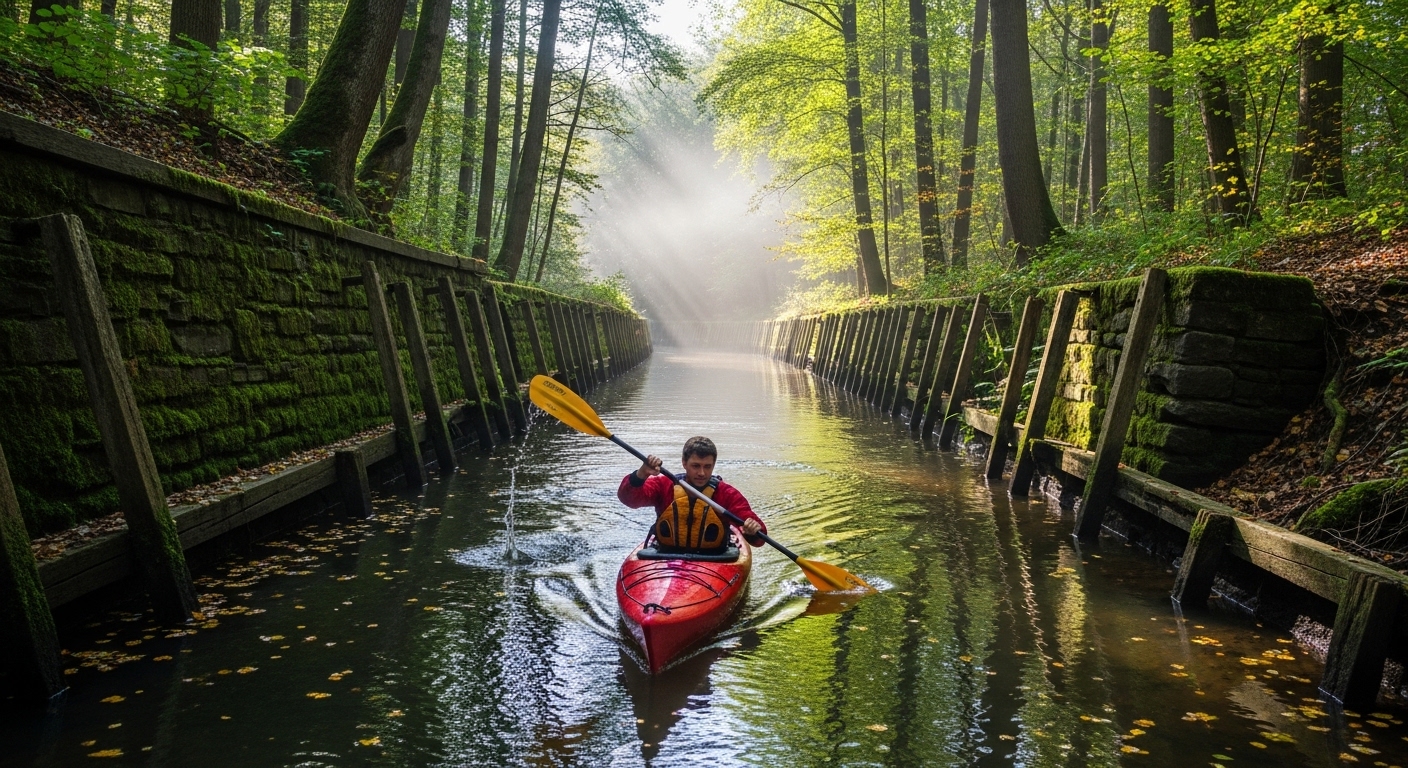
There are few travel experiences that let you glide directly through history, but timber slide rivers do exactly that. Once carved and engineered for moving massive logs downstream, these forgotten waterways now offer travelers something rare: the chance to paddle along historic industrial routes that once powered entire economies. What used to be roaring channels of timber transport have slowly transformed into peaceful corridors for kayaking, canoeing, and slow exploration.
Timber slide rivers are scattered across forested regions of North America and Europe, often hidden in national parks or rural landscapes. These rivers were never meant for leisure. They were functional, engineered systems, sometimes involving wooden chutes, stone walls, and artificial channels built to guide logs safely through dangerous rapids. Today, they are some of the most atmospheric paddling routes you can experience.
Have you ever paddled through a place where thousands of trees once rushed past your boat every day? Or wondered how early industries moved entire forests without trucks or railways? Timber slide rivers offer that story in physical form.
What Exactly Are Timber Slide Rivers?
Timber slide rivers are waterways that were modified or engineered specifically for log driving, a practice common from the 18th to early 20th century. In forest-rich regions, rivers became highways for timber. Logs were floated downstream toward sawmills, ports, and growing cities.
To make this possible, workers built timber slides — artificial channels made from wood or stone — around waterfalls, steep rapids, or narrow gorges. These slides prevented logs from jamming or breaking while maintaining speed and flow. In many places, entire rivers were reshaped to suit this industry.
Today, the logging has stopped, but the rivers remain. Their engineered paths, smooth rock corridors, and strangely straight channels still reveal the industrial logic beneath their natural beauty.
Would you guess that a peaceful kayaking trail was once a high-risk industrial transport route?
The Golden Age of Log Driving
From Canada’s Ottawa Valley to Sweden’s Dalälven River, log driving was once one of the most dangerous and important professions. Workers called river drivers balanced on moving logs, breaking jams with long poles, often risking their lives in freezing waters.
Entire communities grew around these rivers. Towns depended on timber for housing, ships, railroads, and fuel. Rivers like the Ottawa River in Algonquin Park became global supply lines long before highways existed.
In Europe, rivers such as Germany’s Kinzig and France’s Vosges waterways were similarly engineered. Many of these timber slides still exist, now protected as historical structures.
Can you imagine modern cities being built almost entirely from trees that floated past the same rocks you paddle today?

Why These Rivers Are Perfect for Modern Paddlers
Ironically, what made timber slide rivers dangerous for logs makes them ideal for paddlers. Their controlled gradients, engineered curves, and stabilized channels often create smooth, predictable water flow.
Many timber slide rivers now sit within protected areas or heritage parks, making them accessible for eco-tourism. They are typically:
- Surrounded by dense forests and wildlife
- Free from heavy boat traffic
- Rich in historical markers and ruins
- Gentle enough for beginner paddlers
Unlike artificial canals, these rivers feel wild but carry invisible design beneath the surface. You’re paddling through both nature and forgotten engineering.
Famous Timber Slide Rivers You Can Still Paddle
Several iconic timber slide rivers have become bucket-list destinations for slow travelers and outdoor explorers.
Ottawa River, Canada
This river powered one of the largest timber industries in the world. Today, it offers multi-day canoe routes through wilderness once crowded with log rafts. Parks Canada preserves many original slide structures.
St. John River, New Brunswick
Once a major artery for shipbuilding timber, this river now supports kayaking tourism and historical interpretation centers.
Dalälven River, Sweden
Sweden’s timber heritage lives on here, with marked paddle routes following old log channels. Tourism boards like Visit Sweden promote these experiences as cultural nature travel.
Kinzig River, Germany
Flowing through the Black Forest, this river’s timber slides are preserved as part of industrial heritage trails supported by Germany Tourism.
Would you rather paddle a river known for castles and vineyards, or one shaped by forgotten labor and survival?
What It Feels Like to Paddle One
Paddling a timber slide river feels different from ordinary kayaking. The river often narrows into smooth corridors, flanked by stone walls or wooden remains. You sense the intention behind the landscape.
There is also a strange quiet. These rivers no longer carry economic urgency. The only sounds are water, wind, and birds. Yet the layout feels purposeful, almost mechanical beneath the surface calm.
Many paddlers describe it as moving through a “ghost industry.” You can almost imagine the shouts of log drivers and the thunder of timber crashing downstream.
Cultural and Emotional Value
Timber slide rivers are powerful cultural artifacts. They represent early globalization, environmental transformation, and the human need to reshape nature for survival.
Visiting them connects travelers to forgotten labor histories. These rivers tell stories of risk, migration, and industrial growth long before digital economies existed.
In many regions, descendants of log drivers now work as guides, historians, and conservationists, keeping these stories alive through tourism and education.
Does travel feel more meaningful when it carries memory, not just scenery?

Environmental Recovery and Rewilding
Since log driving ended, many timber slide rivers have undergone natural recovery. Fish populations returned. Forests regenerated. Wetlands reformed along artificial banks.
These rivers now represent rare examples of industrial landscapes healing themselves. Conservation programs focus on protecting both the ecology and the historic structures.
In some cases, slides are intentionally preserved as cultural monuments rather than removed, blending heritage with rewilding.
How to Plan Your Own Timber Slide River Trip
Planning a timber slide river paddle is simpler than it sounds. Most routes are beginner-friendly and well-marked.
- Choose rivers within national parks or heritage zones
- Look for guided tours that include historical interpretation
- Use lightweight kayaks or canoes for narrow channels
- Visit during late spring or early autumn for ideal water levels
Airlines such as Air Canada and regional European carriers make these remote regions increasingly accessible.
The Future of Timber Slide Tourism
As travelers seek slower, more meaningful experiences, timber slide rivers fit perfectly into the future of travel. They combine nature, history, physical movement, and emotional depth.
Unlike theme parks or artificial attractions, these routes require no reconstruction. They already exist, quietly waiting to be rediscovered.
Would you rather visit another crowded landmark, or paddle a river that once built entire civilizations?
We would love to hear your thoughts. Have you ever paddled a historic river, or would you try one in the future? Share your experiences in the comments.
Follow WentWorld.com on our social media platforms for more stories about forgotten landscapes, hidden travel routes, and places where history still flows beneath the surface.
Catch up on the top stories and travel deals by subscribing to our newsletter!