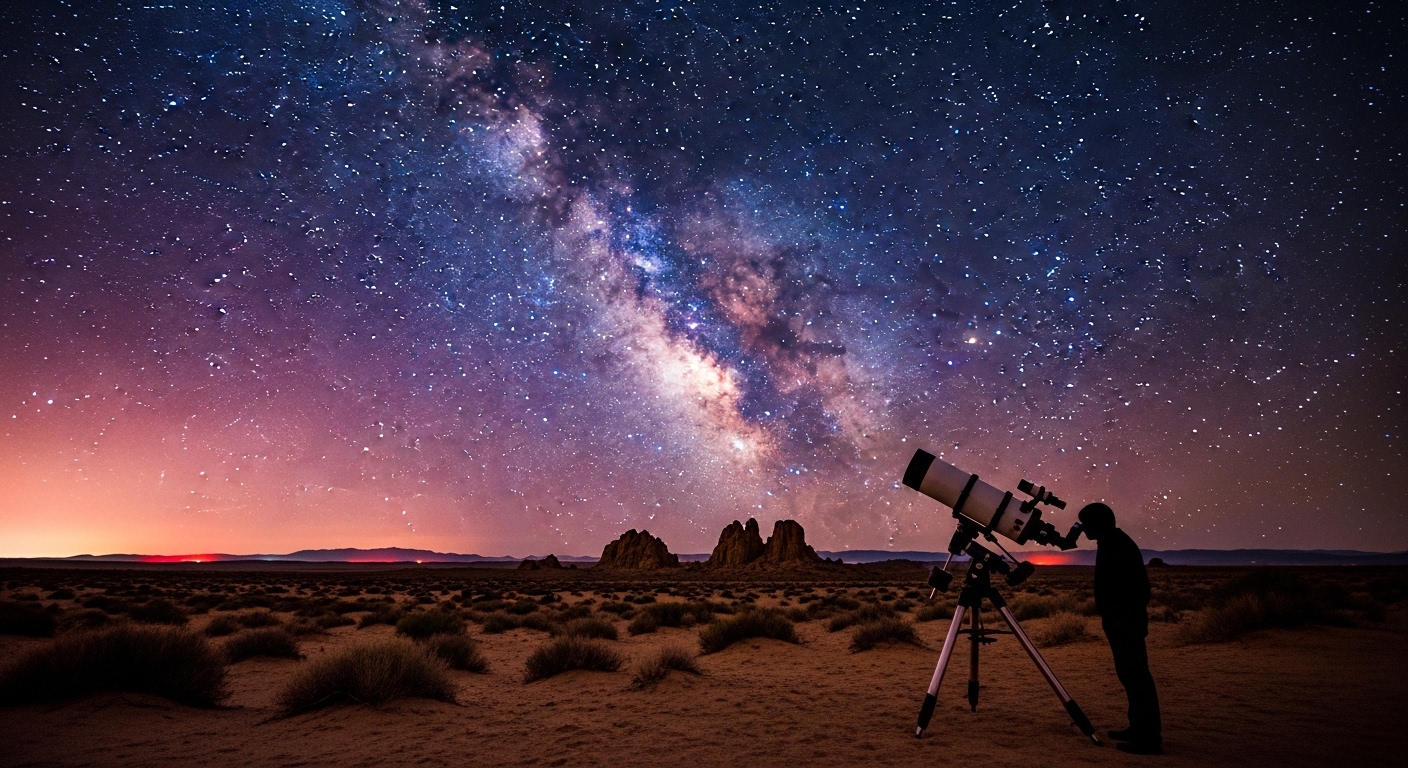
There is something deeply humbling about standing under a sky so dark that the Milky Way looks like a glowing river. In desert star parks with telescope libraries, this experience becomes even more powerful. Instead of simply admiring stars from a distance, visitors are invited to actively explore the universe through shared telescopes placed in some of the most remote deserts on Earth.
In today’s world of glowing screens and constant artificial light, genuine darkness feels almost unfamiliar. However, desert star parks exist specifically to protect it. These locations preserve natural night skies while also making astronomy accessible to everyday travelers. As a result, people who have never owned a telescope can suddenly observe Saturn’s rings, Jupiter’s moons, or distant nebulae with their own eyes.
WentWorld.com explores how desert star parks with telescope libraries are quietly becoming some of the most meaningful travel destinations on the planet. Rather than offering speed or spectacle, these places offer perspective, stillness, and an emotional connection to something far larger than ourselves.
What Exactly Are Desert Star Parks?
Desert star parks are protected natural areas located in regions with extremely low light pollution. Many of them are officially recognized as International Dark Sky Parks, a status supported by organizations like International Dark-Sky Association.
What truly sets some of these parks apart is the presence of telescope libraries. Instead of requiring visitors to bring expensive equipment, these parks provide telescopes on-site. In some cases, they even operate formal lending systems similar to public libraries. Consequently, astronomy becomes inclusive rather than exclusive.
Most importantly, these parks are not designed for professionals only. Beginners, families, and casual travelers are all encouraged to participate. In fact, many people discover their interest in space for the first time while standing under these desert skies.
Why Deserts Are Perfect for Stargazing
Deserts provide some of the clearest skies on Earth. Because humidity is low and cloud cover is minimal, stars appear brighter and sharper. Furthermore, desert regions are usually far from major cities, which dramatically reduces light pollution.
High elevation deserts offer even greater advantages. Since the atmosphere is thinner at altitude, light from distant objects travels with less distortion. That is precisely why many of the world’s major observatories are built in desert environments.
However, desert star parks with telescope libraries bring this scientific advantage to ordinary travelers. Instead of observing the universe through documentaries, visitors become active participants. As a result, stargazing becomes personal rather than abstract.
Have you ever wondered what the universe actually looks like when seen with your own eyes instead of through a screen?

Big Bend National Park, Texas
Big Bend National Park in Texas is one of the most celebrated desert star parks in North America. Located near the Mexican border, it is surrounded by vast empty landscapes and almost no artificial lighting.
Because of its isolation, Big Bend regularly records some of the darkest skies in the United States. On clear nights, visitors can observe thousands of stars, meteor showers, and even faint galaxies.
Moreover, the park frequently hosts public astronomy nights where visitors can use telescopes provided by volunteers and park staff. Educational programs are supported through nps.gov, making astronomy accessible to all age groups.
Standing in Big Bend at night feels less like tourism and more like entering a silent cosmic classroom.
Atacama Desert, Chile
The Atacama Desert is widely regarded as one of the best places on Earth for astronomical observation. In fact, it is home to some of the world’s most advanced observatories, including facilities operated by European Southern Observatory.
However, beyond professional research, the Atacama has developed an impressive culture of public stargazing. Many desert lodges and star parks offer telescope access, guided sky tours, and astrophotography workshops.
Meanwhile, the sheer clarity of the Atacama sky creates a visual experience that feels almost unreal. Stars appear layered in depth, and the Milky Way stretches across the horizon like a luminous road.
Have you ever felt small in a way that felt peaceful instead of intimidating?
NamibRand Nature Reserve, Namibia
NamibRand Nature Reserve in Namibia is one of the first officially recognized Dark Sky Reserves in Africa. This vast desert landscape offers extraordinary night visibility due to its isolation and minimal development.
Some lodges within NamibRand maintain telescope libraries for guests. Therefore, travelers can explore southern hemisphere constellations that are invisible from most parts of the world.
In contrast to urban stargazing, there are no nearby cities, no traffic noise, and no glowing skylines. Instead, there is only wind, sand, and starlight.
Namibia has become more accessible in recent years through airlines like Qatar Airways, making it easier for travelers to reach some of the darkest skies on Earth.
Death Valley National Park, California
Death Valley is often associated with extreme heat and harsh landscapes. Nevertheless, it is also one of the most impressive stargazing locations in the United States.
As one of the largest protected areas in the country, Death Valley offers massive open skies and minimal artificial light. Consequently, it regularly hosts astronomy programs featuring public telescopes.
Seeing the Milky Way above Death Valley’s salt flats creates a striking contrast. A place famous for lifelessness suddenly becomes a gateway to cosmic abundance.
The Role of Telescope Libraries
Telescope libraries are among the most powerful tools in modern travel education. By removing financial barriers, they allow anyone to experience astronomy firsthand.
Some parks operate structured lending systems, while others offer guided sessions led by astronomy volunteers. In both cases, visitors learn how to use different types of telescopes safely and effectively.
For many travelers, this becomes their first real interaction with science beyond textbooks. As a result, astronomy feels tangible rather than theoretical.
Would your relationship with science have been different if you had grown up with regular access to dark skies?

Stargazing as a Mental Reset
Stargazing is increasingly recognized as a form of mental wellness. Unlike most travel activities, it requires stillness instead of movement.
Desert star parks with telescope libraries encourage silence, patience, and attention. As a result, visitors often describe feeling calmer and more grounded.
Moreover, the scale of the universe naturally reduces everyday stress. It becomes difficult to obsess over deadlines while watching light that traveled millions of years to reach your eyes.
Protecting Darkness in a Bright World
Light pollution is increasing globally, and truly dark skies are becoming rare. According to studies highlighted by Nature, a significant portion of humanity has never seen the Milky Way.
Therefore, desert star parks serve a critical conservation role. They protect darkness as an environmental resource, just like forests protect biodiversity.
Visiting these parks responsibly helps reinforce the idea that darkness deserves preservation.
Why These Parks Matter for Future Travelers
Desert star parks with telescope libraries represent a new kind of tourism. They are not about speed, luxury, or constant stimulation.
Instead, they are about presence, curiosity, and reflection. Ultimately, they offer something deeply human: the chance to look up and feel connected to something timeless.
As WentWorld.com continues exploring rare destinations, we believe these parks deserve a place on every thoughtful traveler’s list.
Have you ever visited a place where darkness itself felt meaningful? Would you plan a trip purely to experience real stars again?
We would love to hear your thoughts and experiences. Share your favorite stargazing memories and tell us which desert star parks you dream of visiting.
If stories like this inspire your curiosity about the world and beyond, follow WentWorld.com on our social media platforms for more journeys into the extraordinary.
Catch up on the top stories and travel deals by subscribing to our newsletter!