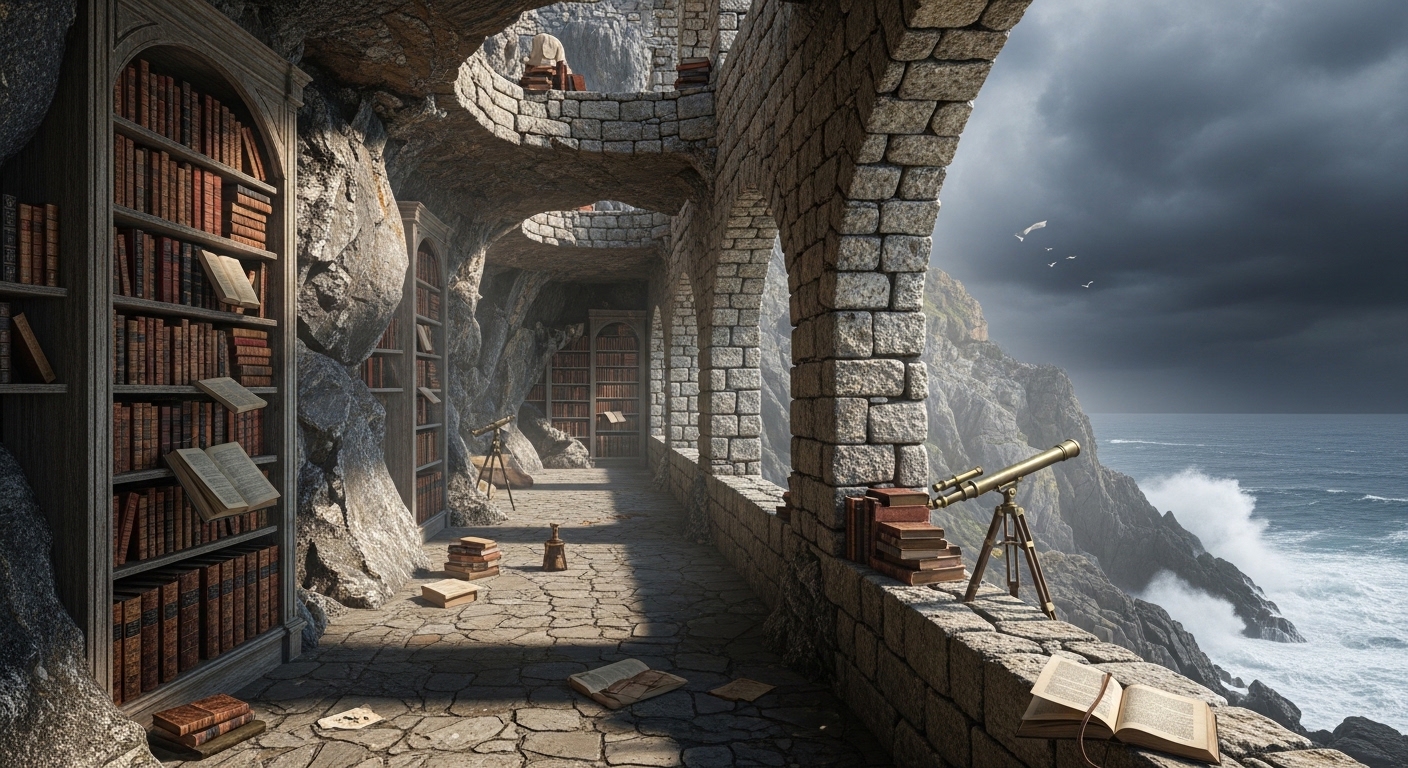
Salt wind libraries preserving books in dry air may sound like a poetic idea, yet they represent a very real and quietly revolutionary approach to protecting human knowledge. In a world obsessed with technology, these libraries rely on something far older and more reliable: nature itself.
Instead of sealed rooms and constant climate machines, these spaces allow carefully controlled natural air to circulate. As a result, books survive in conditions that feel almost effortless. More importantly, this method challenges how we think about preservation in the modern age.
So what happens when salt, wind, and dry air become librarians? And why are architects and historians suddenly paying close attention to these environments?
Salt wind libraries preserving books in dry air are not just about storage. Rather, they are about redefining our relationship with time, memory, and sustainability.
Why Dry Air Matters So Much for Books
Books are far more sensitive than they appear. Although paper seems solid, it reacts constantly to its surroundings. When humidity rises, fibers expand. Eventually, mold forms, insects thrive, and entire collections can be destroyed.
By contrast, dry air slows down all these processes. Consequently, chemical reactions weaken. Bacteria struggle to survive. Pages remain stable for much longer.
For this reason, many preservation experts now prefer naturally dry environments over artificial climate systems. Not only are they more reliable, but they also consume almost no energy.
Salt wind libraries preserving books in dry air take this idea further. They combine low humidity with natural airflow and salt particles, which together discourage microbial growth.
Salt as a Natural Preservative
Salt has been used for preservation for thousands of years. Historically, it kept food from spoiling. In libraries, it plays a quieter role.
Salt in the air reduces moisture. At the same time, it creates an environment where fungi and bacteria struggle to multiply. Therefore, books stored in lightly salty air decay more slowly.
Of course, excessive salt can damage materials. However, when managed carefully, it becomes a powerful ally.
That is why coastal and desert locations are becoming prime candidates for experimental preservation libraries.

Ancient Knowledge and Geography
Interestingly, humans understood this principle long before modern science.
The famous Library of Alexandria thrived in a dry Mediterranean climate. Similarly, the manuscripts at Saint Catherine’s Monastery survived for centuries thanks to desert mountain air.
In Tibet, sacred texts remained intact because of cold, thin, and extremely dry conditions. Meanwhile, in North Africa, entire family archives still exist in mud-brick homes designed to regulate humidity naturally.
In other words, salt wind libraries preserving books in dry air are not new. Instead, they are rediscovering ancient wisdom.
Modern Interpretations of Natural Preservation
Today, designers are translating these ideas into contemporary architecture.
For instance, the Svalbard Global Seed Vault in Norway uses cold, dry air to protect seeds. Although it stores plants instead of books, the philosophy is identical.
Likewise, new archive projects in Morocco and Oman rely on desert airflow and thick walls to regulate temperature without machines.
Meanwhile, in Portugal and Chile, coastal libraries are experimenting with open-air corridors that guide salt wind through reading rooms.
As a result, buildings become part of the preservation process rather than obstacles to it.
How These Libraries Are Designed
Salt wind libraries look very different from traditional ones.
Instead of sealed glass boxes, they feature open layouts. Courtyards allow wind to pass through. Narrow windows reduce sunlight. Elevated floors prevent ground moisture.
Furthermore, materials such as stone, clay, and untreated wood regulate humidity naturally.
Because of this, the entire building acts like a breathing organism. Air flows gently, adjusting to seasonal changes.
Salt wind libraries preserving books in dry air are designed for patience, not speed.
Why This Matters in the Digital Age
At first glance, physical preservation may seem outdated. After all, we store everything in the cloud.
However, digital data is surprisingly fragile. Servers fail. Formats become obsolete. Power outages erase years of work.
In contrast, a book stored in the right environment can survive hundreds of years without electricity.
Therefore, salt wind libraries preserving books in dry air act as a backup for human civilization.
They protect not only stories, but also legal records, cultural identities, and scientific knowledge.
The Emotional Experience of Visiting These Libraries
Walking into one of these spaces feels different.
Instead of artificial silence, you hear wind. Instead of plastic smells, you sense salt and wood.
Moreover, the atmosphere feels timeless. You become aware that these books may outlive you.
This creates a deep emotional connection. Many visitors describe these libraries as sacred spaces, even if they are secular.
They feel less like buildings and more like memory temples.
Tourism and Slow Travel
Salt wind libraries preserving books in dry air are also becoming travel destinations.
Writers seek inspiration there. Researchers study conservation methods. Travelers search for meaningful experiences.
Some libraries even offer sea-facing reading decks, rooftop platforms, and guided archive tours.
As a result, tourism shifts from entertainment to reflection.
Instead of crowds and noise, visitors find silence and wind.

Sustainability and Energy Use
From an environmental perspective, these libraries are revolutionary.
Traditional archives consume massive energy for climate control. By contrast, salt wind libraries use almost none.
No air conditioning. No dehumidifiers. No constant electricity.
Therefore, they are ideal for a future facing climate instability and energy scarcity.
They prove that sustainable design can also be elegant.
Challenges and Risks
Nevertheless, this approach has limitations.
Salt can corrode metals. Extreme dryness can make paper brittle. Not all climates are suitable.
Moreover, modern materials like glossy paper and synthetic inks still require stable temperatures.
Thus, salt wind libraries preserving books in dry air work best for long-term archives, not everyday libraries.
They are vaults, not coffee shops.
The Future of Knowledge Preservation
Looking ahead, experts predict hybrid systems.
Digital platforms for access. Natural archives for survival.
This combination ensures that information remains both available and permanent.
In a world of rapid change, such balance may be essential.
What This Means for You
You may never build a preservation library. Still, the idea matters.
It reminds us to think long-term.
What knowledge deserves to last? How do we protect it? And are we building systems that respect time?
Salt wind libraries preserving books in dry air are not just about architecture.
They represent a philosophy of patience.
Final Thoughts
In an age obsessed with speed and storage, these libraries feel radical.
Yet they may be closer to the truth than any server room.
Sometimes, the future looks like ancient stone walls, quiet wind, and paper resting peacefully in dry air.
Have you ever visited a library in a desert or coastal region? Did it feel different from modern city libraries?
We would love to hear your experiences and thoughts.
And if you enjoy discovering unique travel and cultural ideas, make sure to follow WentWorld on social media for more stories that explore how the world protects its knowledge.
Catch up on the top stories and travel deals by subscribing to our newsletter!