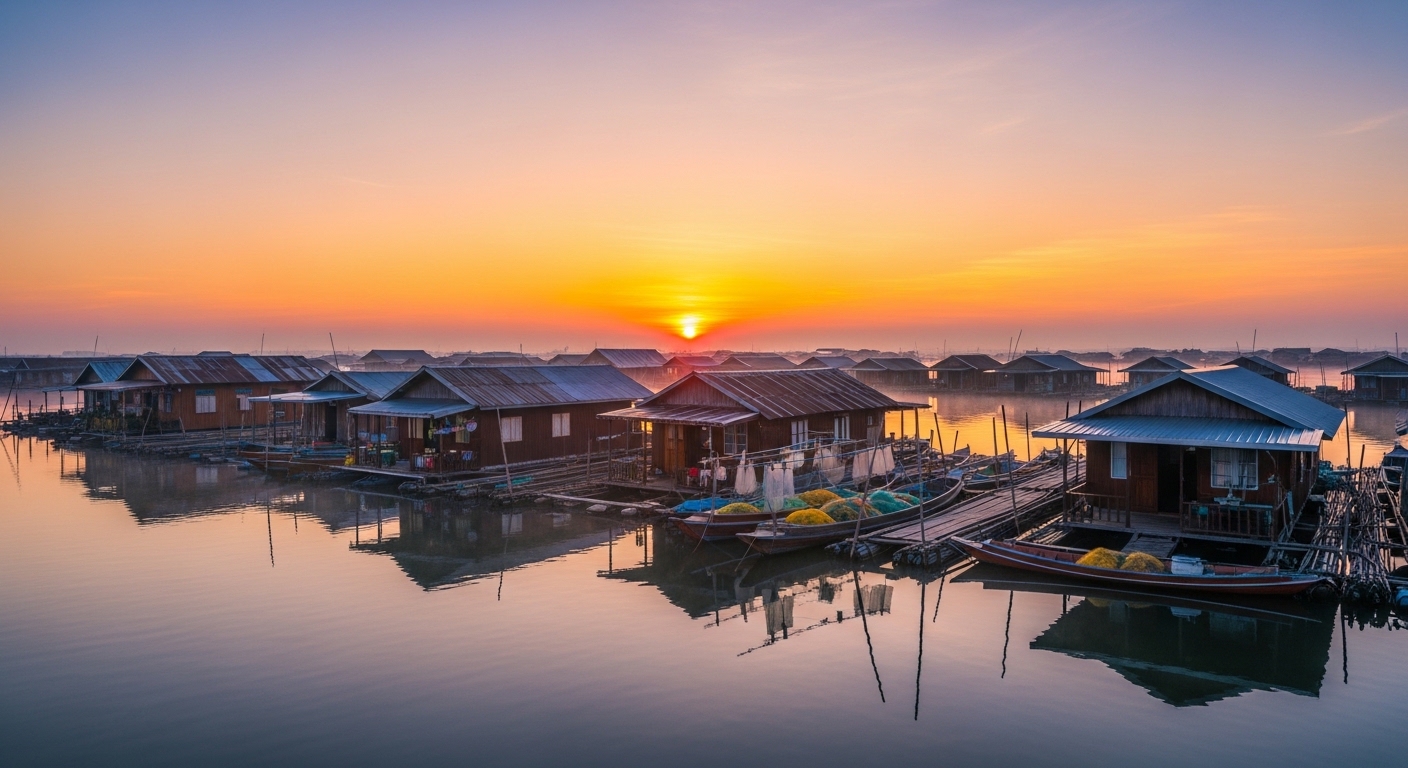
There is something deeply fascinating about migratory island villages that shift with currents. The idea that entire communities can move, drift, or subtly relocate over time feels almost impossible in a world where we associate villages with fixed maps and permanent borders. Yet across oceans, rivers, and lagoons, real places exist where homes float, neighborhoods migrate, and geography is never quite final.
Instead of relying on solid ground, these communities build their lives on water. Homes rise on stilts, platforms float on reeds, and entire villages adjust their position as tides change. Over time, movement becomes normal, not disruptive. In fact, for many residents, stillness would feel more unnatural than drift.
Have you ever imagined living in a place where your surroundings change without you ever packing a bag? Where your front view today might not exist tomorrow? Where even your sense of direction depends more on tides than roads?
At WentWorld.com, we explore unusual ways humans adapt to extreme environments. Among them, migratory island villages that shift with currents stand out as one of the most remarkable examples of flexibility, resilience, and cultural intelligence.
What Does It Mean for a Village to Migrate?
When people hear the phrase migratory island villages that shift with currents, they often imagine dramatic journeys across oceans. However, the reality is usually far more subtle. Movement happens slowly, sometimes only a few meters per year. Nevertheless, over decades, entire settlements change location.
In some regions, villages drift naturally because they are built on floating materials. In others, communities rebuild seasonally as water levels rise or fall. Meanwhile, erosion and sediment flow constantly reshape usable land.
Rather than treating migration as a crisis, these societies treat it as routine. As a result, movement is built into daily life, not feared or resisted.
The Bajau Sea Nomads of Southeast Asia
Across Southeast Asia, the Bajau people have lived as sea nomads for centuries. Instead of permanent villages, they rely on houseboats and stilt settlements built above shallow reefs. Over time, their communities shift according to fishing patterns, storms, and changing tides.
Because of this lifestyle, Bajau children learn navigation before they learn reading. Fishing spots replace street names. Meanwhile, social ties matter more than physical location.
Interestingly, some Bajau settlements split and merge naturally. One year, families cluster together. The next year, groups drift apart based on resources. Therefore, the concept of a single permanent village barely exists.
In many ways, the Bajau do not migrate away from home. Instead, home migrates with them.

Uros Floating Islands on Lake Titicaca
High in the Andes, Lake Titicaca hosts one of the most famous floating communities in the world. The Uros people live on islands constructed entirely from totora reeds. These islands float naturally and require constant rebuilding.
Over time, as older reeds decay and new layers are added, the islands slowly drift across the lake. Consequently, the villages change position without anyone ever lifting a house.
Moreover, families literally rebuild the ground beneath their feet every week. Without regular maintenance, the islands would simply sink.
Originally, this lifestyle developed for protection from hostile tribes. Today, however, it stands as a powerful example of human engineering shaped entirely by water.
Ganvié, the Floating City of Benin
In West Africa, Ganvié rises above Lake Nokoué as a city built entirely on stilts. Often called the Venice of Africa, it is home to over 20,000 residents who travel by canoe instead of car.
Although Ganvié does not float freely, its structure constantly evolves. Wooden foundations decay and are rebuilt. As a result, sections of the city shift gradually over time.
Meanwhile, new homes appear where fishing is strongest, while older zones fade or relocate. In contrast to traditional cities, growth here is organic rather than planned.
Therefore, the village migrates not through dramatic movement, but through continuous rebuilding.
Micronesian Island Drift
In the Pacific, entire island communities face constant relocation due to rising sea levels and storm cycles. On islands such as Satawal, villages periodically rebuild further inland or migrate to new coastal zones.
While the islands themselves remain in place, usable land shifts dramatically. Consequently, village centers migrate every few generations.
Navigation plays a crucial role here. Instead of relying on modern maps, residents use stars, waves, and currents. Therefore, movement is understood culturally, not technologically.
Why These Villages Exist at All
Migratory island villages that shift with currents exist because fixed land is not always safe or sustainable. In flood-prone regions, floating is safer than settling. Similarly, in conflict zones, water offered historical protection.
Moreover, climate change now forces many communities to rethink permanent construction. Rising seas, erosion, and unpredictable storms make traditional housing increasingly risky.
Instead of resisting nature, these societies adapt. Consequently, flexibility becomes survival.
The Emotional Reality of Living on Moving Ground
Living in a migratory village changes how people experience home. Instead of attaching identity to land, residents attach it to relationships.
Children grow up understanding that movement is normal. Therefore, uncertainty feels less threatening.
Interestingly, many residents describe a deep sense of emotional stability. Because they expect change, fear decreases. As a result, adaptability becomes second nature.
Would you feel safe if your village drifted every year? Or would you find comfort in knowing that change is expected?

Climate Change and the Future of Floating Communities
As climate change accelerates, migratory island villages may represent the future of coastal living. Low-lying cities already face mass relocation.
Meanwhile, architects are designing floating neighborhoods inspired by traditional communities. Rather than evacuating millions, some countries now consider floating infrastructure.
Ironically, what once seemed primitive may soon become essential.
What These Villages Teach Travelers
For travelers, these communities challenge basic assumptions. You cannot rely on static maps. Instead, you must arrive ready to adapt.
Slow travel becomes unavoidable. When a village drifts, schedules lose meaning.
Ultimately, these places teach that stability is not about staying still. Instead, it is about moving wisely.
Should Tourists Visit Migratory Villages?
This question requires sensitivity. Some communities welcome visitors. Others prefer isolation.
Ethical travel means supporting local economies without turning survival cultures into entertainment.
Therefore, respect matters more than photography.
Why These Places Stay With You
People rarely forget migratory island villages.
Not because of comfort. Not because of luxury.
Rather, they linger in memory because they challenge how we define home.
They show that roots do not need soil. Belonging does not require permanence.
So here is a final question.
Could you live in a place that moves? Would you feel free, or would you feel lost?
Have you ever visited a floating village or seen one from afar? Did it change how you think about stability?
We would love to hear your thoughts and experiences.
If stories like this inspire your curiosity about unusual places and human resilience, follow WentWorld.com on our social media platforms to stay connected with journeys that reveal how adaptable life on Earth truly is.
Catch up on the top stories and travel deals by subscribing to our newsletter!