Fresh water is one of the most valuable resources on Earth, yet millions of people live along coastlines surrounded by saltwater they cannot drink. This contradiction has inspired one of the most fascinating innovations in sustainable urban design: solar desalination gardens by the coast. These living systems combine renewable energy, landscape architecture, and water science to transform seawater into clean, usable freshwater—while also creating beautiful green public spaces.
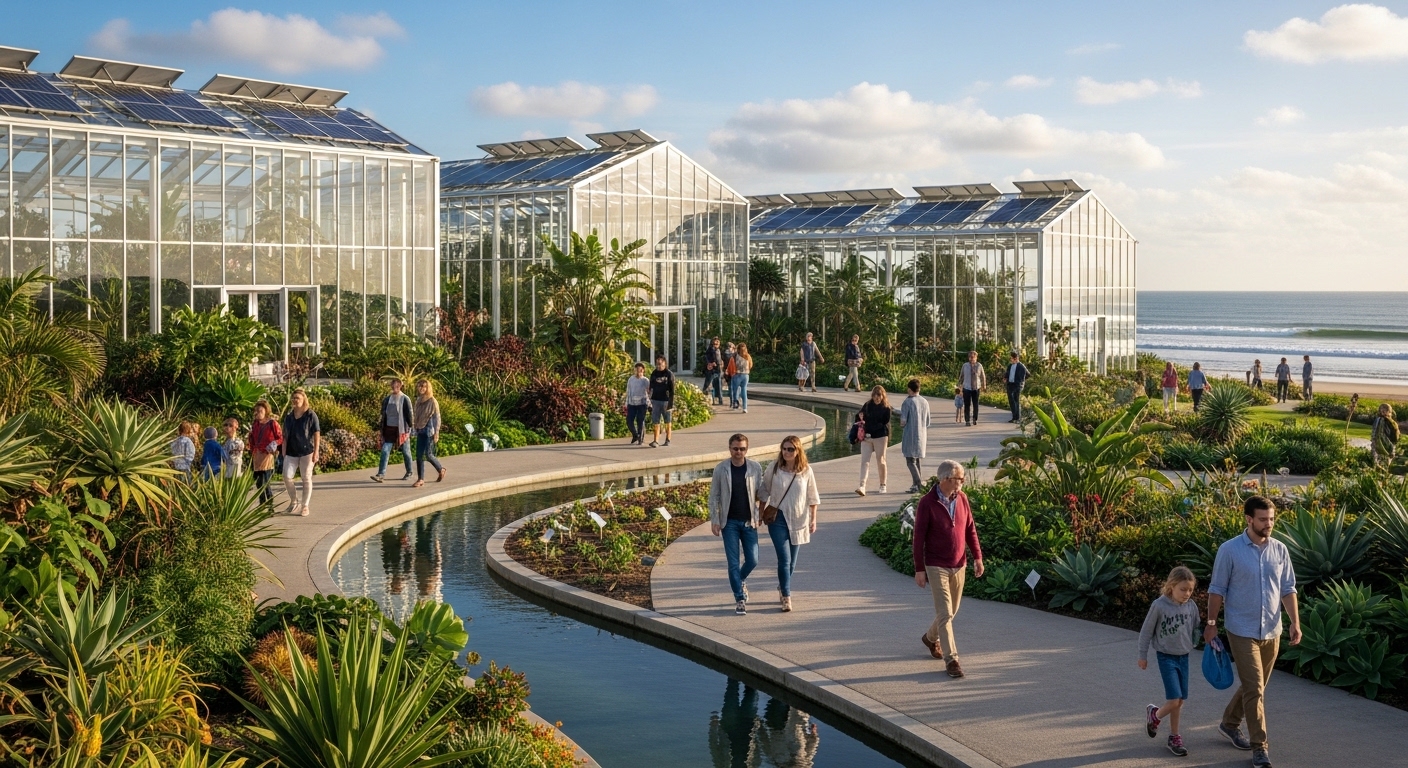
Imagine walking through a coastal park filled with plants, ponds, glass structures, and solar panels, knowing that the entire space is quietly producing drinking water using nothing but sunlight and saltwater. These gardens are not just infrastructure. They are part power plant, part water factory, and part public art. They show how cities can address real-world problems without sacrificing beauty or community engagement.
Have you ever thought about where your water really comes from? And how different city life would feel if water itself became a visible part of the landscape instead of hidden underground in pipes?
What Are Solar Desalination Gardens?
Solar desalination gardens are landscaped systems that use solar energy to remove salt from seawater through natural evaporation and condensation. Instead of relying on large industrial plants, these gardens distribute the process across open-air structures, greenhouses, and planted zones.
The basic principle is simple. Sunlight heats seawater, causing it to evaporate. Salt and impurities remain behind, while clean water vapor rises, cools, and condenses into freshwater. This freshwater is then collected, stored, and either used for irrigation, public fountains, or even municipal water supplies.
What makes solar desalination gardens by the coast special is that they are designed to look like parks, botanical gardens, or art installations. Visitors can walk through them, learn from them, and interact with water systems in ways that feel natural rather than industrial.
Why Coastal Cities Are Turning to Solar Desalination
Coastal cities face growing challenges: rising populations, climate change, groundwater depletion, and saltwater intrusion into freshwater aquifers. Traditional desalination plants consume massive amounts of energy and often generate environmental concerns.
Solar desalination gardens offer a softer alternative. They produce less water than mega plants, but they do so sustainably, locally, and visibly. Instead of one massive facility, a city can build dozens of small water-producing landscapes spread across its coastline.
These systems are especially valuable in regions with abundant sunlight and limited freshwater access. Countries across the Middle East, North Africa, Australia, and Southern Europe are experimenting with solar-based water systems to reduce dependence on fossil fuels and centralized infrastructure.
Would you rather see a concrete industrial plant on your shoreline, or a living garden that produces water while people relax, learn, and explore?

Real-World Examples of Solar Desalination Gardens
Several cities and research institutions are already bringing this concept to life.
In Saudi Arabia, the King Abdullah University of Science and Technology has developed solar desalination greenhouses that combine agriculture with water production. These systems grow crops using water generated entirely from seawater and sunlight.
In Australia, the Commonwealth Scientific and Industrial Research Organisation (CSIRO) has tested solar thermal desalination systems integrated into coastal landscapes, exploring how public parks can double as water infrastructure.
In Spain, experimental desalination gardens have been built along the Mediterranean coast as part of climate adaptation projects. These spaces serve both tourists and local communities, showing how renewable water systems can become part of urban culture.
Even small island nations are exploring solar desalination gardens as a way to reduce reliance on imported water and expensive fuel-based desalination plants.
How These Gardens Actually Work
Although designs vary, most solar desalination gardens use a combination of the following elements:
- Shallow seawater pools or channels
- Transparent greenhouse roofs
- Solar collectors or panels
- Condensation surfaces
- Freshwater storage tanks
- Salt-tolerant plants and wetlands
Sunlight enters the system through glass or transparent plastic, heating seawater inside enclosed spaces. As the water evaporates, vapor rises and condenses on cooler surfaces, where it is collected as freshwater.
The leftover saltwater becomes more concentrated and is either diluted again with fresh seawater or used for salt harvesting and marine aquaculture.
Plants play a key role. They cool the environment, stabilize temperatures, and often use part of the produced freshwater for irrigation, creating self-sustaining ecosystems.
This is why solar desalination gardens by the coast are often described as living machines rather than mechanical factories.
Why These Gardens Are Also Public Art
One of the most powerful aspects of solar desalination gardens is their visual impact. Unlike hidden infrastructure, these systems invite curiosity. People see water flowing, evaporating, condensing, and being reused in real time.
Some designers treat these spaces as environmental art. Sculptural glass roofs, reflective pools, interactive fountains, and educational displays turn technical systems into cultural landmarks.
In places like Dubai and Abu Dhabi, experimental solar gardens are being designed not just to produce water, but to symbolize future sustainability and climate resilience.
Would climate change feel more real if people could physically see how much work it takes to produce a single liter of freshwater?
Tourism Potential of Solar Desalination Gardens
These gardens are quickly becoming tourist attractions. Travelers increasingly seek experiences that combine learning, sustainability, and aesthetics.
Instead of visiting traditional museums, visitors can walk through water-producing landscapes, take guided tours, and understand how cities are preparing for environmental challenges.
Tourism boards like Visit Dubai and Tourism Australia already highlight eco-architecture and sustainability parks as part of their travel narratives.
Solar desalination gardens fit perfectly into this emerging category of meaningful travel—where visitors learn something real while enjoying beautiful spaces.

Environmental Benefits Beyond Water
These gardens do more than produce freshwater. They:
- Reduce carbon emissions compared to fossil-fuel desalination
- Create microclimates that cool coastal cities
- Support biodiversity through wetlands and plant systems
- Act as flood buffers and erosion protection
- Provide educational platforms for climate literacy
They also encourage decentralized infrastructure. Instead of relying on massive centralized systems that can fail catastrophically, cities can distribute water production across multiple small sites.
This resilience is becoming increasingly important in an era of climate uncertainty.
Challenges and Limitations
Despite their promise, solar desalination gardens are not a universal solution.
They require large land areas, especially for meaningful water output. They produce less water than industrial plants. They also depend heavily on climate conditions—cloudy or cold regions may struggle to generate sufficient output.
Maintenance can be complex, as salt buildup, algae growth, and system calibration require ongoing care.
However, as part of a broader water strategy, these gardens can significantly reduce pressure on existing water systems while educating the public.
The Future of Coastal Cities and Water Design
As sea levels rise and freshwater becomes scarcer, the idea of hiding water systems underground may become obsolete.
Future cities may treat water as a visible, celebrated element of public life—something people see, touch, learn from, and respect.
Solar desalination gardens by the coast represent a shift in thinking. Water is no longer just a utility. It becomes architecture, landscape, and culture.
Imagine children growing up in cities where parks produce drinking water, where science is part of playgrounds, and where sustainability is something you walk through every day.
Is this the future of urban living—or should it already be our present?
We would love to hear your thoughts. Would you visit a solar desalination garden? Should cities invest more in visible environmental infrastructure? Share your perspective in the comments below.
Follow WentWorld.com on social media for more stories about innovative cities, future travel, and the fascinating ways humans are redesigning the planet.
Catch up on the top stories and travel deals by subscribing to our newsletter!