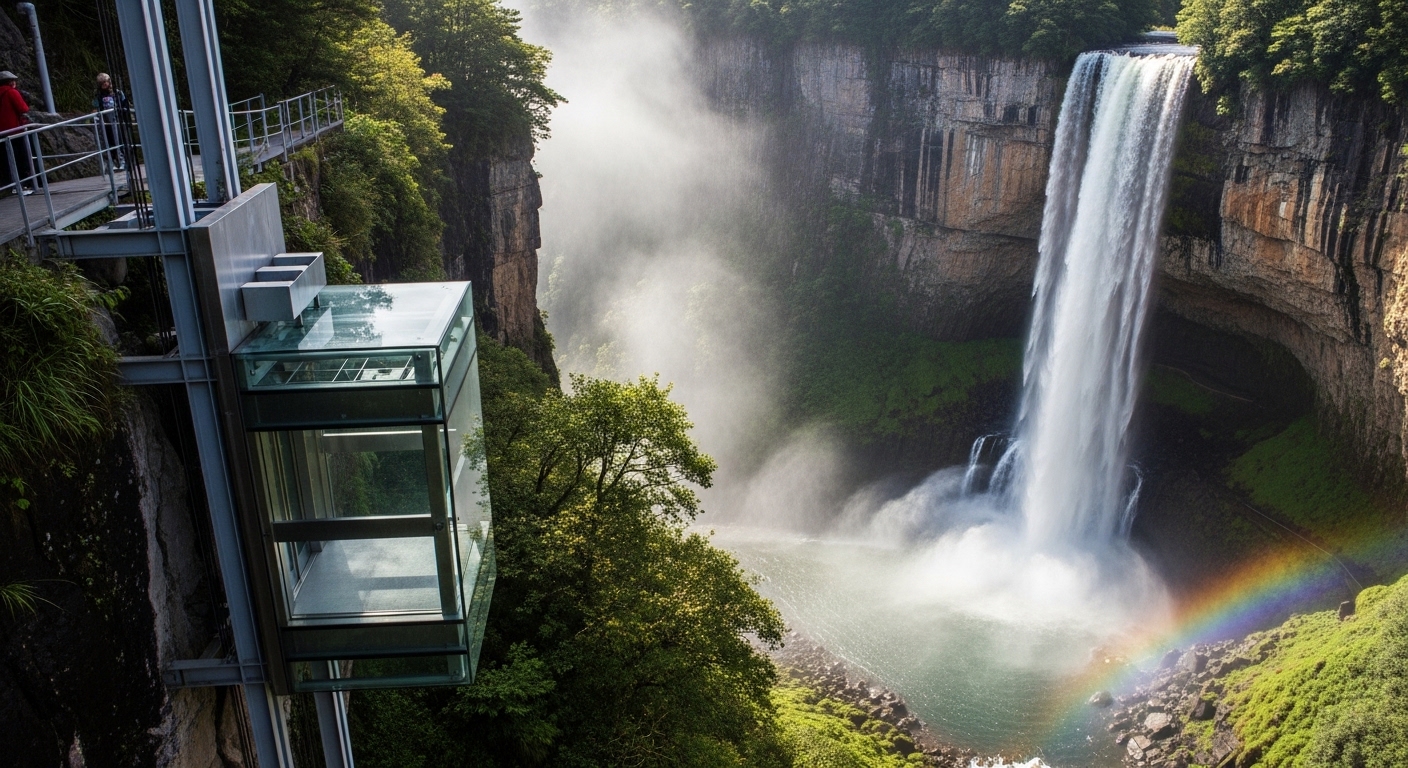
There are few travel experiences as surreal as stepping into a moving cabin that rises beside a roaring waterfall, climbing vertically through solid rock while mist touches your face. Waterfall elevators carved into cliffs represent one of the most fascinating intersections between nature and human engineering. They are not just transport systems; they are experiences that make your heart beat a little faster and your perspective shift entirely.
Imagine this for a moment. You are standing at the base of a massive cliff. Water is crashing down beside you, echoing through the valley. Instead of hiking for hours or climbing endless staircases, you walk into an elevator carved directly into the rock face. As the doors close and the cabin begins to rise, you are lifted through layers of stone, mist, and light. The world below slowly shrinks while the horizon opens up in front of you.
These structures feel almost mythical, like something taken from a fantasy novel. Yet they exist in real places across the world, built to conquer impossible terrain and give access to landscapes once reserved for elite climbers or locals. In this WentWorld.com exploration, we dive deep into the story of waterfall elevators carved into cliffs, why they exist, where you can find them, and why they leave such a powerful emotional impact on travelers.
Why Waterfall Elevators Feel So Unreal
The human brain is wired to associate vertical cliffs with danger and waterfalls with raw power. When you combine both and then place a glass cabin between them, the result is something deeply unsettling yet irresistibly fascinating. Waterfall elevators carved into cliffs disrupt our natural expectations of movement and space.
Instead of climbing the mountain, the mountain seems to open itself to you. Instead of avoiding the waterfall, you travel alongside it. The sound of water becomes your soundtrack. The vibration of falling streams becomes part of the journey.
Have you ever experienced a moment where fear and wonder exist at the same time? These elevators often create exactly that feeling. You feel completely safe, yet deeply aware of the immense forces of nature surrounding you.
The Engineering Behind Vertical Wonders
Building waterfall elevators carved into cliffs is one of the most complex feats of civil engineering. These systems require cutting through solid rock, stabilizing massive cliff faces, and installing machinery capable of operating in humid, high-pressure environments.
Engineers must consider constant exposure to water, erosion risks, seismic stability, and wind pressure. Unlike city elevators, these are exposed to temperature changes, moisture infiltration, and natural vibrations. Every bolt and cable must withstand years of environmental stress.
Most of these elevators are built not for luxury, but necessity. They provide access to sacred sites, natural parks, mountain villages, and tourism hubs that would otherwise require exhausting climbs. In some cases, they are the only practical way for elderly visitors or disabled travelers to experience these landscapes.

Bailong Elevator, Zhangjiajie, China
Perhaps the most famous example of waterfall elevators carved into cliffs is the Bailong Elevator in Zhangjiajie National Forest Park, China. Often called the world’s tallest outdoor elevator, it rises over 300 meters up a sheer sandstone cliff.
As the elevator ascends, visitors witness forests, rock pillars, and cascading water streams flowing down the cliff face. The cabin itself is partially glass, allowing panoramic views during the ride. The sensation is almost cinematic, as if you are floating upward through a living painting.
The region gained global recognition after inspiring landscapes in the film Avatar. Tourism platforms like Lonely Planet regularly rank Zhangjiajie among the world’s most surreal destinations.
Guatapé Rock Elevator, Colombia
El Peñol de Guatapé in Colombia is a massive granite monolith rising dramatically from surrounding lakes. Traditionally, visitors climbed over 700 steps to reach the summit. But in recent years, an elevator carved into the rock has made the ascent accessible to more travelers.
What makes this location unique is the combination of still water below and vertical stone above. On rainy days, small waterfalls form along the rock surface, creating a natural curtain beside the elevator shaft.
Colombia’s tourism growth, supported by airlines like Avianca, has brought international attention to such engineering marvels hidden within natural landmarks.
Sigiriya Rock Fortress Lift, Sri Lanka
Sigiriya, an ancient rock fortress in Sri Lanka, is another place where modern engineering meets historical wonder. While most visitors still climb stairways, experimental lift systems have been proposed and partially implemented to assist mobility.
During monsoon seasons, waterfalls stream down the rock face, transforming the climb into a misty vertical journey. Standing inside a lift while ancient frescoes and flowing water surround you creates a rare blend of history, nature, and innovation.
Information from UNESCO highlights Sigiriya as one of the world’s most significant archaeological sites, making accessibility an important concern.
Emotional Impact of Vertical Travel
Traveling inside waterfall elevators carved into cliffs is not just physically impressive; it is emotionally powerful. The slow vertical movement forces reflection. You are not rushing from one place to another. You are witnessing transition.
As you rise, the sound of water shifts. The light changes. The air cools. The landscape transforms beneath your feet. This gradual movement creates a meditative state rarely found in modern travel.
Many travelers describe a sense of vulnerability inside these elevators. You are enclosed in glass, surrounded by rock and falling water. Yet that vulnerability often leads to deeper appreciation rather than fear.
Have you ever experienced a journey where the movement itself felt more meaningful than the destination?
Why These Structures Exist
Waterfall elevators carved into cliffs exist for three main reasons: accessibility, safety, and conservation.
First, they allow people of all ages and physical abilities to access landscapes previously limited to elite hikers. Second, they reduce accidents caused by dangerous staircases or slippery trails. Third, they help preserve natural environments by concentrating visitor movement into controlled pathways.
Instead of thousands of feet damaging fragile ecosystems, a single vertical shaft guides traffic responsibly. Organizations like World Wildlife Fund support such solutions when implemented sustainably.

The Psychological Effect of Height and Water
Psychologists note that height triggers awareness of mortality, while water triggers emotional calm. When combined, they produce a powerful cognitive experience. You feel small, yet safe. Exposed, yet protected.
This may explain why people remember these journeys so vividly. Long after forgetting hotel names or restaurant meals, they remember the moment the elevator doors opened at the top of a cliff, with mist drifting past and silence replacing thunder.
These moments stay with you because they challenge perception. You realize that movement itself can be meaningful.
Planning a Visit to Waterfall Elevators
If you plan to experience waterfall elevators carved into cliffs, timing matters. Early mornings offer calmer conditions and fewer crowds. Rainy seasons enhance waterfall effects but may reduce visibility.
Safety rules should always be respected. Do not lean excessively, do not shake cabins, and avoid distractions. These systems are marvels of engineering, but nature remains unpredictable.
Travel resources like National Geographic often recommend such sites as examples of responsible adventure tourism.
Why These Places Matter in a Changing World
In a world dominated by screens and speed, waterfall elevators carved into cliffs remind us that awe still exists. They show how humans can adapt to nature without conquering it.
They represent balance: engineering that respects terrain, tourism that preserves ecosystems, and travel that prioritizes experience over consumption.
These structures prove that progress does not have to erase beauty. Sometimes, it can amplify it.
We would love to hear your thoughts. Have you ever traveled using a vertical lift in a natural environment? Did it feel thrilling or unsettling? Share your experience and reflections with us.
If stories like this inspire your sense of wonder, follow WentWorld.com on our social media platforms and stay connected with journeys that reveal the world’s most extraordinary pathways.
Catch up on the top stories and travel deals by subscribing to our newsletter!