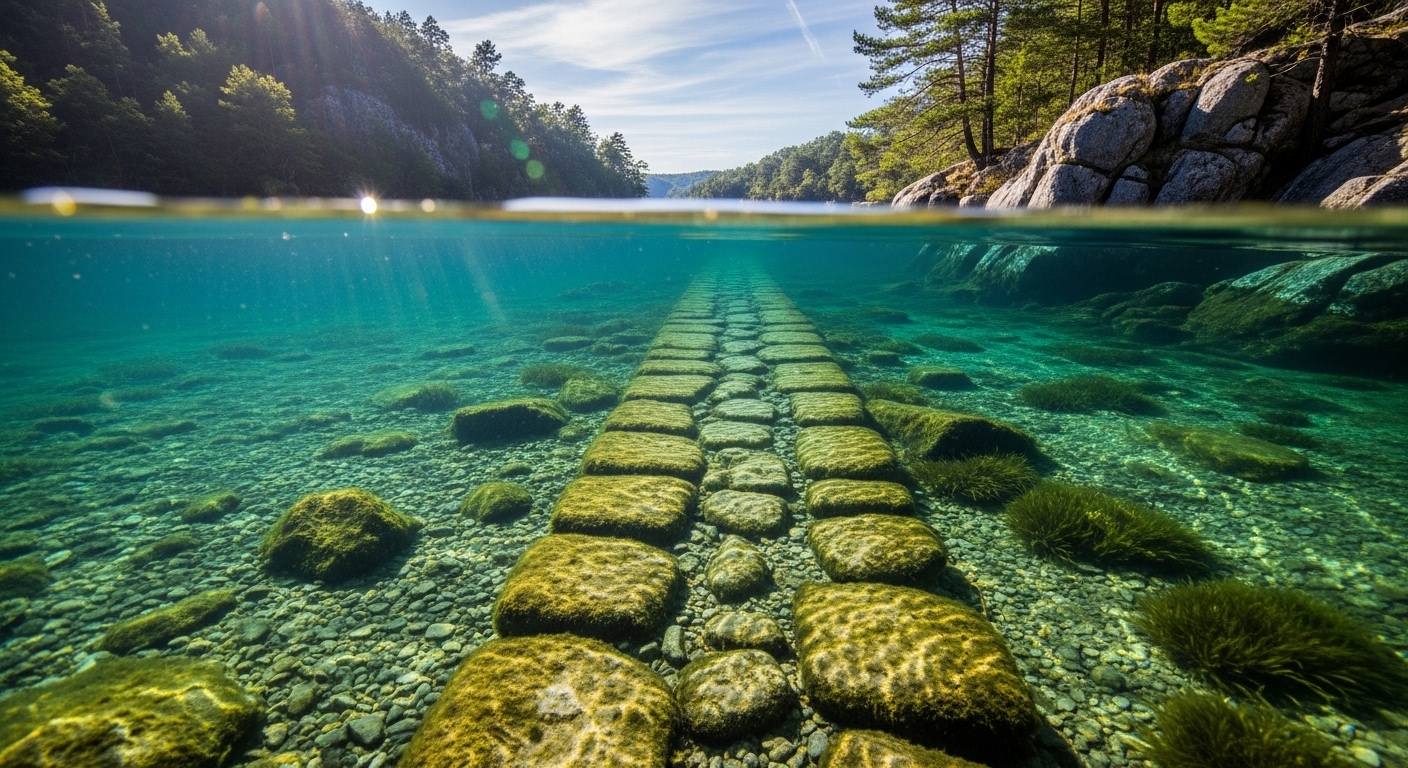
There is something hauntingly beautiful about sunken Roman roads visible in clear lakes. These ancient highways, once alive with soldiers, merchants, and messengers, now lie quietly beneath glassy water surfaces. In certain parts of the world, when lakes are calm and clear, you can actually see the outlines of Roman stone roads stretching into the depths like forgotten time corridors.
Imagine standing on a lakeshore, peering down into water so transparent it feels unreal, and realizing that what you are looking at is not just rocks or shadows but a road built nearly two thousand years ago. A road that once carried entire empires. Have you ever experienced a moment where history felt physically close enough to touch?
These submerged routes are not myths or artistic interpretations. They are real, documented remnants of Roman engineering, preserved accidentally by nature itself. As water levels rose or landscapes shifted over centuries, some Roman roads slipped beneath lakes, turning into underwater museums that few people even know exist.
Why Roman Roads Were Built to Last
To understand why sunken Roman roads visible in clear lakes still exist today, you first need to understand how the Romans built roads. Roman engineers did not simply lay stones on soil. They constructed layered systems using gravel, sand, mortar, and massive stone slabs. These roads were designed to support heavy military transport and endure centuries of use.
Roman roads were so well designed that many modern European highways still follow their original routes. The Romans measured distances with remarkable accuracy and built drainage systems to prevent water damage. Ironically, it is water that ended up preserving some of these roads by submerging them instead of eroding them.
Would modern infrastructure survive two thousand years underwater? It is an uncomfortable question, and one that highlights just how advanced Roman engineering truly was.
Lake Bolsena, Italy
One of the most famous examples of sunken Roman roads visible in clear lakes can be found in Lake Bolsena in central Italy. This volcanic lake sits near several ancient Roman settlements, including the old city of Volsinii.
During periods of low water and perfect light conditions, stone road segments become visible beneath the surface. Divers and archaeologists have confirmed the existence of Roman pathways leading toward submerged ruins and harbors.
Italy remains one of the richest countries for Roman archaeological sites, and organizations like Italia.it actively promote heritage tourism across the region. Yet even here, most visitors have no idea that Roman roads lie hidden underwater.
Lake Bracciano, Italy
Not far from Rome itself, Lake Bracciano holds another remarkable secret. This lake once supported ancient settlements and transportation routes connected directly to the Roman capital.
In recent years, drought conditions lowered water levels enough to reveal parts of Roman stone roads along the lakebed. The structures appeared almost intact, with rectangular paving stones still aligned in precise patterns.
Seeing a Roman road reappear after centuries underwater is a reminder that history is never really gone. It is simply waiting for the right moment to resurface.

Lake Van, Turkey
Lake Van, one of the largest lakes in the Middle East, holds submerged ruins linked to Roman and pre-Roman civilizations. While not entirely Roman in origin, some underwater routes and harbor structures show strong influence from Roman engineering techniques.
Underwater exploration teams have discovered walls, roads, and foundations beneath the lake’s surface. The clarity of the water allows some of these structures to be visible even without diving equipment.
Turkey’s tourism authority, through GoTürkiye, highlights the country’s layered history, but few realize that some of its most fascinating ruins are invisible unless you look beneath the water.
How Lakes Preserve Ancient Infrastructure
It might seem strange, but water can sometimes preserve structures better than air. When roads are submerged in calm, low-oxygen environments, they are protected from temperature fluctuations, erosion, and human interference.
Clear lakes with stable conditions act like natural storage vaults. Algae growth is limited, currents are weak, and sediment slowly covers the stone without destroying it. This is why sunken Roman roads visible in clear lakes often appear surprisingly intact.
Do you find it comforting or unsettling that some of humanity’s greatest achievements are now safer underwater than on land?
The Emotional Power of Underwater History
There is a unique emotional impact to seeing historical infrastructure underwater. It feels different from visiting ruins on land. Underwater ruins feel more secret, more fragile, and more intimate.
Looking at a sunken Roman road through clear water creates a sense of silent continuity. These stones were once walked on by people with lives, dreams, fears, and ambitions, just like us. Now they rest beneath lakes, untouched, invisible to most of the world.
Have you ever thought about how many stories are hidden beneath places we assume are empty?
Modern Technology and Underwater Archaeology
Advances in underwater scanning, sonar imaging, and remote-operated vehicles have revolutionized underwater archaeology. Institutions like National Geographic regularly document discoveries of submerged cities, roads, and ports.
In the case of Roman roads, modern mapping tools allow archaeologists to trace entire networks beneath lakes without disturbing them. This helps preserve these sites while still making them accessible to researchers.
Some scientists even use satellite imagery from programs associated with NASA to detect underwater patterns in shallow lakes and coastal regions.

Why These Sunken Roads Matter Today
Sunken Roman roads visible in clear lakes are more than just historical curiosities. They are symbols of human resilience, adaptability, and ambition.
They remind us that civilizations rise and fall, landscapes change, and what seems permanent is often temporary. The Roman Empire once dominated Europe, North Africa, and the Middle East. Now, some of its greatest achievements lie quietly beneath water.
In a world obsessed with future technologies and rapid progress, these submerged roads invite us to reflect on what truly lasts.
Visiting Without Harming the Past
If you ever visit lakes with submerged ruins, remember that these sites are fragile. Touching, walking, or disturbing underwater structures can cause irreversible damage.
Organizations like UNESCO actively promote the protection of underwater cultural heritage, encouraging observation rather than interaction.
The best way to experience sunken Roman roads is through guided tours, museum exhibits, and responsible diving programs that prioritize conservation.
A Different Kind of Travel Experience
Traveling to see sunken Roman roads visible in clear lakes is not about adrenaline or luxury. It is about curiosity, patience, and perspective.
These experiences appeal to travelers who enjoy slow exploration and meaningful discovery. They offer something rare: a chance to witness history in its quietest form.
At WentWorld.com, we believe that the most powerful journeys are not always the loudest or most famous ones. Sometimes they happen beneath still water, hidden in plain sight.
We would love to hear from you. Have you ever seen submerged ruins, whether Roman or otherwise? Did it change how you view history or travel? Share your thoughts with us.
Follow WentWorld.com on our social media platforms for more stories that uncover the extraordinary layers of our planet, from desert reflections to underwater empires.
Catch up on the top stories and travel deals by subscribing to our newsletter!