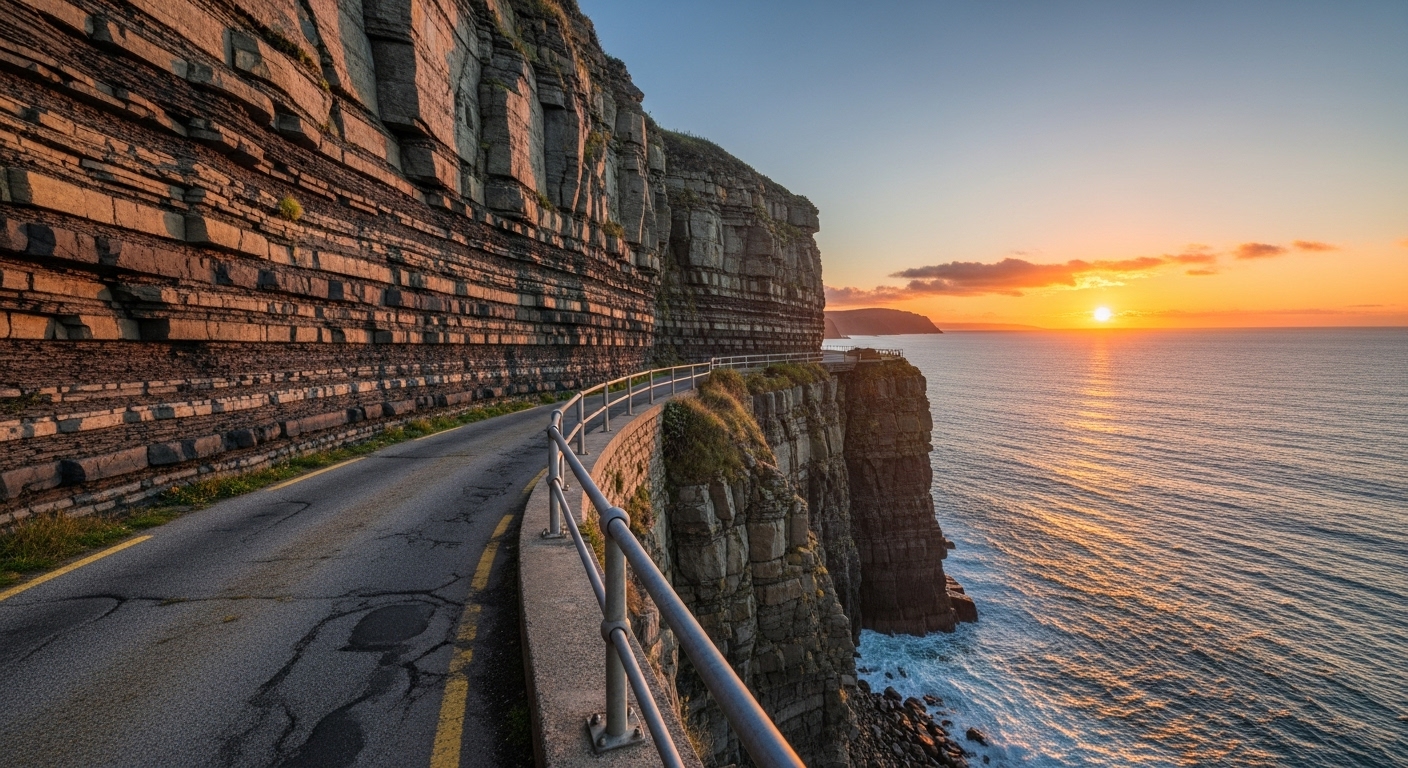
There is something irresistibly intense about driving along the world’s best cliff-edge roads with safety rails. The road curves tightly along towering rock faces while thousands of feet of empty air stretch endlessly just beyond a narrow metal barrier. The engine hums. The wind howls. The ocean crashes or the valley vanishes below. In that moment, travel stops feeling ordinary and begins to feel unforgettable.
For some people, these roads represent danger. However, for others, they represent absolute freedom. They are physical reminders of humanity’s determination to conquer impossible terrain without surrendering to recklessness. Importantly, safety rails transform sheer terror into calculated thrill.
So what makes the world’s best cliff-edge roads with safety rails so magnetic? Is it the engineering? The arrogance of construction? The cinematic views? Or is it something more emotional — the human desire to flirt with fear while remaining protected?
Why cliff-edge roads exist in the first place
Long before tourism existed, cliff-edge roads served pure survival. Coastal trade routes, mountain supply paths, war logistics, and inter-village connections all demanded access through impossible landscapes. Therefore, early engineers carved roads where nature offered no mercy.
As technology improved, these raw survival roads transformed into modern travel icons. Consequently, safety rails became the thin line that separates terror from accessibility. Without them, most of these roads would remain inaccessible to everyday travelers.
Interestingly, many of today’s scenic cliff-edge highways still follow ancient trade paths first cut by hand centuries ago.
The psychological effect of driving beside empty air
The human brain responds strongly to perceived vertical danger. When a driver sees open sky beside their door instead of solid land, adrenaline spikes instantly. Heart rate rises. Focus sharpens. Awareness intensifies.
However, the presence of safety rails quietly reassures the subconscious. While fear remains alive, panic stays subdued. As a result, drivers experience controlled exhilaration rather than full terror.
This delicate psychological balance is exactly why the world’s best cliff-edge roads with safety rails feel addictive rather than traumatic.
How modern safety rails transform deadly routes into global attractions
Early cliff roads offered little protection beyond prayer. Today, advanced steel barriers, reinforced concrete rails, dynamic impact-absorbing systems, and smart sensors protect travelers from fatal errors.
Therefore, modern safety rails do not simply block vehicles. They absorb energy, redirect motion, and reduce catastrophic momentum. Consequently, roads once known only for death have become celebrated symbols of precision engineering.
Organizations such as National Geographic, Lonely Planet, Michelin Travel Guides, Roadtrippers, and UNESCO continue showcasing these roads as global wonders rather than danger zones.
Norway’s Atlantic Ocean Road and the illusion of floating
Among the world’s best cliff-edge roads with safety rails, Norway’s Atlantic Ocean Road stands apart. Rather than hugging cliffs directly, it dances across open sea between rugged coastal islands. Yet the emotional effect remains identical.
Massive waves frequently crash against bridge pylons during storms. Meanwhile, safety rails shield drivers from lateral wind forces that would otherwise push vehicles into open water. During storms, visibility shrinks. Water rises. Wind screams. However, the safety design holds firm, proving how modern engineering tames chaos rather than challenges it recklessly.
Italy’s Amalfi Coast and controlled chaos along vertical beauty
The Amalfi Coast in Italy features one of Europe’s most dramatic cliff-hugging road systems. Houses cling to vertical rock. Buses squeeze through impossible bends. Meanwhile, deep sapphire water glows thousands of feet below.
Here, safety rails work in combination with stone walls, convex mirrors, and driver discipline. The roadway itself remains narrow and unforgiving. However, protection exists exactly where mistakes would become fatal.
Rather than removing danger entirely, the Amalfi road compresses it into a controlled experience of beauty and fear.

China’s Guoliang Tunnel Road and vertical defiance
Carved directly through a cliff face by hand, Guoliang Tunnel Road represents one of the most intense examples of the world’s best cliff-edge roads with safety rails. Open windows cut into stone reveal massive drops beyond dripping rock walls.
Originally built with no true safety infrastructure, the road later received reinforced railings to accommodate rising tourism. Therefore, today’s travelers witness raw survival engineering stabilized by modern protection.
The tunnel stands not just as a road but as a vertical monument to determination.
California’s Big Sur and graceful exposure above the Pacific
Highway 1 through Big Sur offers a comparatively gentle version of cliff-edge driving. Smooth curves sweep above crashing Pacific waves. Redwood forests lean over exposed headlands. Meanwhile, safety rails line nearly every open drop.
Unlike harsher mountain routes, Big Sur’s danger feels poetic rather than severe. Nevertheless, the engineering challenge remains enormous as erosion, landslides, and coastal collapse continuously threaten road stability.
Thus, safety rails here serve not only travelers but the road itself by stabilizing shifting terrain.
Japan’s Irohazaka Roads and stacked terror management
Japan’s Irohazaka Roads ascend steep mountain slopes through tightly stacked switchbacks. Here, cliff-edge danger multiplies vertically as roads pass above and below one another.
In this environment, safety rails do more than prevent falls. They guide visual perception, limit overcorrection, and stabilize driver orientation during extreme elevation change.
As a result, even novice drivers can navigate routes that once challenged professional mountain transporters.
Engineering challenges specific to cliff-edge safety systems
Installing safety rails along vertical rock faces demands precision far beyond roadside installation. Engineers must anchor supports into unstable geological layers while accounting for wind, vibration, freeze-thaw cycles, and erosion.
Moreover, dynamic impact testing must account for downward momentum rather than horizontal collision alone. Therefore, cliff-edge rails are reinforced differently than flat-road barriers.
Failure is not an option when gravity waits directly beside the pavement.
Weather as the invisible threat on exposed roads
Weather transforms every cliff-edge road. Rain reduces traction. Fog erases depth perception. Ice multiplies inertia. Wind pushes sideways. Heat expands metal. Cold contracts stone.
Therefore, safety systems remain in constant battle with climate. Smart road sensors now monitor vibration, moisture, and movement in real time. When instability rises, closures prevent catastrophe.
Thus, modern cliff-edge safety is both physical and digital.
Tourism pressure and the need for stronger rail systems
As global awareness of the world’s best cliff-edge roads with safety rails grows, tourism explodes. More vehicles, heavier loads, impatient drivers, and rental traffic increase collision risk.
Therefore, many regions now reinforce older rails with double-layer steel, impact absorption cylinders, and automated vehicle detection warning systems. Scenic exposure comes with growing responsibility.

Do safety rails reduce fear or intensify it?
Psychologically, safety rails create a unique paradox. While they offer protection, they also highlight danger by clearly marking the edge. Drivers become constantly aware of the drop beyond.
Therefore, fear does not disappear. Instead, it becomes sharpened and cinematic. The rail draws a literal line between survival and gravity. This is why photos taken on these roads feel so dramatic. The safety rail frames the void.
Motorcycles, bicycles, and exposure multiplication
While cars benefit most from safety rails, two-wheeled travelers face different risk levels. Motorcycles interact differently with wind shear. Bicycles lack physical protection.
Therefore, safety rails often determine whether two-wheel travel remains possible at all. Without them, crosswinds alone would make passage suicidal on many cliff routes. Even with protection, expert control remains non-negotiable.
Economic lifelines created by dangerous beauty
Many cliff-edge roads exist not merely for thrill but for survival economies. Remote coastal villages, mountain farms, tourism-dependent communities, and emergency services rely on these connections.
Thus, safety rails do not protect tourists alone. They protect medical transport, food supply, and disaster response lifelines. Without these roads, entire populations would face isolation.
The cinematic legacy of cliff-edge roads
Filmmakers have long understood the emotional power of exposed roads. Countless chase scenes, contemplative driving sequences, and thrill moments rely on cliff exposure to communicate vulnerability.
Here again, safety rails operate invisibly. Actors appear inches from death. Production crews operate within strict safety systems hidden from the final frame. Danger becomes art through protection.
Cultural symbolism of roads carved into cliffs
Across cultures, cliff-edge roads symbolize defiance against limitation. They represent community survival against isolation. They reflect national identity through engineering triumph.
In some regions, roads themselves become pilgrimage destinations. In others, they remain expressions of quiet survival. Regardless of use, safety rails turn survival into sustainability.
Are future cliff-edge roads becoming safer or more extreme?
Modern infrastructure allows engineers to push routes deeper into impossible terrain than ever before. Therefore, new cliff-edge roads appear in locations once deemed unreachable.
However, safety systems evolve at the same speed. Smart barriers, drone-monitored slopes, predictive landslide modeling, and AI-based sensor grids now guard routes before danger manifests physically. The future does not reduce exposure. It manages it intelligently.
Some would. Others might fade slowly into obscurity. Tourism revenue now finances constant reinforcement, monitoring, and modernization. Therefore, travelers indirectly fund their own protection when exploring the world’s best cliff-edge roads with safety rails.
The world’s best cliff-edge roads with safety rails sit at the intersection of fear, beauty, engineering, and human obsession with extremes. They are not merely roads. They are suspended conversations between gravity and motion. Each safety rail marks humanity’s refusal to surrender to vertical limits while acknowledging danger honestly rather than denying it.
We would love to hear from you. Would you drive one of these roads? Or would you prefer to admire them from a distance? Which location feels most tempting to your adventurous side? Share your perspective and become part of this global conversation. If stories of extreme travel, rare engineering, and hidden world wonders inspire you, follow WentWorld on social media for unforgettable journeys, unusual destinations, and the edges of possibility.
Catch up on the top stories and travel deals by subscribing to our newsletter!