
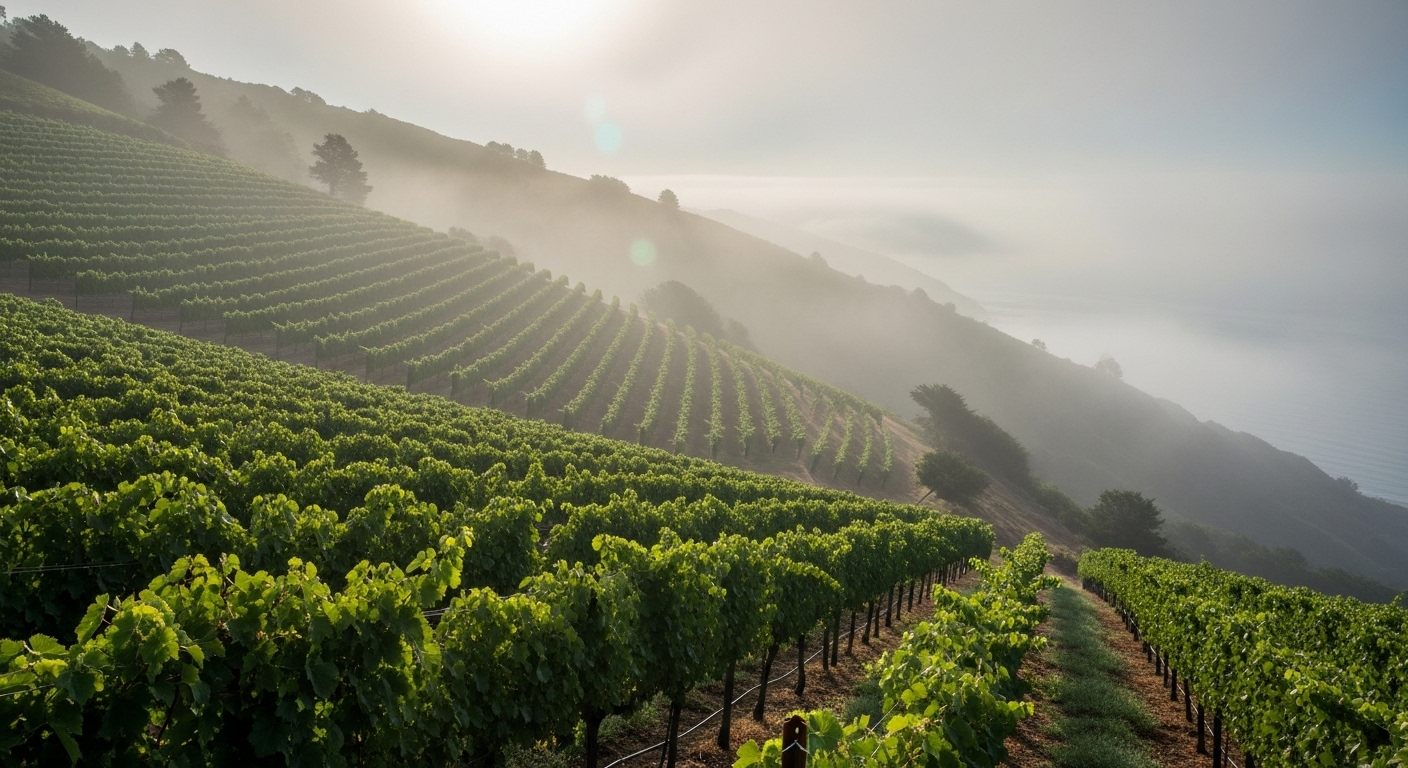
Imagine vineyards flourishing in places where rainfall is scarce, irrigation is forbidden, and yet grapes grow with incredible depth and complexity. This is the quiet miracle of fog-fed vineyards without irrigation, where coastal mist replaces sprinklers, and nature becomes the sole water source for wine. These vineyards are some of the most fascinating agricultural experiments on Earth, proving that great wine doesn’t always need rivers, pumps, or heavy rainfall.
Fog-fed vineyards exist in regions where traditional farming would seem impossible. Instead of depending on rain or artificial irrigation, these vineyards capture moisture from ocean fog, which drifts inland and gently nourishes the vines. The result is wine shaped not by technology, but by climate, geography, and patience.
Would you believe that some of the world’s most celebrated wines grow in landscapes that look closer to deserts than farmland?
What Are Fog-Fed Vineyards Without Irrigation?
Fog-fed vineyards without irrigation rely entirely on atmospheric moisture rather than direct water sources. Fog condenses on vine leaves, soil, and surrounding vegetation, slowly dripping down into the ground. Over time, deep-rooted vines learn to survive on this limited but consistent moisture supply.
Unlike irrigated vineyards, these vines grow roots that plunge several meters into the earth, seeking ancient underground water reserves. This forces vines to struggle, and that struggle often produces smaller grapes with more concentrated flavors.
Winemakers believe this stress creates wines with stronger character, higher mineral content, and greater aging potential. In other words, less water often means more personality.
Why Winemakers Avoid Irrigation on Purpose
In many wine regions, irrigation is legal but intentionally avoided. Some countries even ban it altogether in premium appellations. The reason is simple: irrigation can dilute flavors and encourage excessive grape yields.
Fog-fed vineyards create natural limitations. Vines cannot overproduce. They must focus energy into fewer grapes, resulting in richer aromas, deeper colors, and more structured wines.
This philosophy is deeply rooted in European wine traditions, especially in places like Bordeaux and parts of California, where dry farming has been practiced for centuries.
Do you think luxury products should always rely more on natural limits than technological efficiency?

Chile’s Coastal Vineyards and the Power of Fog
Chile is one of the most impressive examples of fog-fed vineyards without irrigation. Along the Pacific coast, especially in the Casablanca and Limarí valleys, cold ocean currents generate thick morning fog that rolls over vineyards daily.
This fog provides enough moisture to sustain vines even in semi-desert conditions. Combined with cool temperatures, it produces elegant wines with crisp acidity and complex aromatics.
Some of the best examples come from wineries near Chile’s coastal wine routes, where Sauvignon Blanc and Pinot Noir thrive almost entirely on fog.
Standing in these vineyards feels surreal. Dry soil under your feet, blue skies above, yet invisible water floating through the air.
The Atacama Desert: Growing Wine at the Edge of Possibility
The Atacama Desert is considered the driest non-polar place on Earth. Yet, experimental vineyards near its coastal edges survive using fog alone. Known locally as “camanchaca,” this dense fog acts as the region’s only reliable water source.
Vines here are planted strategically to capture maximum fog exposure. Some even use mesh fog nets nearby to increase condensation in the surrounding environment.
These wines are rare, expensive, and often produced in extremely limited quantities. But they prove that fog-fed vineyards without irrigation can exist even in the most hostile climates.
Would you taste a wine grown where rain may not fall for years?
California’s Dry-Farmed Coastal Vineyards
California is home to some of the world’s most respected fog-dependent vineyards. Regions like Sonoma Coast, Santa Cruz Mountains, and parts of Monterey rely heavily on ocean fog.
Here, cold marine air flows inland every evening, cooling vines and depositing moisture on leaves. Many vineyards legally avoid irrigation to maintain traditional dry-farming practices.
Wineries promoted through California Wine Institute often highlight fog-fed cultivation as a sustainability badge.
Not only does fog reduce water usage, it also protects grapes from heat stress, preserving delicate aromas and acidity.
Canary Islands: Ancient Vines and Volcanic Fog
On the Canary Islands, vineyards grow in black volcanic soil where rainfall is minimal. Fog drifting from the Atlantic provides essential moisture.
Some vines are over 200 years old, surviving purely through fog capture and underground condensation. These are among the most dramatic examples of fog-fed vineyards without irrigation.
The landscape looks alien: dark lava fields, deep vine pits, and constant mist swirling over steep hillsides.
Yet from this extreme environment comes wine with intense minerality and unique volcanic character.
How Fog Shapes Flavor
Fog doesn’t just water vines; it changes how grapes develop. Cooler temperatures slow ripening, extending the growing season. This allows sugars, acids, and aromas to balance naturally.
Fog-fed wines often show:
- Higher acidity
- Lower alcohol
- Stronger mineral notes
- Greater aging potential
In blind tastings, sommeliers frequently describe these wines as more “precise,” “elegant,” and “transparent to terroir.”
Do you prefer bold powerful wines or subtle expressive ones?

Sustainability and the Future of Wine
As global water scarcity increases, fog-fed vineyards without irrigation are becoming models of sustainable agriculture.
They require no pumps, no reservoirs, and no water rights disputes. Nature controls production, not machines.
In a world facing climate instability, these vineyards demonstrate resilience. They adapt to extremes rather than fight them.
Many wine scientists now study fog farming techniques for broader agricultural use, especially in drought-prone regions.
Why Travelers Are Drawn to Fog-Fed Vineyards
Beyond wine, these vineyards offer extraordinary travel experiences. Fog landscapes are mysterious, quiet, and cinematic.
Walking through mist-covered vines at sunrise feels more like entering a dream than a farm.
Wine tourism platforms such as Wine-Searcher increasingly highlight fog-fed regions as premium eco-travel destinations.
Would you plan a trip based on climate instead of country?
The Philosophy Behind Fog-Fed Wine
At its core, fog-fed vineyards without irrigation represent a philosophy: working with nature instead of overpowering it.
These vineyards accept limits, embrace uncertainty, and allow terroir to dominate flavor.
They produce less wine, but often better wine.
In a world obsessed with efficiency, fog-fed vineyards quietly argue that restraint can create beauty.
Have you ever tasted something and felt the landscape inside it?
We would love to hear your thoughts. Have you tried wines from dry-farmed or fog-fed vineyards? Did you notice a difference in flavor or texture? Share your experiences in the comments.
Follow WentWorld.com on social media for more stories about extraordinary places where nature still leads the way.
Catch up on the top stories and travel deals by subscribing to our newsletter!










Leave a Reply
You must be logged in to post a comment.