Most people walk past rain drains every day without giving them a second thought. They are usually hidden, ignored, or seen as nothing more than dull concrete channels meant to carry dirty water away from the city. But in some of the world’s most forward-thinking places, city rain drains turned fish ladders & walkways are completely redefining what urban infrastructure can be.
Instead of treating rain drains as dead spaces, cities are transforming them into vibrant ecological corridors. These once-forgotten channels now help fish migrate, allow people to walk alongside flowing water, and reconnect urban life with natural systems. It is one of the most fascinating examples of how cities can heal themselves by working with nature instead of against it.
Have you ever imagined salmon swimming through your city center, or pedestrians strolling along a former storm drain? It sounds surreal, but it is already happening in several parts of the world.
The Hidden Problem With Traditional Rain Drains
Traditional rain drains were designed with only one goal: move water away as quickly as possible. While effective for flood control, this approach created serious long-term problems. Rainwater rushed through concrete channels, carrying pollution into rivers and oceans. Wildlife lost natural waterways. Cities became more disconnected from natural water cycles.
Over time, many urban rivers were buried underground or converted into massive drainage systems. Fish migration routes were cut off. Wetlands disappeared. Entire ecosystems collapsed silently beneath busy streets.
This is why the concept of city rain drains turned fish ladders & walkways is so revolutionary. It flips the entire idea of drainage. Instead of hiding water, cities are now bringing it back into public life.
What Are Fish Ladders and Why Do They Matter?
Fish ladders are structures that allow fish to move upstream past obstacles like dams, walls, or steep channels. In nature, rivers naturally include gentle slopes and pools that fish can navigate. Urban environments removed these features.
By redesigning rain drains with steps, pools, and flowing paths, cities are creating artificial fish ladders inside urban landscapes. These systems allow species like salmon, trout, and eel to return to areas they abandoned decades ago.
It is not just about fish. When fish return, birds follow. Insects reappear. Plants regrow. Entire micro-ecosystems rebuild themselves inside the city.

Seoul: The Project That Started a Global Movement
One of the most famous examples of this concept is Cheonggyecheon in Seoul. Once buried under highways and concrete, the stream was restored into a 10-kilometer green corridor running through the heart of the city.
What used to be a polluted drainage system is now a living waterway with walkways, bridges, fish habitats, and public spaces. Millions of people visit it every year, and wildlife has returned in massive numbers.
Seoul proved that urban rain drains do not have to be ugly or lifeless. They can become cultural landmarks and ecological lifelines at the same time.
Japan’s Urban Canals and Fish Streets
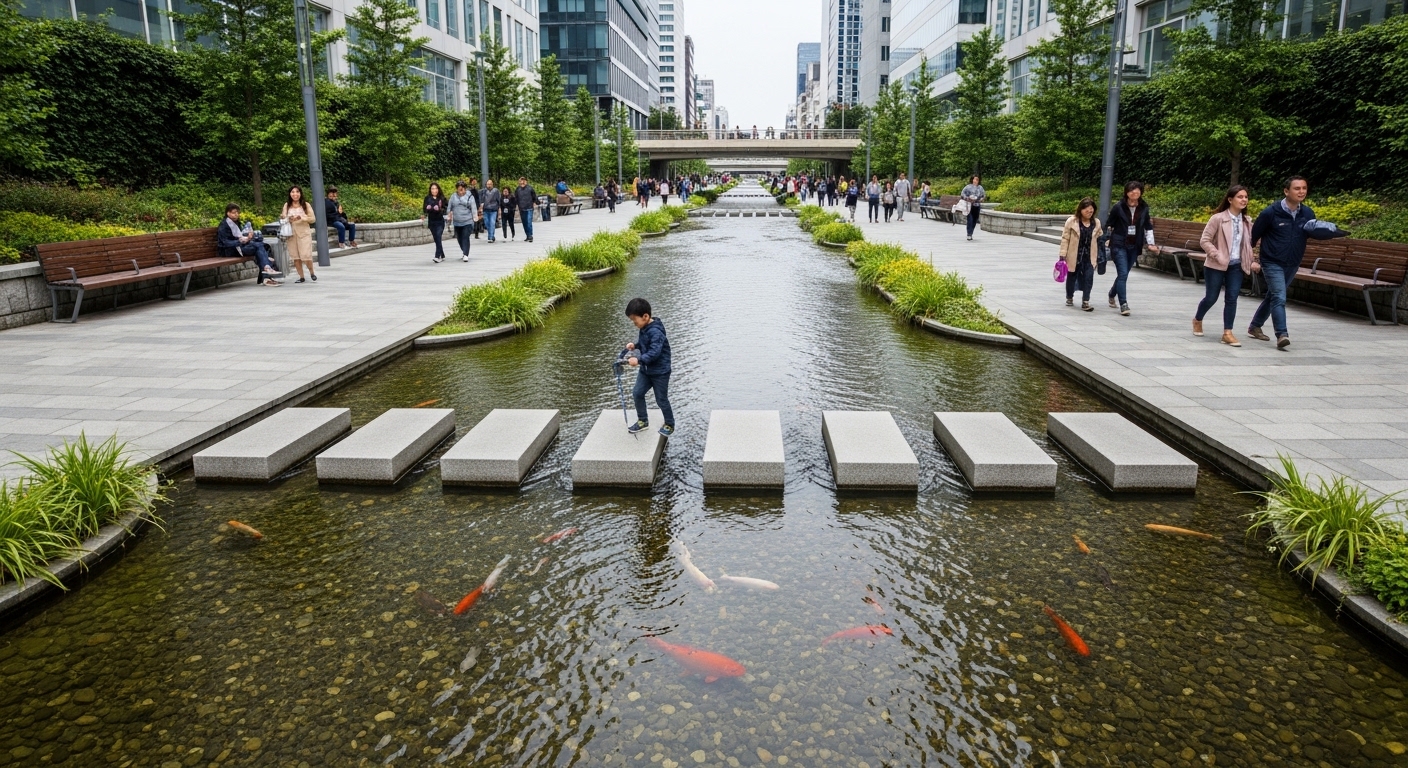
Japan has quietly become a leader in transforming storm channels into public ecological spaces. In cities like Osaka and Kyoto, narrow drainage canals have been redesigned with stone steps, shallow pools, and pedestrian paths.
These canals function as both rain drains and fish ladders. Locals regularly spot koi and native fish swimming through what used to be plain concrete ditches.
In some neighborhoods, children feed fish on their way to school while commuters walk alongside flowing water instead of traffic.
Would your daily routine feel different if you walked next to a living stream instead of a parking lot?
Europe’s Green Drainage Revolution
Several European cities are also rethinking rainwater infrastructure. In Copenhagen, Rotterdam, and Hamburg, storm drains are being transformed into green corridors that double as flood protection and public spaces.
These systems use gentle slopes, plant filtration, and open channels instead of underground pipes. Fish ladders are integrated directly into the designs, allowing species to move freely between rivers and coastal waters.
People can walk, bike, and relax along these drainage routes, turning what was once purely functional into something deeply human.
Why Walkways Matter as Much as Fish
The genius of city rain drains turned fish ladders & walkways is that they serve both nature and people. Fish ladders restore ecosystems, while walkways restore our emotional connection to water.
Urban life often separates people from natural rhythms. We forget where water comes from and where it goes. Walkable rain drains remind us that cities are part of larger ecosystems, not separate from them.
When people walk along these spaces, they begin to care about them. And when people care, they protect.

The Mental Health Impact of Urban Water
Studies consistently show that proximity to water improves mental health. Flowing water reduces stress, lowers anxiety, and increases feelings of calm.
Transforming rain drains into accessible walkways gives millions of city residents daily contact with water without needing to leave urban areas.
It is like giving every neighborhood its own tiny river.
Challenges and Limitations
Not every rain drain can be transformed easily. Pollution, space constraints, maintenance costs, and climate extremes all create challenges.
Some cities struggle with water quality. Others lack funding. In highly dense areas, opening up drainage systems may require removing buildings or roads.
However, the long-term benefits often outweigh the costs. Cleaner water, reduced flood damage, improved biodiversity, and higher quality of life create massive returns over time.
The Future of Urban Water Design
The future of city rain drains turned fish ladders & walkways is closely tied to climate adaptation. As cities face rising temperatures, stronger storms, and water scarcity, natural systems are becoming essential infrastructure.
Instead of building bigger pipes, cities are learning to slow water down, spread it out, and let nature handle the work.
We may soon see cities where every storm channel is also a park, every drainage route is a wildlife corridor, and every neighborhood has access to flowing water.
Would you support turning your city’s rain drains into public green spaces, even if it meant redesigning streets or infrastructure?
Have you ever seen a rain drain transformed into something beautiful? Share your thoughts and experiences in the comments below.
Follow WentWorld.com on social media for more stories about cities reimagining forgotten spaces into extraordinary destinations.
Catch up on the top stories and travel deals by subscribing to our newsletter!