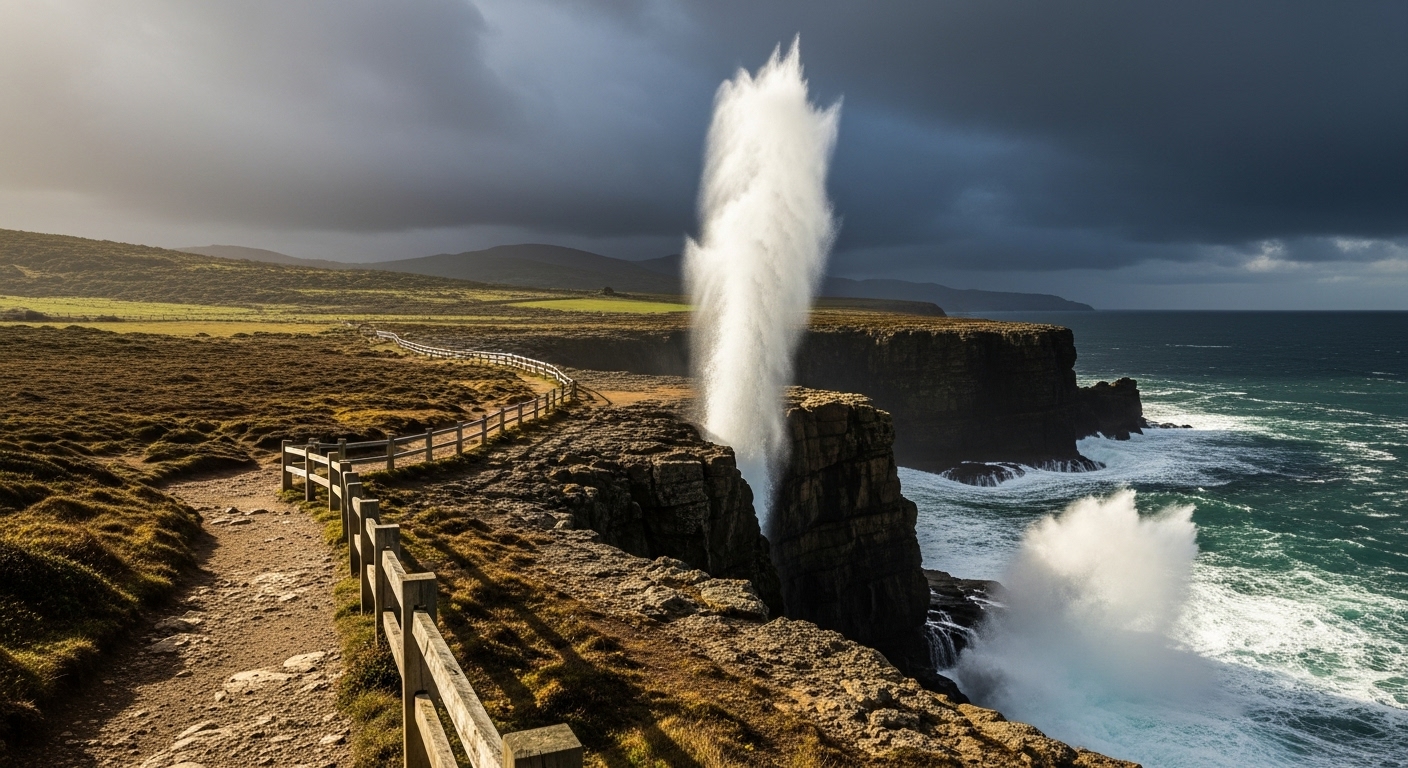
Some coastal walks feel peaceful and predictable. Others feel restless, loud, and alive. Sea-spray trails with natural blowholes belong firmly in the second group. These are not paths where the ocean stays politely in the background. Here, the sea announces itself with sound, pressure, and sudden bursts of water that rise from the rock beneath your feet.
Sea-spray trails with natural blowholes transform an ordinary walk into a conversation with the coast. You hear the ocean before you see it. A deep rumble travels through stone. The air tightens. Then, without warning, seawater explodes upward through narrow rock openings, scattering mist across the trail. It feels raw, unscripted, and unforgettable.
Have you ever walked somewhere that made you stop not because of the view, but because the land itself felt active?
What defines sea-spray trails with natural blowholes
Sea-spray trails with natural blowholes follow coastlines shaped by erosion, pressure, and time. These trails pass close to vertical shafts in rock that connect the ocean to the surface. When waves surge into underground caves, compressed air and water escape violently upward.
Unlike fountains or geysers, blowholes respond to the ocean’s mood. Tide height, wave direction, and swell size all influence their behavior. One moment they release gentle mist. The next, they erupt with force that shakes the ground.
This unpredictability keeps walkers alert. Every step feels connected to what the ocean is doing below.
How blowholes form beneath coastal trails
Sea-spray trails exist where rock meets relentless wave energy. Over centuries, waves exploit cracks in volcanic rock, limestone, or sandstone. Water carves horizontal sea caves. Pressure widens them. Eventually, vertical vents open to the surface.
When waves push into these chambers, air compresses rapidly. With nowhere else to escape, water and air shoot upward. Trails often develop nearby because early coastal routes followed elevated ground for visibility and safety.
Many modern trails trace paths once used by fishermen, lighthouse keepers, or coastal patrols.

Why these trails feel louder than others
Sea-spray trails with natural blowholes engage sound as much as sight. Echoing booms travel through hollow rock. Air whistles through narrow vents. Waves slam against cave walls far below.
The noise creates anticipation. Walkers often pause instinctively, waiting for the next eruption. Silence feels temporary, as though the coast is holding its breath.
This acoustic element sets these trails apart from calmer seaside walks.
Punakaiki Pancake Rocks, New Zealand
Punakaiki offers one of the most accessible examples of sea-spray trails with natural blowholes. Layered limestone formations sit beside powerful coastal vents that erupt during high tide.
Well-designed walkways allow visitors to experience the force without unnecessary risk. Sea spray drifts across paths, leaving salt on railings and skin. The ocean remains the central character.
Official guidance is available through the New Zealand Department of Conservation.
Bufadero de la Garita, Gran Canaria
On Gran Canaria’s eastern coast, Bufadero de la Garita shows how dramatic sea-spray trails with natural blowholes can become. Lava rock tunnels amplify wave pressure, sending water skyward with explosive force.
Trails nearby demand respect. Conditions change quickly, and safety barriers mark essential limits. When swell increases, the ground vibrates beneath your feet.
Local coastal information can be found at GranCanaria.com.
Thor’s Well along the Oregon Coast
Thor’s Well looks like a bottomless pit, but it functions as a collapsed sea cave connected to blowhole activity. Sea-spray trails with natural blowholes here feel intense and moody.
Fog often rolls in without warning. Wind carries mist inland. Timing the walk with tide charts transforms the experience entirely.
Safety updates are shared by Visit the Oregon Coast.
Why timing matters more than distance
Sea-spray trails with natural blowholes reward awareness more than endurance. The ocean dictates the experience, not the hiker.
Low tide reveals empty vents that breathe quietly. High tide combined with swell turns the same trail into a powerful display of motion and sound.
Experienced walkers plan visits around wave forecasts rather than sunrise schedules.
Have you ever adjusted your plans to match nature’s timing instead of your own?
Safety without losing the experience
The power that defines sea-spray trails with natural blowholes also introduces risk. Slippery surfaces, sudden spray, and rogue waves demand caution.
Staying behind barriers, wearing proper footwear, and avoiding cliff edges during rough conditions help preserve both safety and enjoyment.
Organizations like NSW National Parks emphasize observation over proximity.
The physical sensation of walking these trails
Sea-spray trails with natural blowholes create physical feedback. Vibrations travel through rock before eruptions occur. Fine mist cools skin. Salt clings to clothing.
You often leave damp, even on clear days. These sensory details linger longer than photos.
Many travelers recall the feeling before they remember the view.
Why these trails demand presence
Unlike long-distance hikes, these paths discourage rushing. Sudden eruptions stop people mid-step. Conversations fade as attention shifts to sound and movement.
Sea-spray trails with natural blowholes encourage stillness. Waiting becomes part of the walk.
That enforced pause often creates the strongest memories.
Why WentWorld highlights places like this
WentWorld focuses on landscapes that behave rather than simply exist. Sea-spray trails with natural blowholes show coastlines as active systems, constantly reshaped by pressure and motion.
They remind us that travel does not always require covering distance. Sometimes, standing still at the right moment reveals everything.
If you’ve walked a trail where nature interrupted your pace, we’d love to hear about it.
Follow WentWorld on social media to discover more paths where land and sea interact in unforgettable ways.
Catch up on the top stories and travel deals by subscribing to our newsletter!