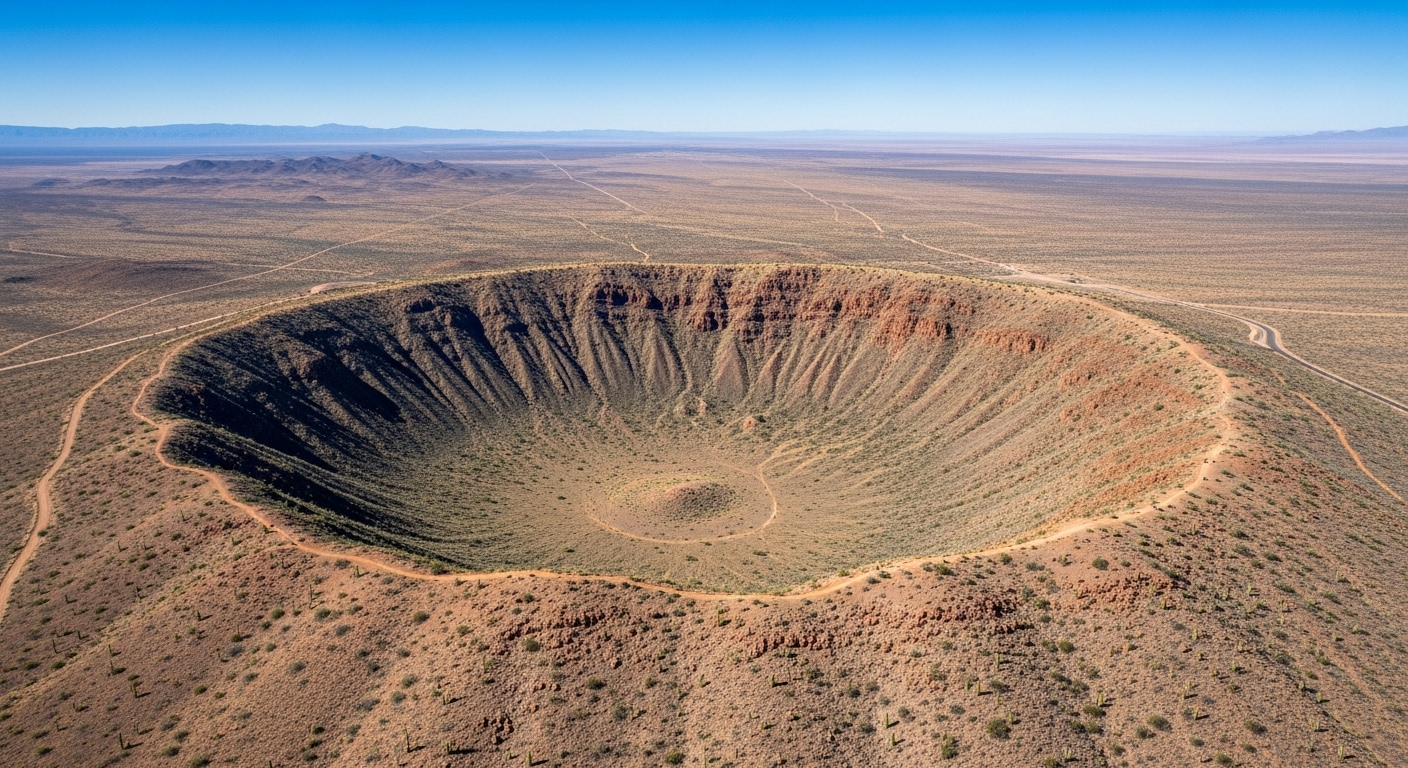
Have you ever stood in a place where the sky quite literally met the ground? Where an ancient meteor—blazing through the atmosphere at unimaginable speed—collided with Earth and left behind a scar so vast, it redefines your sense of scale? That’s the magic of meteor craters and astro-landscapes. They’re reminders of our planet’s fiery encounters with the cosmos—silent witnesses to moments that changed the surface of the Earth forever.
For travelers who love science, history, and awe-inspiring nature, exploring meteor craters is one of the most unforgettable adventures out there. These sites blend the drama of geological power with the beauty of the unknown. Whether you’re hiking along an impact rim in Arizona, stargazing over Namibia’s desert craters, or visiting an astro-themed reserve in Australia, these are destinations that bring the universe a little closer to home.
So pack your curiosity (and maybe a telescope), because we’re about to explore the world’s most fascinating meteor craters and cosmic landscapes open to the public. Ready to take a walk through space and time?
The Science Behind Meteor Craters: Earth’s Celestial Signatures
Before we jet off to our first destination, let’s understand what makes meteor craters so extraordinary. A crater forms when a meteoroid—usually a rock or metal fragment from space—slams into Earth’s surface with colossal energy. The impact vaporizes part of the ground, flings debris into the air, and leaves a massive depression that can remain visible for millions of years. Some are shallow bowls; others are deep, layered scars large enough to be seen from space.
These craters are time capsules. They tell scientists about the composition of the early solar system, Earth’s geological evolution, and even how life might have emerged after catastrophic impacts. But beyond science, there’s something spiritual about standing where space once struck Earth. It’s like touching a cosmic memory.
Arizona’s Barringer Crater: The World’s Best-Preserved Impact Site
If you’ve ever seen photos of a crater that looks like a perfect circle punched into the desert, you’ve probably seen the Barringer Meteor Crater in Arizona, USA. Located near Winslow, it’s one of the few meteor craters fully accessible to tourists. Formed about 50,000 years ago by a 50-meter-wide iron meteorite, this colossal pit measures 1.2 kilometers across and 170 meters deep.
The Meteor Crater Visitor Center makes this more than just a sightseeing stop—it’s an educational experience. Interactive exhibits, a 4D immersive theater, and guided rim tours let you relive the moment of impact. Standing on the edge of this crater, you realize how small humanity is compared to the universe’s power. NASA even used this site to train Apollo astronauts, preparing them for lunar exploration. Pretty cosmic, right?
Vredefort Dome, South Africa: The World’s Oldest Known Crater
Now let’s head south—to South Africa’s Vredefort Dome, near Johannesburg. This UNESCO World Heritage Site is not only the largest but also the oldest verified impact structure on Earth. Around two billion years ago, a meteor roughly 10 kilometers in diameter struck here, creating a crater over 300 kilometers wide. Erosion has softened its outlines, but its geological layers still whisper tales of apocalypse and rebirth.
Visitors can take guided tours around the dome, exploring its concentric ridges and ancient rocks. Local guides often mix science with storytelling—explaining how the impact may have reshaped early Earth’s environment and possibly influenced the planet’s habitability. Hiking through this landscape feels like walking through Earth’s deep past.
Lonar Crater, India: Where Mythology Meets Geology
In the heart of Maharashtra, India, lies Lonar Lake, a crater formed by a meteor impact about 50,000 years ago. What makes this site fascinating is its fusion of science and spirituality. The crater, nearly 1.8 kilometers wide, now contains a saltwater lake surrounded by lush greenery and ancient Hindu temples. According to local legends, it was formed when a demon was struck down from heaven.
Scientists, however, have a different story. Lonar is one of the few hyper-velocity meteor craters in basaltic rock on Earth. Its unique alkaline and saline water layers harbor rare microorganisms found nowhere else. Visitors can hike around the rim, photograph the turquoise lake from above, or explore temples like the Daitya Sudan Mandir nearby. It’s a perfect example of how science and myth often share the same ground.
Kaali Crater Field, Estonia: A Cluster of Celestial Scars
On the quiet island of Saaremaa in Estonia lies something out of a cosmic mystery novel—the Kaali Crater Field. Formed around 4,000 years ago, this cluster of nine small craters resulted from a meteor breaking apart in the atmosphere before striking Earth. The main crater, 110 meters across, holds a small lake that looks peaceful today—but ancient texts suggest it caused widespread fires upon impact.
Estonian folklore links Kaali to divine punishment or celestial anger, and archaeologists believe ancient rituals were performed here. Today, tourists can walk through the forested site, visit the local museum, and stand beside the serene lake that was once a fiery impact zone. It’s a perfect destination for those who love quiet landscapes infused with cosmic history.
Tenoumer Crater, Mauritania: A Perfect Circle in the Sahara
If you ever find yourself exploring Mauritania’s desert, you might stumble upon a crater so symmetrical that it looks man-made. The Tenoumer Crater, located in the Sahara, is about 1.9 kilometers wide and 100 meters deep. Surrounded by vast emptiness, it stands as a silent reminder of a cataclysmic event that happened some 20,000 years ago.
Few travelers reach this remote spot, but for those who do, it’s unforgettable. The wind whispers through the sand, and the horizon stretches endlessly—an otherworldly setting that blurs the line between Earth and Mars. Satellite images of Tenoumer often confuse viewers who can’t believe such perfect geometry could be natural. It’s truly one of Earth’s desert treasures.
Wolfe Creek Crater, Australia: Outback Meets Outer Space
Australia’s vast Outback hides its own celestial surprise—Wolfe Creek Crater in Western Australia. Known to the local Djaru people as “Kandimalal,” it’s about 880 meters across and 60 meters deep. Formed roughly 120,000 years ago, Wolfe Creek is among the world’s best-preserved craters, with easy access for visitors traveling through the remote Kimberley region.
Local Aboriginal stories describe the crater as the site where the Rainbow Serpent emerged from the ground—a myth echoing cosmic birth. Tourists can hike around the rim or take aerial flights to appreciate its striking symmetry. The nearby Wolfe Creek Meteorite Crater National Park offers camping for stargazers who want to experience the Outback’s legendary night skies. Just remember, it gets very dark—and eerily quiet.
Tswaing Crater, South Africa: A Meteor Meets a Salt Lake
Not far from Pretoria, the Tswaing Crater is one of South Africa’s most accessible astro-landscapes. Formed by a meteor impact 220,000 years ago, it’s now filled with a circular salt lake. The hike down to the crater floor is a favorite among local adventurers—it’s about 1.3 kilometers to the lake, surrounded by rim-top viewpoints and birdlife.
Tswaing combines beauty and scientific value. The site’s small museum explains how scientists determined the impact origin (for years it was mistaken for a volcanic crater). Today, it’s both a natural classroom and a tranquil hiking retreat—perfect for those seeking a blend of outdoor activity and cosmic wonder.
Astro-Landscapes Beyond Craters: Where the Stars Still Rule
While meteor craters are dramatic, not all astro-landscapes involve impact scars. Some places celebrate our connection with the cosmos in subtler ways—through stargazing reserves, observatories, and light pollution-free zones. The Atacama Desert in Chile, for instance, offers one of the clearest night skies on Earth. Visitors can tour observatories like ALMA or join local astronomy tours that teach you to navigate the heavens with the naked eye.
Namibia’s NamibRand Dark Sky Reserve is another gem. Imagine sleeping under a blanket of stars so bright it feels like daylight. Many eco-lodges in the area offer guided night sky walks, linking astronomy with ancient folklore. These experiences remind us that while craters show where space has touched Earth, the stars show us where we came from.

What to Know Before Visiting Meteor Craters
- Timing is everything: Visit early in the morning or late afternoon for the best light and cooler temperatures.
- Respect the landscape: Avoid collecting rocks or meteor fragments—it’s illegal in many areas and damages scientific research.
- Dress for the terrain: Crater sites can be windy, dusty, and remote—bring sturdy shoes, water, and sun protection.
- Look up, too: Many crater areas are also top-tier stargazing sites. Stay after dark to catch the Milky Way.
Why We’re Drawn to Cosmic Landscapes
What makes meteor craters so captivating? Maybe it’s because they connect us to something bigger. These are the marks left by the universe on our planet—reminders that Earth is part of a vast, living cosmos. Standing on a crater’s rim, you can almost feel the ancient energy still humming beneath the surface. It’s humbling and thrilling all at once.
Perhaps that’s why more travelers are adding astro-landscapes to their bucket lists. They’re not just sightseeing spots; they’re opportunities for perspective. They teach us how fragile—and how resilient—our planet truly is.
From Arizona’s monumental Barringer Crater to India’s mystical Lonar Lake, the world’s meteor craters invite you to explore where space and time collide. Each site tells a different story—of destruction, creation, and wonder. These destinations remind us that we don’t have to leave Earth to experience the universe; sometimes, the cosmos has already come to us.
So, where will your next journey through time and space take you? Have you ever visited a meteor crater or astro-landscape that left you speechless? Share your stories with us in the comments below—your cosmic adventure might inspire someone else’s next trip! Follow WentWorld on social media for more incredible travel stories, cosmic destinations, and offbeat adventures around our fascinating planet.
Catch up on the top stories and travel deals by subscribing to our newsletter!