Some places on Earth feel so surreal that they seem borrowed from another planet. Lunar landscape hikes on solidified lava waves are exactly that kind of experience. These landscapes look like frozen oceans of stone, shaped by ancient volcanic forces into rippling waves, sharp ridges, and endless black fields. Walking across them feels less like hiking and more like stepping onto the surface of the Moon.
Unlike lush forests or snowy peaks, lava landscapes are raw, silent, and dramatic. The ground beneath your feet was once flowing magma, moving like water but burning hotter than imagination allows. Today, these solidified lava waves create some of the most striking hiking environments on the planet. They attract photographers, geologists, adventure travelers, and anyone searching for something completely different from typical nature trails.
What Are Solidified Lava Waves?
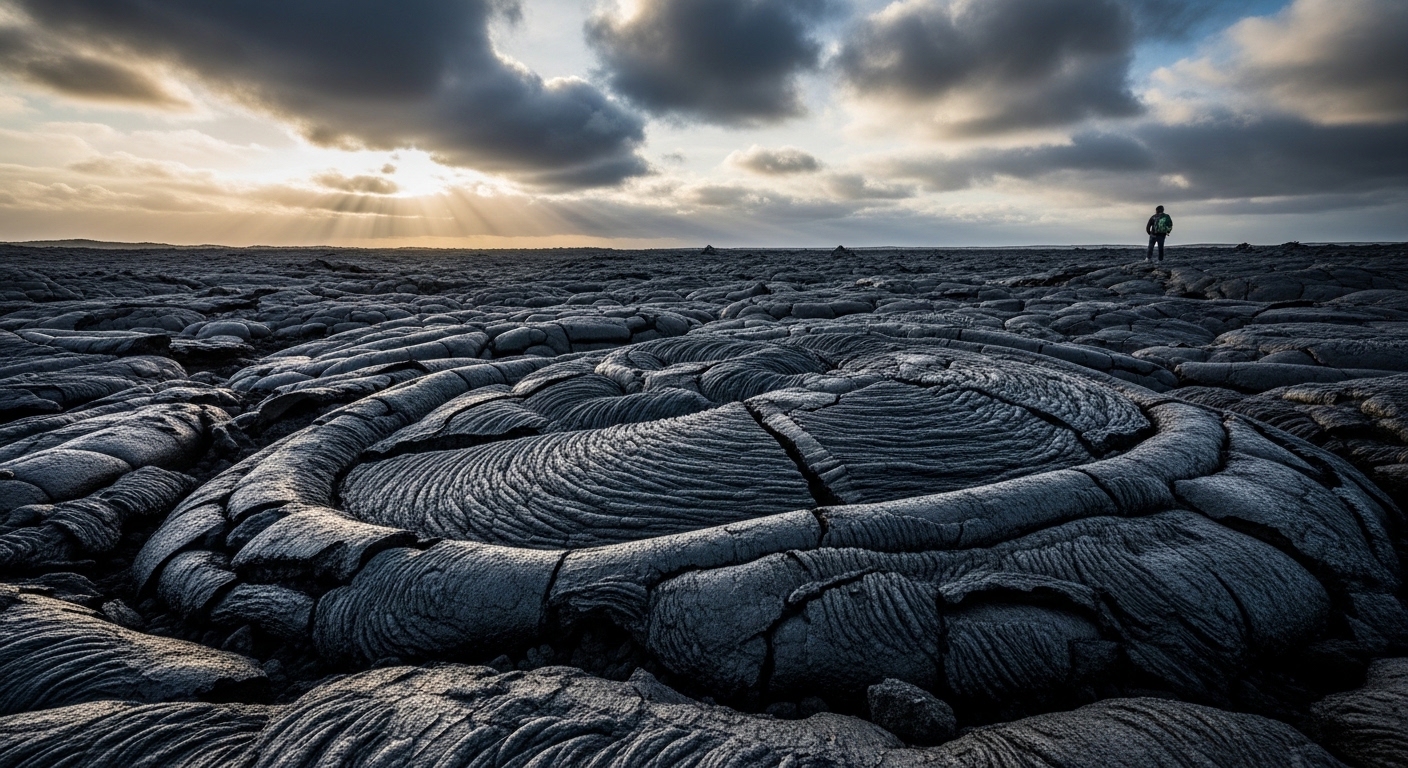
Solidified lava waves form when molten lava flows across land and cools rapidly, preserving the motion of the flow in stone. Just like waves frozen mid-ocean, these formations capture movement in time. You can see folds, swirls, ripples, and cracks that reveal how the lava once surged forward.
There are different types of lava textures, including smooth, rope-like formations known as pahoehoe, and jagged, broken surfaces called a‘a. Both create surreal hiking terrain, but pahoehoe is often what gives landscapes their most lunar appearance.
Have you ever looked at a photo and thought, “This doesn’t look real”? That’s the reaction many people have when they first encounter lava waves in person.
Why These Landscapes Feel So Lunar
The Moon’s surface is covered in ancient lava plains created by volcanic activity billions of years ago. Earth’s lava fields are the closest natural equivalent we have. The absence of vegetation, the monochrome colors, and the strange textures all contribute to that otherworldly feeling.
In many lunar landscape hikes on solidified lava waves, you’ll find vast open spaces with almost no sound except the wind. The ground crunches underfoot. The horizon feels endless. It’s easy to forget you’re still on Earth.
This sense of isolation and scale is why these landscapes are often used as training grounds for astronauts and filming locations for science fiction movies.

Iconic Places for Lunar Landscape Hikes
Several destinations around the world are famous for their lava wave formations and hiking opportunities.
Hawaiʻi Volcanoes National Park, USA is one of the most iconic. Vast lava fields stretch across the island, formed by eruptions from Kīlauea and Mauna Loa. Visitors can hike across solidified flows, lava tubes, and volcanic craters. Official visitor information is available through National Park Service.
Timanfaya National Park, Lanzarote in the Canary Islands offers a Martian-like landscape created by eruptions in the 18th century. The terrain looks burned, twisted, and untouched by time. Spain’s tourism board highlights it as one of the most surreal natural parks in Europe via Spain Tourism.
Þingvellir and surrounding lava fields, Iceland present endless black rock plains shaped by volcanic rifts. Hiking here feels like walking through a geological museum under open sky. Iceland’s official travel portal Visit Iceland showcases many lava-based trails.
Crater of the Moon National Monument, USA in Idaho features vast lava flows, caves, and spatter cones. The park was used by NASA for astronaut training in the 1960s. More details can be found through National Park Service.
What It Feels Like to Hike on Lava Waves
Hiking across lava landscapes is unlike any other type of trekking. There are no trees for shade. No soft soil. No obvious trails in many areas. You navigate across hardened rock that once burned at over 1,000 degrees Celsius.
The textures vary dramatically. Some areas feel smooth and glassy, while others are sharp and brittle. Each step requires awareness. Good footwear is essential. So is water, sun protection, and respect for the terrain.
But the reward is extraordinary. The silence. The vastness. The feeling of standing on something ancient and powerful. It makes you feel very small in the best possible way.
Would you prefer a hike that feels comfortable, or one that makes you feel like an explorer on another planet?
Photography and Creative Appeal
Lava landscapes are a dream for photographers and filmmakers. The dramatic light, deep shadows, and abstract patterns make every angle visually striking. Sunrise and sunset are especially powerful, when the dark rock reflects warm colors from the sky.
Many sci-fi movies and documentaries use these locations to simulate alien planets. It’s not hard to see why. No artificial set can replicate the raw beauty of solidified magma.
Some travelers plan entire trips around capturing these scenes, using drones and wide-angle lenses to showcase the scale of lava fields.
The Psychological Experience
There is something deeply reflective about walking through barren landscapes. Without distractions, your mind slows down. The lack of color and sound creates a meditative environment.
In lunar landscape hikes on solidified lava waves, people often describe feeling both isolated and connected at the same time. Isolated from modern noise, connected to planetary forces that existed long before humans.
It’s not unusual for hikers to feel emotional in these places. The terrain reminds you how temporary everything is — even mountains can melt.

Environmental and Safety Considerations
Despite their tough appearance, lava landscapes are fragile. The rock can break. Rare moss and microorganisms grow slowly. Stepping off designated paths can cause permanent damage.
Safety is also important. Lava fields can hide cracks, unstable surfaces, and sharp edges. Temperatures can be extreme, and mobile signals may be weak or nonexistent.
Guided hikes are recommended in unfamiliar areas, especially in remote locations like Icelandic highlands or Hawaiian backcountry.
The Future of Lunar Landscape Tourism
As travelers search for unique and meaningful experiences, lava landscapes are becoming increasingly popular. People want places that feel untouched, authentic, and different from social-media-saturated destinations.
Some tourism boards now promote volcanic hiking as a form of slow travel and nature therapy. These landscapes offer no entertainment facilities, no shops, no distractions — just geology, silence, and time.
In a world dominated by screens, walking on ancient lava waves might be one of the most grounding experiences available.
Have you ever visited a volcanic landscape, or would you be willing to hike somewhere that feels completely alien? Share your thoughts in the comments.
Follow WentWorld.com on social media for more travel stories that explore the most unusual, beautiful, and mind-bending places on Earth.
Catch up on the top stories and travel deals by subscribing to our newsletter!