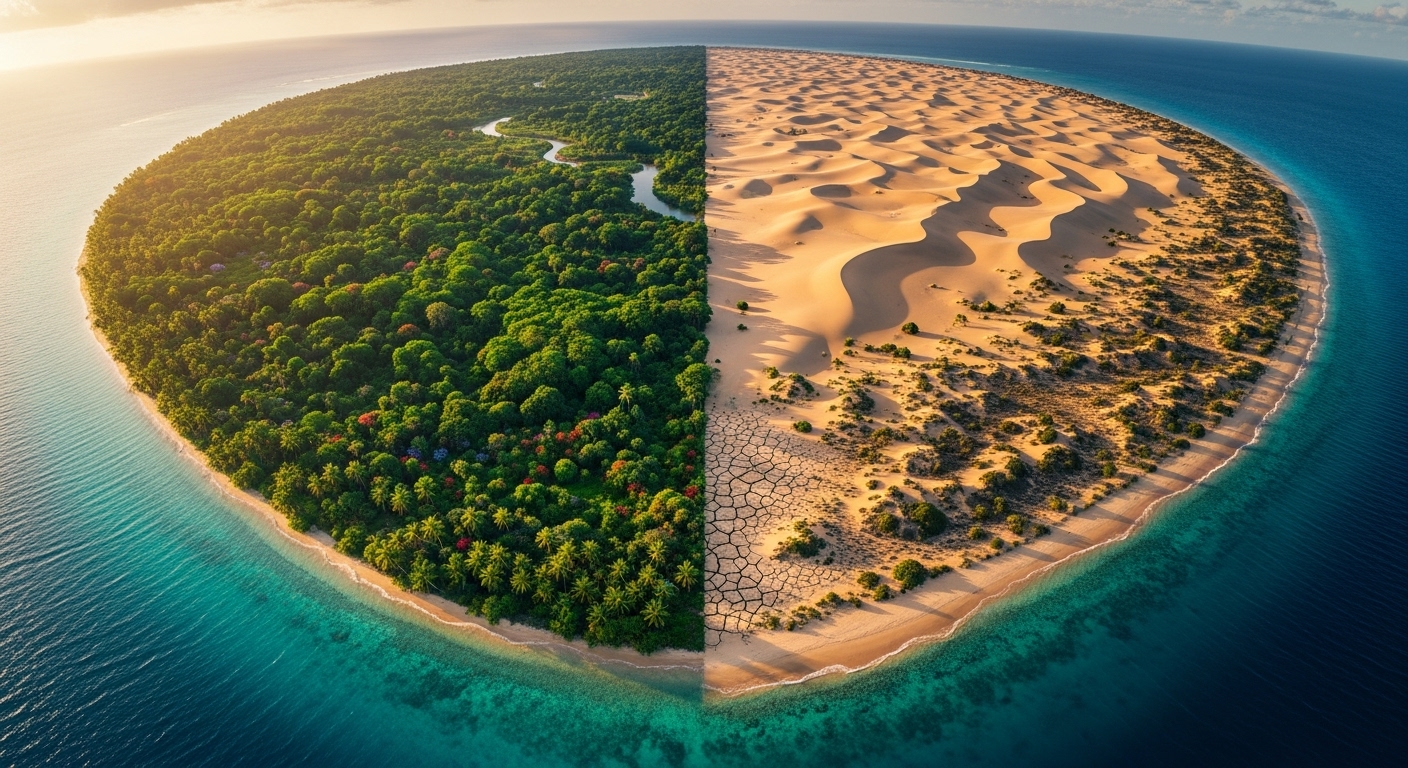
There are places on Earth where you can wake up surrounded by towering green jungles, hear birds echo through thick rainforests, and then by afternoon find yourself standing in a dry, windswept desert under a blazing sun — all without ever leaving the same island. These rare and astonishing places are known as islands with both desert and jungle in one day, and they feel almost unreal when you experience them.
We often imagine islands as either tropical paradises or dry, rocky wastelands. But nature doesn’t follow simple categories. In certain extraordinary parts of the world, geography, ocean currents, trade winds, volcanic activity, and elevation combine to create ecosystems that clash and coexist in the most dramatic way possible.
At WentWorld, we love uncovering destinations that challenge what we think we know about the planet. And few things challenge our imagination more than islands with both desert and jungle in one day. These islands prove that climate can change faster than your shadow, and that nature can rewrite the rules of what we expect from a single place.
As you read this, imagine this question: if you had only one day on such an island, would you choose to walk through misty jungle trails in the morning or watch sandstorms race across your footprints in the afternoon?
How Can One Island Have Both Desert and Jungle at the Same Time?
Before we explore specific islands with both desert and jungle in one day, it helps to understand how such extreme contrasts can exist side by side. It may sound impossible, but the reasons are deeply rooted in Earth’s climate systems.
One of the biggest factors is mountain elevation. When moist ocean air rises and cools against tall mountain ranges, it drops rain on one side of the island, creating rainforests and lush jungle. The other side, shielded by those same mountains, receives little rainfall and becomes dry or even desert-like. This is known as a rain-shadow effect.
Ocean currents also play a critical role. Cold currents reduce evaporation and suppress rainfall, turning coastal regions into desert zones even near the equator. Meanwhile, warmer currents on the opposite side of the same island can drive heavy rainfall and thick vegetation.
Add volcanic soil, shifting wind patterns, trade winds, and seasonal climate cycles into the mix, and suddenly it becomes possible for one island to host palm-filled jungles, barren sand dunes, rocky badlands, and misty cloud forests all within a single day’s drive.
Maui, Hawaii: Volcano Slopes, Rainforests, and Lunar-Like Deserts
Maui is one of the most breathtaking examples of islands with both desert and jungle in one day. Most people know Hawaii for its lush beauty, waterfalls, and tropical forests. But few realize that Maui also hosts true desert landscapes that feel closer to Mars than to the tropics.
On one side of the island, moist trade winds rise against the slopes of Haleakalā, producing dense rainforests in Hana and surrounding valleys. Here, waterfalls spill over cliffs, bamboo forests stretch toward the sky, and vines wrap the land in layers of green.
Yet just a few hours away, near the summit of Haleakalā and across the central valley, the climate flips entirely. Rainfall drops sharply. The vegetation thins into scrub. Soil turns dry and dusty. The landscape becomes so barren that it has been used as a training ground for astronauts due to its resemblance to lunar and Martian surfaces.
It is entirely possible on Maui to swim beneath jungle waterfalls in the morning and stand among volcanic deserts in the evening, watching stars rise in silence.

Sicily, Italy: Mediterranean Jungles and African-Style Deserts
Sicily may surprise many people as one of the most unusual islands with both desert and jungle in one day. While it is known for its beaches, vineyards, and ancient ruins, Sicily’s interior climate tells a very different story.
Near Mount Etna, fertile volcanic soil and higher rainfall support thick vegetation, forests, and almost jungle-like greenery. Deep valleys collect moisture, and mountain clouds bring steady water to the ecosystem.
Travel south toward the island’s dry heartland, and the scenery shifts rapidly. Rain becomes scarce. Heat intensifies. Wind erodes the land into pale rolling badlands that resemble North African deserts. In summer, temperatures can reach extreme levels, turning farmland into dusty plains.
Within hours, travelers cross from lush green slopes into sun-blasted desert zones — a powerful example of how islands with both desert and jungle in one day quietly exist in Europe itself.
Tenerife, Canary Islands: One Island, Four Worlds
Tenerife is often described as a continent squeezed into a single island. It stands as one of the most dramatic islands with both desert and jungle in one day anywhere in the world. The northern side of Tenerife receives abundant moisture from Atlantic winds. This gives rise to thick laurel forests, cloud jungles, and banana plantations. The air here feels cool, damp, and fresh.
Then comes the sudden shift. As you drive around the island and descend into the southern regions, rainfall nearly disappears. The land becomes arid, rocky, and desert-like. Cacti dominate the landscape. The air turns dry and hot. The contrast is immediate and shocking.
At the center rises Mount Teide, a massive volcano surrounded by high-altitude deserts that resemble another planet entirely. Snow occasionally dusts its peak while beaches bake below. Few places demonstrate the power of elevation better than Tenerife.
Socotra Island, Yemen: Alien Deserts and Primeval Jungles
Socotra is often called the most alien-looking island on Earth — and for good reason. It represents one of the most mysterious islands with both desert and jungle in one day.
Large portions of Socotra are dry, rocky, and desert-like, shaped by relentless wind and sun. Yet tucked into valleys and elevated plateaus are hidden jungles of plants found nowhere else on Earth. The famous dragon’s blood trees grow here in surreal shapes, creating forests that look like something from science fiction.
Seasonal monsoons bring bursts of rain that briefly transform barren land into green life. Then, just as quickly, the desert returns. It is a place where survival has shaped evolution into some of the strangest forms ever seen on this planet.

Madagascar: Rainforest to Spiny Desert in Hours
Madagascar’s eastern coast is one of the greenest rainforest regions on Earth, dripping with humidity, waterfalls, and biodiversity found nowhere else. Yet travel westward across the island and you will encounter one of the strangest deserts on the planet.
Here, the “spiny desert” dominates — a dry ecosystem filled with needle-like plants, baobabs, and skeletal trees. Rain rarely falls. The air turns dry and dusty. Life adapts to extremes.
This transformation happens so quickly that it feels like crossing continents in a single road trip. Madagascar stands as one of the most biologically extreme islands with both desert and jungle in one day.
Cape Verde: Atlantic Deserts and Hidden Green Valleys
Cape Verde sits off the coast of Africa and is shaped by volcanic rock, Atlantic winds, and African desert air. Much of the archipelago appears dry and barren at first glance. But in the higher elevations, especially on islands like Santo Antão, lush valleys and jungle-covered cliffs appear like secret worlds.
Moist air condenses over mountain peaks, feeding deep green ecosystems while dry winds scorch the coast below. It is possible to hike through jungle paths in the morning and descend into desert heat by afternoon.
Why These Islands Feel So Surreal to Travelers
What makes islands with both desert and jungle in one day so emotionally powerful is the suddenness of change. Human minds expect nature to shift slowly. These islands break that expectation completely.
One moment you are surrounded by humidity, thick leaves, echoing birds, and dripping water. The next moment you are in silence, wind, dust, and burning sun. It creates a startling awareness of how fragile comfort truly is.
Many travelers describe these transitions as deeply humbling. You stop taking landscapes for granted. You realize that the Earth can turn its face instantly.
How Life Adapts to Such Extreme Contrasts
On these islands, plants and animals evolve remarkable survival strategies. Jungle species thrive in wet valleys while desert organisms manage water with near-perfection. Some animals migrate vertically between ecosystems. Others survive only in tiny climate pockets.
Human communities adapt as well. Farming methods shift between rainfall-based agriculture and irrigation. Housing design changes between moisture protection and heat defense. Culture itself becomes shaped by environmental extremes.
Is Climate Change Making These Extremes Stronger?
Scientists increasingly believe that climate change is intensifying the contrast on many islands with both desert and jungle in one day. Rainfall is becoming less predictable. Storms grow stronger. Dry zones are expanding into greener regions. The fear is not just that jungles may dry or deserts may expand — but that the delicate balance allowing both ecosystems to survive side by side may collapse. When that balance fails, biodiversity risks disappearing forever.
If you were given just one day on one of these islands, what would you choose first? Would you walk beneath thick jungle canopies where light barely touches the ground? Or would you chase the open silence of the desert where the horizon feels endless?
And if you had to live there, how would you adapt your life between water abundance and water scarcity within the same sunrise and sunset? These are not fantasy questions. For millions of people, this contrast is daily reality.
These islands remind us that the world is far more complex than our shortcuts allow. Climate isn’t just hot or cold, wet or dry. It is layered, broken, shaped, and reshaped constantly by invisible forces. More importantly, these islands teach us respect. They show us that survival has always depended on adaptability. The civilizations of the future may not be built by those who dominate nature, but by those who understand how to move with it.
At WentWorld, we believe these hidden extremes reveal the deepest truths about our planet. If one island can contain both desert and jungle within a single day, how many other contradictions are quietly shaping our world right now without us noticing?
We would love to hear your thoughts. Have you ever visited a place where the climate changed drastically within hours? What surprised you the most? And if stories like this inspire your curiosity about the strange and beautiful extremes of our planet, make sure you stay connected with WentWorld across our social media platforms for more powerful global explorations.
Catch up on the top stories and travel deals by subscribing to our newsletter!