
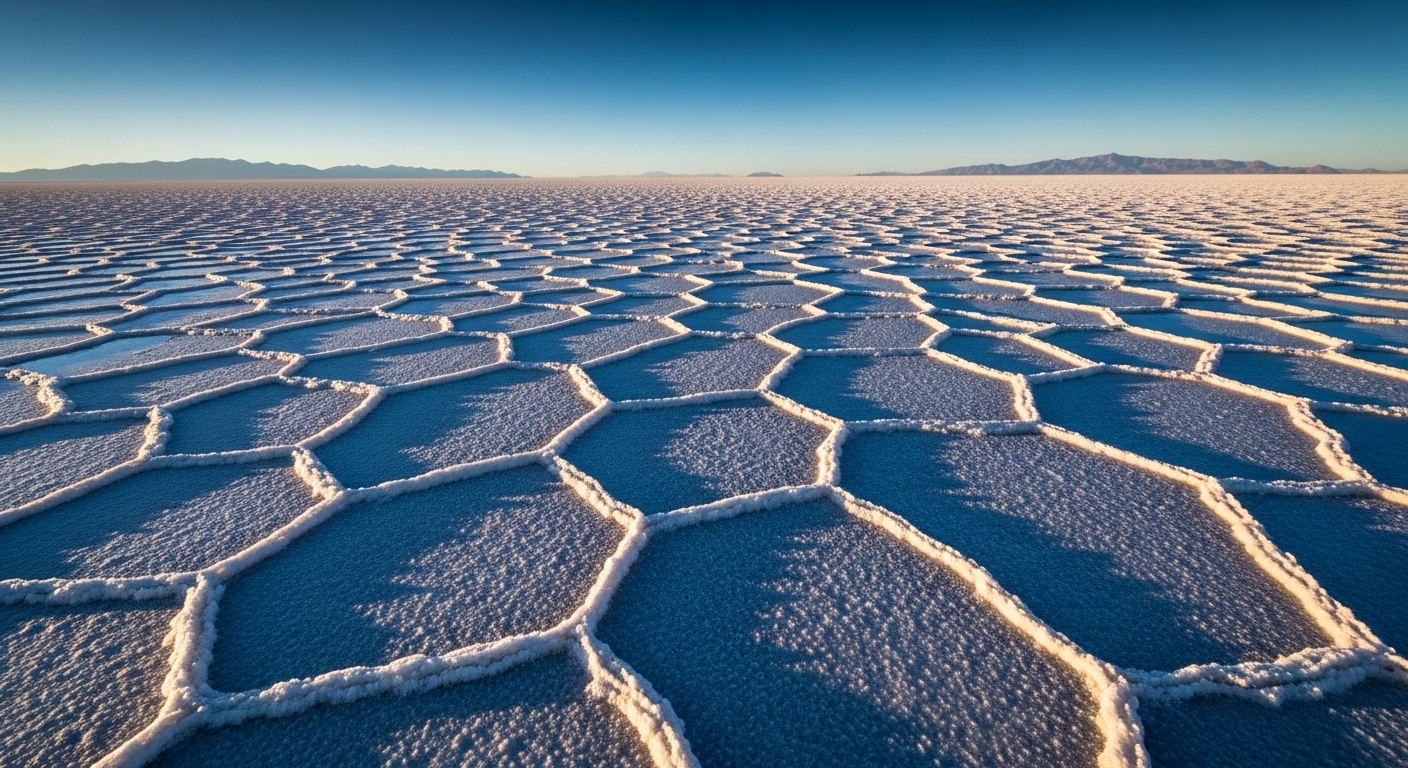
At first glance, salt crystal fields that grow like crops look almost unreal. Vast white plains stretch toward the horizon, divided into geometric patterns that resemble farmland. But instead of wheat or rice, these fields produce shimmering salt crystals, slowly forming and regenerating with each season. These places feel less like industrial sites and more like natural artworks shaped by time, sun, and human patience.
Salt is one of the oldest traded resources in human history. It preserved food, fueled economies, and even determined trade routes and wars. Yet most of us encounter salt only as something sitting quietly on a kitchen table. Seeing where it actually comes from changes your entire relationship with this everyday mineral. Have you ever stood in a place so bright and silent that it felt like walking on snow under a blazing sun?
Salt crystal fields that grow like crops exist in deserts, coastal flats, and high-altitude basins. They operate on simple principles: seawater or brine is guided into shallow pools, the sun evaporates the water, and salt crystals slowly form. Over weeks and months, workers harvest the salt, then refill the pools, beginning the cycle again. It is agriculture without plants, farming without soil.
Why Salt Fields Look Alive
What makes salt crystal fields feel alive is the way they evolve. Unlike static landscapes, these fields change daily. Crystals grow, shift, and break apart depending on temperature, humidity, and sunlight. From a distance, the surface can look smooth and endless. Up close, every step reveals intricate patterns, sharp edges, and delicate formations.
In some places, the salt forms hexagonal shapes that resemble honeycombs. In others, it piles into small pyramids or ridges. These patterns are not decorative. They result from evaporation physics and mineral saturation levels. Nature, without intention, creates designs more complex than most human art.
Have you ever watched something grow that wasn’t alive, yet felt like it was? Salt crystal fields often create that strange sensation.
Salar de Uyuni, Bolivia
The most famous example of salt crystal fields that grow like crops is Salar de Uyuni in Bolivia. It is the largest salt flat in the world, covering more than 10,000 square kilometers. During dry season, the surface becomes a massive salt crust made of countless hexagonal plates. During wet season, a thin layer of water turns the entire flat into a perfect mirror.
Salt is still harvested here using traditional methods. Workers scrape salt into cone-shaped piles, let it dry, then transport it for processing. Watching these salt pyramids rise against an endless white background feels like observing an alien agricultural system.
Salar de Uyuni is also used for satellite calibration because of its extreme flatness. Space agencies and research institutions, including NASA, have studied it for this purpose. Yet despite its scientific importance, the place feels deeply emotional. The silence is so complete that even footsteps sound intrusive.

Maras Salt Ponds, Peru
High in the Sacred Valley of Peru lie the Maras Salt Ponds, a network of thousands of small salt pools carved into a mountainside. These ponds have been in continuous use since pre-Incan times. A natural underground spring feeds salty water into each terrace, where evaporation leaves behind crystallized salt.
Unlike massive salt flats, Maras feels intimate. Families own and maintain individual pools, harvesting salt by hand. Each terrace glows slightly differently depending on mineral concentration and sunlight angle. From above, the entire valley looks like a mosaic made of light.
Travelers visiting Peru often focus on Machu Picchu, but Maras offers a quieter, equally powerful experience. Guides listed by Lonely Planet frequently describe it as one of the most photogenic landscapes in South America.
Bonneville Salt Flats, USA
The Bonneville Salt Flats in Utah are another striking example. These salt fields formed from the remnants of an ancient lake that dried thousands of years ago. What remains is a vast salt crust several meters thick in some areas.
Unlike traditional salt farms, Bonneville is mostly not harvested today. Instead, it has become a site for speed records, photography, and scientific research. Yet in certain areas, salt still regenerates naturally through seasonal flooding and evaporation.
Standing on Bonneville feels disorienting. There are no landmarks, no shadows, and no clear sense of distance. The world becomes abstract, reduced to white ground and blue sky. It feels like being inside a blank canvas.
Lake Retba, Senegal
Lake Retba, also known as the Pink Lake, offers a different kind of salt field. Its high salt concentration allows people to float effortlessly, similar to the Dead Sea. The lake’s pink color comes from algae that thrive in salty conditions.
Salt harvesting here is physically demanding. Workers wade into the water, scrape salt from the bottom, and carry heavy loads to shore. Over time, these deposits rebuild, creating a cycle that mirrors agricultural harvesting.
Organizations like UNESCO have highlighted traditional salt production as an important cultural practice, recognizing both its economic value and heritage significance.
The Emotional Geography of Salt
Salt fields do something unusual to the human mind. They erase visual noise. With no trees, buildings, or animals, attention shifts inward. Many travelers report feeling calm, reflective, and strangely grounded in these environments.
Perhaps this is because salt represents permanence. These crystals are ancient. Some formed from oceans that vanished millions of years ago. Walking on salt feels like walking on compressed history.
Have you ever felt small in a good way? Salt landscapes often create that sensation. They make you aware of your scale in relation to the planet.

Salt as Living Landscape
Although salt is a mineral, salt crystal fields behave almost like living systems. They respond to climate, human management, and geological changes. Floods dissolve them. Heat rebuilds them. Harvesting removes them. Nature replaces them.
This cycle makes salt fields one of the few places where industrial production and natural beauty coexist visibly. You are not just observing scenery. You are observing a working system that feeds people, economies, and traditions.
In a world increasingly dominated by automation, these manual, sun-powered processes feel almost revolutionary.
Planning a Visit to Salt Fields
If you plan to visit salt crystal fields that grow like crops, preparation matters. These environments are bright, reflective, and often located in extreme climates. Sun protection, hydration, and respectful behavior are essential.
Many salt fields are working sites. Workers depend on them for income. Observing without interfering, staying on designated paths, and avoiding damage to crystal formations ensures these places remain sustainable.
Environmental organizations such as World Wildlife Fund emphasize responsible travel in fragile landscapes, especially where traditional livelihoods are involved.
Why These Places Feel So Memorable
Salt crystal fields remain in memory because they challenge expectations. We rarely think of salt as something that grows, changes, and regenerates. Yet these landscapes prove that even minerals follow cycles of renewal.
They also remind us that beauty does not require complexity. Sometimes, simplicity creates the strongest emotional response. Just light, surface, silence, and time.
Salt crystal fields that grow like crops show us that the Earth is constantly producing its own harvest, whether we notice it or not.
We would love to hear your thoughts. Have you ever visited a salt flat or salt farm? Did it change how you view everyday resources? Share your experiences with us.
For more journeys into rare landscapes and hidden natural systems, follow WentWorld.com on our social media platforms and stay connected with stories that reveal how extraordinary our planet truly is.
Catch up on the top stories and travel deals by subscribing to our newsletter!










Leave a Reply
You must be logged in to post a comment.