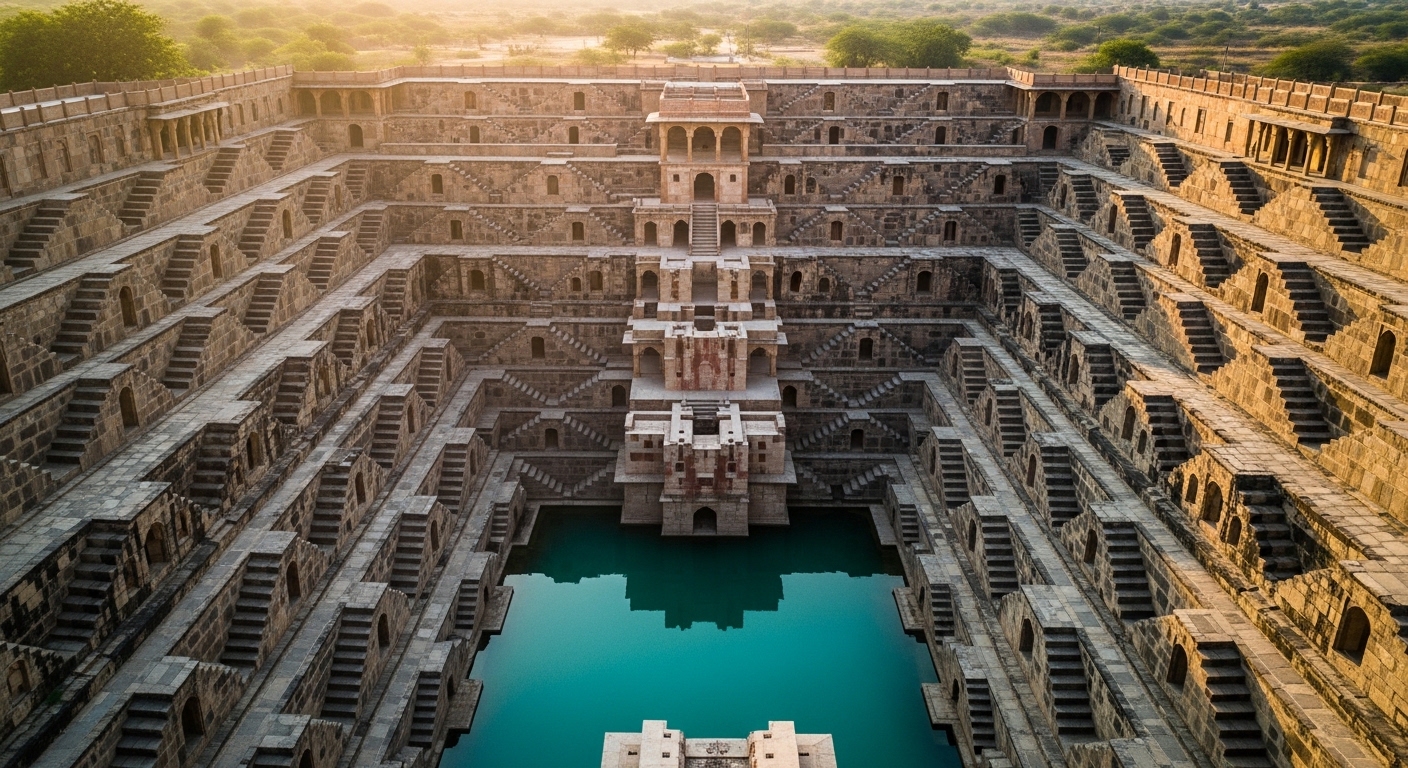
Across the world, travelers search for places that feel meaningful rather than merely beautiful. Among the most powerful of these experiences, rock-cut water stairs leading to sacred tanks stand as silent witnesses to humanity’s ancient relationship with water, faith, and survival. Instead of functioning as simple infrastructure, these stairways shape emotional journeys that guide visitors from the outer world into spaces of calm and reflection.
Moreover, these structures reveal how early civilizations understood psychology long before the term existed. As people descend, the surrounding stone absorbs sound, the temperature cools, and the mind naturally slows. Consequently, the architecture itself becomes part of the spiritual ritual.
At the same time, sacred tanks solved practical problems. Communities needed reliable water sources, especially in dry climates. Therefore, builders combined engineering knowledge with spiritual symbolism, creating systems that sustained both physical life and emotional well-being.
The Deeper Meaning Behind Sacred Water Tanks
In ancient societies, water represented far more than hydration. Instead, it symbolized rebirth, cleansing, and divine presence. For this reason, sacred tanks often appeared near temples, pilgrimage routes, and royal compounds.
Furthermore, rock carving allowed builders to shape entire landscapes rather than construct separate structures. As a result, the stairs felt like natural extensions of the earth itself.
In contrast to modern plumbing hidden underground, rock-cut water stairs leading to sacred tanks kept water visible and ceremonial. Every visit reinforced the idea that water deserved respect, not exploitation.
India’s Timeless Stepwell Civilizations
Perhaps no country illustrates sacred water architecture better than India. Across Rajasthan, Gujarat, Madhya Pradesh, and Karnataka, thousands of stepwells still survive.
For example, Rani ki Vav in Patan descends seven levels deep and displays intricate carvings depicting Hindu cosmology. Meanwhile, Chand Baori in Rajasthan uses over 3,500 steps arranged in hypnotic symmetry.
According to India’s Archaeological Survey, these stepwells once served as community centers, resting places, and ritual spaces all at once.
As a result, people did not simply collect water. Instead, they gathered, reflected, and built collective memory around these spaces.

Sri Lanka’s Hydraulic Masterpieces
Meanwhile, Sri Lankan kings developed some of the most advanced ancient water systems in the world. Cities such as Anuradhapura still rely on reservoirs carved over a thousand years ago.
At Sigiriya, royal pools carved into solid rock demonstrate how gravity-fed systems maintained stable water levels. Therefore, these pools functioned without pumps, electricity, or modern machinery.
Today, travelers following routes from Sri Lanka Tourism often describe these tanks as spiritual environments disguised as engineering wonders.
Nepal’s Sacred Himalayan Waters
In Nepal, sacred tanks connect religion with geography. Since Himalayan rivers originate from glaciers, water holds cosmic significance.
For instance, Pashupatinath Temple in Kathmandu uses ancient ponds for purification rituals. Before prayer, pilgrims descend stone stairs to symbolically cleanse both body and soul.
Consequently, the physical act of descending becomes inseparable from spiritual preparation.
Desert Survival in the Middle East
However, some of the most impressive sacred tanks exist in the world’s driest environments. In Petra, Jordan, the Nabataeans carved cisterns directly into sandstone cliffs.
Because rainfall remained unpredictable, these tanks stored seasonal water and prevented evaporation. Meanwhile, ceremonial spaces often surrounded these reservoirs.
According to Visit Jordan, many of these structures still function today despite being over 2,000 years old.
Why These Spaces Feel Emotionally Powerful
Psychologically, descending triggers a sense of humility and surrender. As the body moves downward, mental resistance fades.
Moreover, enclosed stone surfaces reduce external noise. Consequently, the mind becomes more receptive to introspection.
Unlike modern staircases built for speed, rock-cut water stairs leading to sacred tanks encourage slowness, awareness, and presence.
In fact, many visitors report feeling calmer after spending time in these spaces, even without religious beliefs.
Living Rituals in Ancient Architecture
Remarkably, many sacred tanks remain active today. In India, people still bathe before temple entry. Similarly, in Nepal, festivals revolve around ceremonial water immersion.
Meanwhile, Sri Lankan monks continue meditation beside ancient reservoirs.
As a result, these structures function not as relics but as living spiritual systems.

Modern Threats to Sacred Water Heritage
Unfortunately, urban expansion now threatens many sacred tanks. Pollution, neglect, and groundwater depletion have caused some to dry completely.
However, organizations such as UNESCO now support restoration projects across Asia and the Middle East.
Nevertheless, many smaller sites remain undocumented and vulnerable.
Lessons for Future Cities
Interestingly, modern architects increasingly study stepwells for sustainable design. Gravity-based systems reduce energy use and align with natural cycles.
Therefore, future cities may borrow ancient solutions instead of inventing new ones.
In contrast to concrete megastructures, sacred water architecture demonstrates that beauty and function can coexist.
A Personal Reflection for Readers
Have you ever visited a place that made you slow down without effort? Did stone, water, or silence shape your emotions in unexpected ways?
We invite you to share your experiences in the comments. Your story might inspire someone else to explore these hidden spaces.
Follow WentWorld.com on our social media platforms for more journeys into forgotten architecture, sacred landscapes, and unusual travel experiences across the globe.
Catch up on the top stories and travel deals by subscribing to our newsletter!