
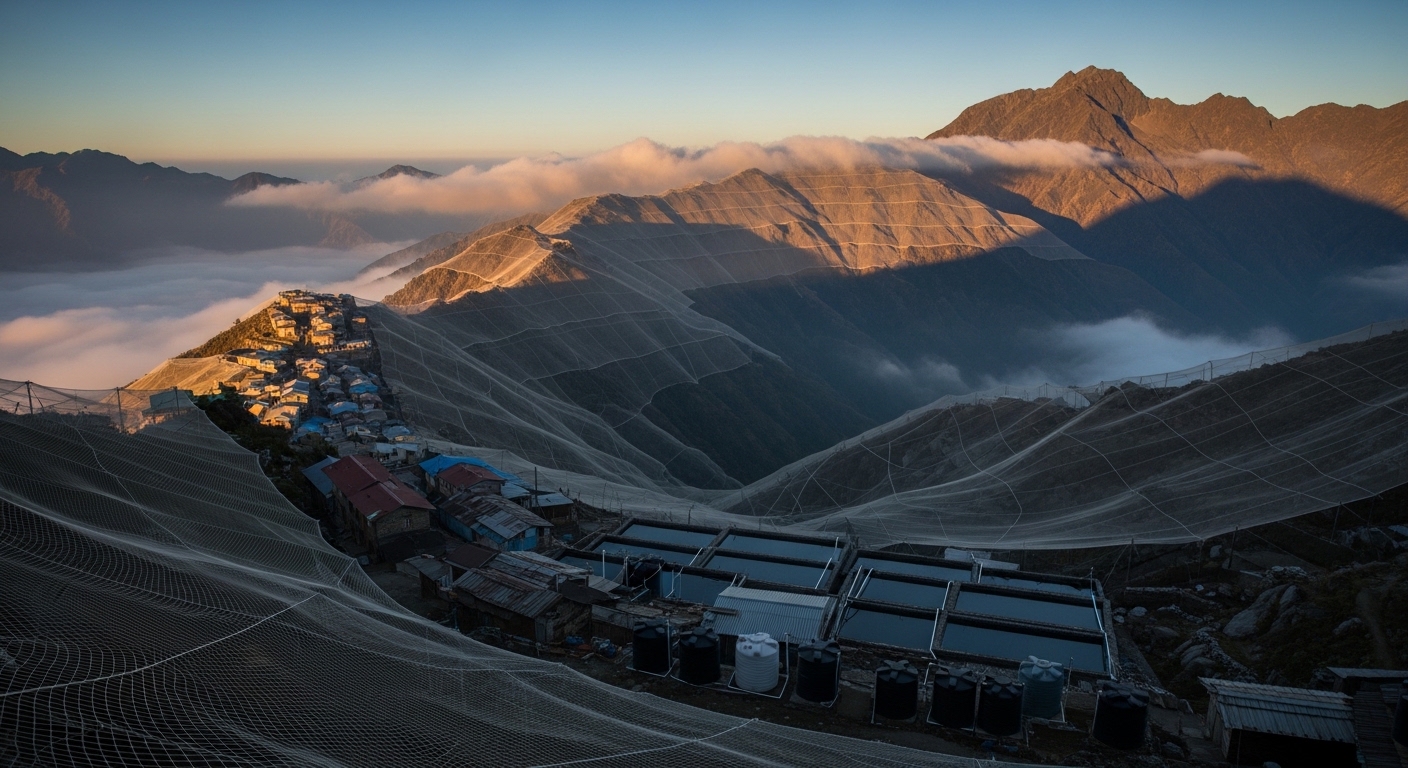
Imagine living in a place where it rarely rains, rivers are miles away, and underground water is scarce. Now imagine waking up each morning to clean drinking water collected directly from the clouds. This is not science fiction. It is the reality of cloud net villages harvesting drinking water in some of the world’s most challenging environments. These communities are transforming fog and mist into life-saving resources, proving that innovation does not always require complex machinery — sometimes, it simply requires understanding nature.
Across deserts, mountain ridges, and coastal highlands, cloud nets are quietly changing lives. Large mesh structures stretch across windy slopes, capturing microscopic droplets from passing fog. The droplets condense, flow downward into collection systems, and become usable water for households, farms, and schools. In regions where water scarcity threatens survival, this simple yet powerful idea is providing dignity, independence, and hope.
Have you ever considered that the air around you might hold enough moisture to sustain an entire village? That question sits at the heart of cloud net villages harvesting drinking water — a sustainable solution that blends traditional knowledge with modern environmental engineering.
What Are Cloud Nets and How Do They Work?
Cloud nets, often called fog collectors, are vertical mesh panels installed in areas with consistent fog movement. As moist air passes through the mesh, water droplets cling to the fibers. Gravity pulls these droplets downward into gutters and storage tanks. The system requires no electricity, no pumps, and minimal maintenance.
The technology is elegantly simple. The mesh material is typically made of polyethylene or similar weather-resistant fibers. The design maximizes surface area so even tiny droplets can accumulate. Over time, enough condensation forms to create a steady flow of water.
This process may sound small-scale, but villages using fog collectors can harvest hundreds of liters per day from a single installation. Multiply that by multiple panels, and entire communities gain reliable drinking water access.
Would you believe that a structure powered only by wind and fog could outperform expensive desalination systems in certain regions?
Where Cloud Net Villages Harvesting Drinking Water Are Thriving
Several regions around the world have embraced this innovative method. One of the earliest large-scale projects began in Chile’s Atacama Desert, one of the driest places on Earth. Organizations such as Water Foundation and academic researchers collaborated with local communities to install fog-harvesting systems in mountain areas where coastal fog is common.
In Morocco’s Anti-Atlas Mountains, villages have adopted cloud nets to reduce the burden on women and children who previously walked miles to fetch water. International support from groups like UN-Water has highlighted these villages as models of sustainable innovation.
Peru and parts of Ecuador have also implemented fog collection programs in highland communities. The technology continues to expand as climate change intensifies drought conditions globally.
Can you imagine living in a desert and seeing your water tank fill simply because fog rolled in overnight?

Why Cloud Net Villages Harvesting Drinking Water Matter More Than Ever
Climate change is disrupting rainfall patterns, shrinking glaciers, and increasing water stress in vulnerable regions. Traditional water infrastructure is expensive and energy-intensive. In contrast, cloud net villages harvesting drinking water demonstrate a decentralized, low-cost solution.
These systems are especially valuable in remote areas where pipelines and reservoirs are impractical. They reduce dependence on trucked water deliveries, cut fuel costs, and minimize carbon emissions. Most importantly, they empower communities to manage their own water resources.
Access to clean water improves health outcomes, increases school attendance, supports agriculture, and boosts local economies. When water is secure, communities can thrive.
The Social Impact on Local Communities
In many fog-harvesting villages, the introduction of cloud nets has transformed daily life. Women who once spent hours walking for water now have time for education, entrepreneurship, or family care. Children can attend school consistently instead of assisting with water collection.
Local farmers use harvested water to irrigate small gardens, improving nutrition and food security. Health clinics report reductions in waterborne diseases as cleaner sources become available.
Would you consider fog harvesting if it meant saving your family several hours every day?
Environmental Benefits of Fog Harvesting
Cloud net systems are environmentally friendly. They require no fossil fuels and have minimal ecological impact. Unlike dams or large reservoirs, fog collectors do not disrupt ecosystems or wildlife migration patterns.
Additionally, these systems encourage environmental stewardship. Communities become more aware of wind patterns, seasonal fog cycles, and ecological balance. This awareness often leads to broader sustainability efforts, such as reforestation and soil conservation projects.
Organizations like National Geographic Environment have highlighted fog harvesting as one of the promising nature-based solutions for water scarcity.
Challenges Facing Cloud Net Villages Harvesting Drinking Water
Despite their success, fog-harvesting systems are not without challenges. They depend on consistent fog patterns, which can shift due to climate variability. Mesh materials may degrade over time and require replacement.
Maintenance training is essential to ensure sustainability. Without local involvement and ownership, projects risk falling into disrepair. Funding for installation can also be a barrier, although long-term costs are relatively low compared to traditional infrastructure.
How can governments and NGOs better support communities adopting fog collection systems?

The Role of Innovation and Future Expansion
Researchers continue to improve mesh efficiency, experimenting with biomimicry inspired by desert beetles that collect water from air. Advanced materials may increase collection rates while remaining affordable.
Urban planners are also exploring fog harvesting in coastal cities with frequent mist, integrating cloud nets into green rooftops and public spaces. Imagine city parks that collect drinking water while serving as educational installations.
Airlines such as LATAM Airlines have even promoted eco-tourism initiatives near fog-harvesting communities, raising awareness about sustainable travel and innovation.
What Travelers Can Learn from Cloud Net Villages
Visiting cloud net villages harvesting drinking water offers a powerful lesson in resilience and creativity. Travelers witness how communities adapt to extreme environments without relying solely on large-scale industrial solutions.
Eco-conscious travelers researching destinations through platforms like Lonely Planet often seek experiences that showcase sustainability in action. Fog-harvesting villages provide exactly that — real stories of ingenuity and hope.
Would you add a visit to a cloud net village to your travel bucket list?
The Bigger Picture: Rethinking Water Scarcity
Cloud net villages harvesting drinking water challenge conventional thinking about water infrastructure. Instead of viewing water scarcity as an insurmountable crisis, these communities see opportunity in the atmosphere itself.
The success of fog harvesting proves that solutions do not always require massive budgets or advanced technology. Sometimes, the answer lies in observing natural processes and adapting them thoughtfully.
As global populations grow and climate pressures intensify, decentralized systems like fog collection may become increasingly vital. Could this simple mesh structure represent one of the most underestimated solutions to the global water crisis?
We would love to hear your thoughts. Do you think cloud harvesting could work in more regions? Have you ever seen fog collectors in person? Share your perspective in the comments below.
Follow WentWorld.com on our social media platforms for more inspiring stories about innovative communities, hidden destinations, and sustainable travel solutions shaping the future.
Catch up on the top stories and travel deals by subscribing to our newsletter!










Leave a Reply
You must be logged in to post a comment.