
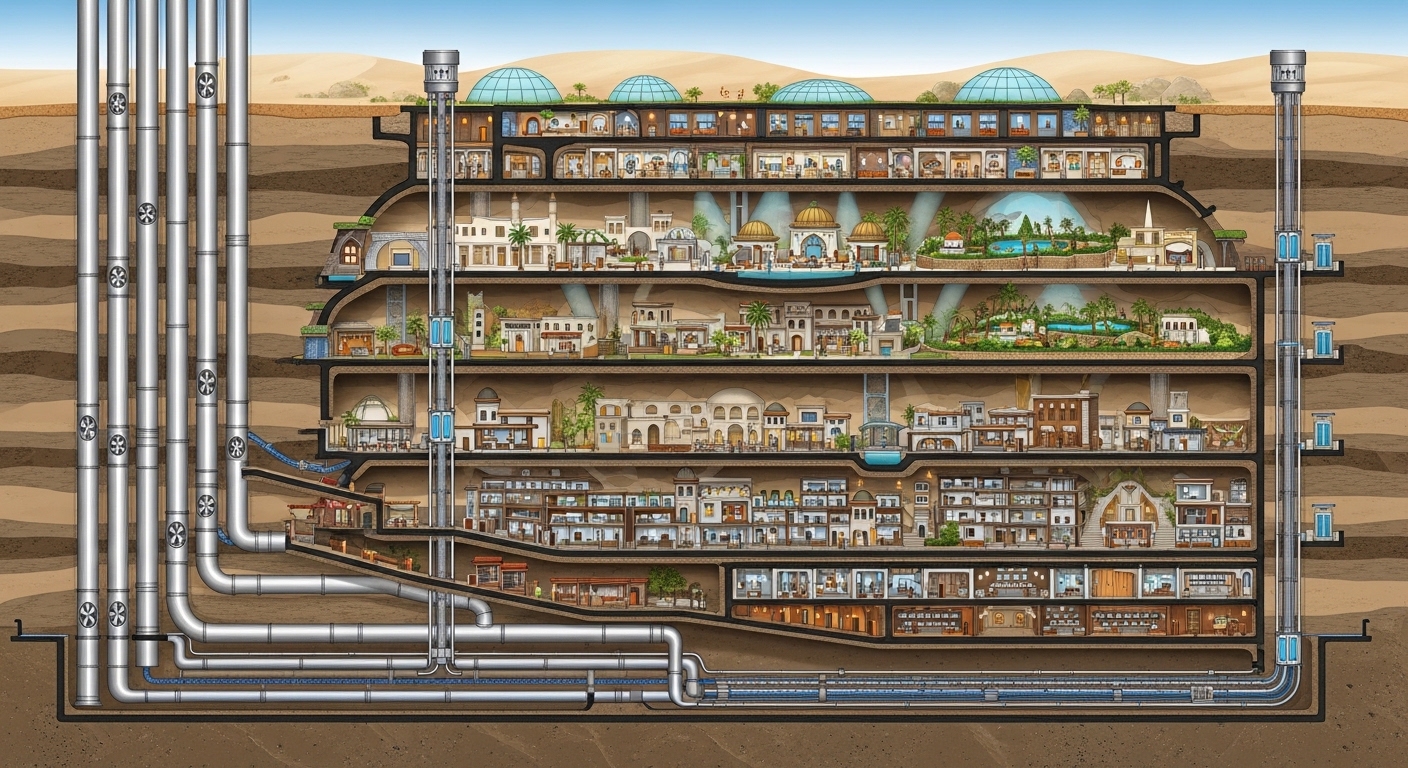
There is something quietly unbelievable about desert underground cities with passive cooling mazes. While most people imagine deserts as wide open landscapes scorched by relentless sun, some of the most intelligent human settlements in history exist beneath the sand. These are cities carved into rock and earth, where temperature stays comfortable without air conditioning, electricity, or modern technology. Instead of fighting the heat, these communities learned how to live with it.
In a world obsessed with smart homes and climate control, these underground cities feel almost futuristic, yet they are ancient. They are built on principles of airflow, thermal mass, and natural insulation. The result is a network of tunnels, rooms, courtyards, and passageways that stay cool even when the surface temperature becomes unbearable. Have you ever wondered how people survived extreme climates before electricity existed?
This is where desert underground cities with passive cooling mazes come in. These places are not just architectural marvels; they are lessons in sustainability, resilience, and human ingenuity. They show us that comfort does not always require technology, and sometimes the smartest solutions are the oldest ones.
What Makes Passive Cooling So Powerful
Passive cooling is the art of controlling temperature without machines. Instead of using energy, these underground cities rely on physics. Thick walls absorb heat during the day and release it slowly at night. Deep chambers remain shielded from the sun. Narrow corridors guide airflow naturally, creating ventilation without fans.
The deeper you go underground, the more stable the temperature becomes. In many desert regions, while surface temperatures may reach 45°C or higher, underground spaces remain close to 20°C. This natural regulation makes underground living not just comfortable, but often healthier than surface housing.
Imagine walking into a tunnel from the blazing desert sun and instantly feeling a cool breeze. No humming machines. No artificial air. Just natural balance. Would modern cities feel different if we learned to build like this again?
Derinkuyu, Turkey
One of the most famous underground cities in the world is Derinkuyu in Cappadocia, Turkey. This massive subterranean settlement extends more than 60 meters underground and once housed up to 20,000 people.
Derinkuyu is a masterpiece of passive cooling design. Its vertical shafts act as natural ventilation systems. Cold air sinks downward, while warm air rises and escapes through narrow openings. Even today, walking through Derinkuyu feels surprisingly refreshing, regardless of how hot it is outside.
The city includes kitchens, schools, wine presses, animal shelters, and even churches. Every space is connected through a maze-like system of tunnels designed not only for cooling but also for security and privacy. Travelers often reach this region through airlines like Turkish Airlines, which connects major cities worldwide to Cappadocia.

Matmata, Tunisia
In southern Tunisia lies Matmata, a village famous for its underground homes carved into soft rock. From the surface, you might see only circular holes in the ground. But below lies a complete residential world built around sunken courtyards.
Each home is carved around a central pit that allows light and air to enter while keeping heat out. Rooms open into this courtyard, maintaining stable temperatures year-round. Even during peak summer, indoor temperatures remain dramatically lower than outside.
Matmata became globally known after being used as a filming location for Star Wars. Yet long before cinema, it was a living example of how desert underground cities with passive cooling mazes could thrive without modern infrastructure.
Coober Pedy, Australia
Coober Pedy is a modern underground town in South Australia where people still actively live below ground. Known as a “dugout town,” most residents build their homes inside hills and rock formations.
Surface temperatures often exceed 40°C, making traditional housing uncomfortable and expensive to cool. Underground homes, however, remain naturally insulated. Many locals say they rarely need air conditioning at all.
What makes Coober Pedy fascinating is that it proves these ancient design principles still work in the modern world. Residents enjoy cinemas, churches, hotels, and even swimming pools underground. It is not a relic of history; it is a living experiment in climate-smart design.
Naours, France
Although not located in a hot desert, Naours in northern France demonstrates similar passive cooling concepts. This underground city consists of more than 300 rooms carved into limestone, originally used for shelter during conflicts.
The internal temperature stays consistent year-round, regardless of external weather. This stability highlights how underground architecture is not just useful for deserts, but for any region facing climate extremes.
It raises an interesting question: why did humanity abandon such efficient designs in favor of energy-heavy buildings?
How Cooling Mazes Actually Work
The maze-like structure of these underground cities is not random. Each turn, shaft, and chamber serves a purpose. Narrow passages slow down air, allowing it to cool naturally. Vertical shafts act as thermal chimneys. Thick rock walls store cold air overnight and release it during the day.
Some cities even use water channels to enhance cooling. As air passes over cool water, its temperature drops further. This technique predates modern evaporative cooling systems by thousands of years.
These cooling mazes are silent systems. They never break down, never consume power, and never pollute. They simply work, as long as the structure remains intact.
Emotional Experience of Underground Living
Living underground changes how you experience space. There is no sky above you, yet many people describe feeling safer, calmer, and more focused. The silence is deeper. The air feels heavier but steadier.
Some travelers say underground cities feel like stepping into another dimension. Time seems slower. Sounds are muted. Light behaves differently. It is an environment that forces introspection.
Have you ever visited a place that made you feel disconnected from the outside world in a good way?

Lessons for Future Cities
As climate change intensifies, surface cities are becoming harder to cool. Energy demands for air conditioning are rising rapidly. Meanwhile, underground cities offer a blueprint for low-energy living.
Architects and urban planners are now studying ancient designs to develop modern underground infrastructure. Research from organizations like MIT shows that passive cooling can reduce energy consumption by up to 70% in some climates.
What if future megacities were partially underground? Would we see fewer power outages, lower carbon emissions, and more resilient communities?
Why These Cities Matter Today
Desert underground cities with passive cooling mazes are more than travel curiosities. They are proof that humans once built in harmony with nature instead of against it.
They teach us that sustainability does not require innovation alone; it requires memory. Remembering what worked before electricity, before glass towers, before machines controlled every breath of air.
In many ways, these cities feel like messages from the past, reminding us that survival does not always mean domination. Sometimes it means adaptation.
We would love to hear your thoughts. Would you live in an underground city if it meant lower costs, stable temperatures, and a smaller environmental footprint? Or does the idea of living below the surface feel unsettling?
If stories like this spark your curiosity about the hidden sides of our planet, follow WentWorld.com on our social media platforms to stay connected with rare destinations, forgotten architecture, and the future of sustainable travel.
Catch up on the top stories and travel deals by subscribing to our newsletter!









Leave a Reply
You must be logged in to post a comment.