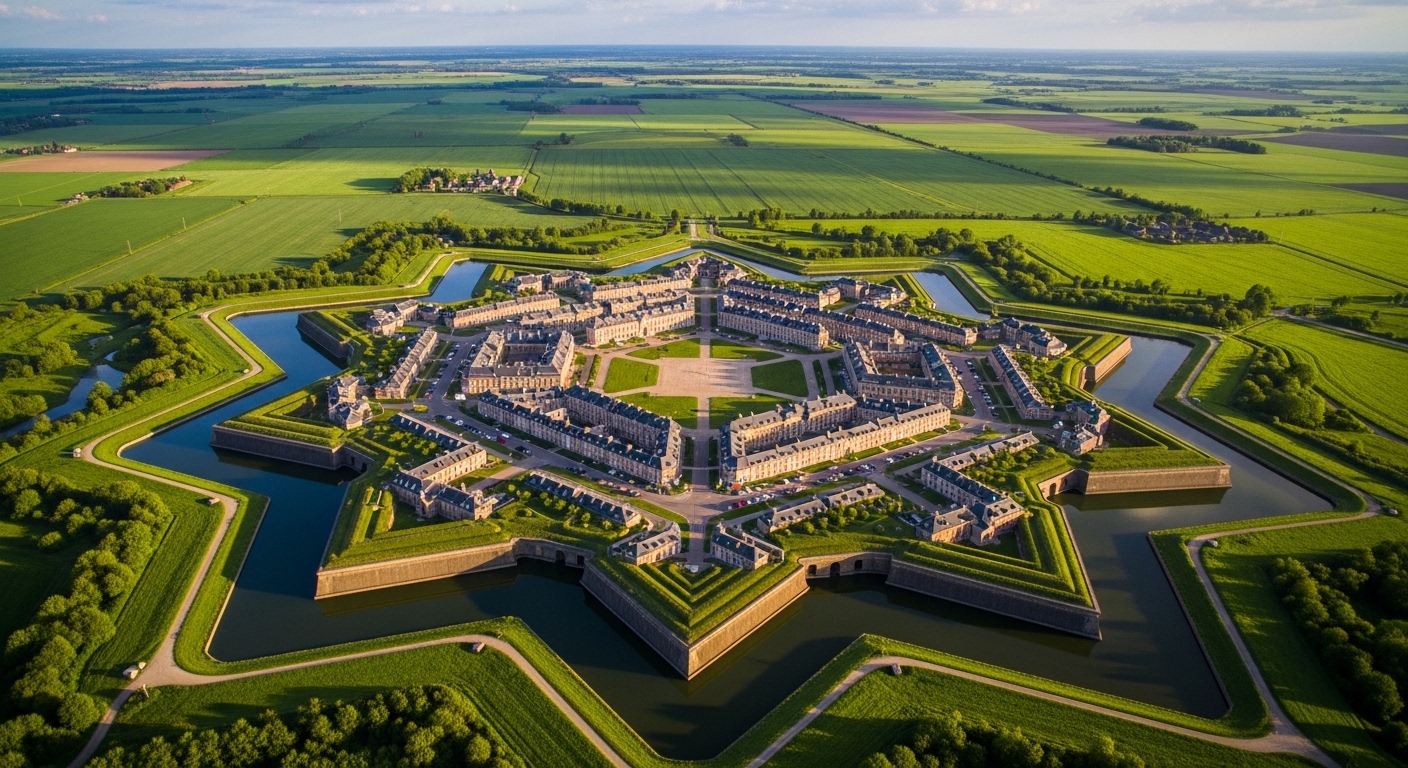
Some cities are meant to be explored on foot. Others reveal their true magic only from above. Star-shaped fort towns seen best from above fall firmly into the second category. From ground level, they may look like quiet historic towns with stone walls and narrow streets. But once viewed from the sky, their true identity appears: perfect geometric stars carved into landscapes, designed with military precision and artistic brilliance.
These fort towns are not accidents. They are masterpieces of early modern engineering, built to defend against cannon fire and invading armies. Today, they stand as some of the most visually striking urban designs ever created. Have you ever wondered why so many historic forts resemble stars instead of circles or squares? And why aerial views are the only way to fully understand them?
The Origins of Star-Shaped Fort Towns
The rise of star-shaped fort towns dates back to the 15th and 16th centuries, when gunpowder warfare transformed military strategy. Medieval castle walls, once effective against arrows and ladders, became useless against cannons. Engineers responded with a revolutionary solution: angled bastions arranged in star formations.
This design allowed defenders to eliminate blind spots and fire upon attackers from multiple angles. Thick earthen walls absorbed cannon impacts better than vertical stone. Over time, entire towns were built within these defensive stars, blending civilian life with military necessity.
Many star-shaped fort towns seen best from above still retain their original outlines centuries later. Do you think modern cities could ever achieve this level of intentional design?
Why These Towns Are Truly Appreciated From the Sky
Walking through a star-shaped fort town, you might notice sloped walls, triangular plazas, and oddly angled streets. Yet the full pattern remains invisible at ground level. Only from above does the star emerge clearly, revealing symmetry that feels almost mathematical.
This is why aerial photography, satellite imagery, and drone footage have renewed global interest in these towns. Platforms like Google Earth allow travelers to explore these structures virtually before visiting them in person.
Have you ever looked at a place on a map and realized it was far more impressive than you imagined?
Palmanova, Italy: The Perfect Nine-Pointed Star
Palmanova is often considered the most perfect example among star-shaped fort towns seen best from above. Built in 1593 by the Venetian Republic, this town features a flawless nine-pointed star design surrounded by massive defensive walls.
From the air, Palmanova looks almost unreal, like a symbol drawn by hand rather than a functioning town. Inside, the streets radiate outward from a central hexagonal plaza, creating balance and harmony rarely seen in urban planning.
Visitors exploring northern Italy via Italy’s official tourism portal often describe Palmanova as a place where geometry and daily life coexist effortlessly.

Naarden, Netherlands: A Star Floating in Water
Naarden is one of the best-preserved fortified towns in Europe and a shining example of how water was integrated into star-shaped defenses. Surrounded by moats and canals, Naarden’s star form becomes especially dramatic when viewed from above.
Each bastion extends into the water, creating layers of defense that once made the town nearly impossible to attack. Today, the same waterways add beauty and tranquility rather than fear.
The Netherlands’ long relationship with military engineering and water management is documented extensively by Holland tourism resources. Would you prefer a city protected by walls, water, or both?
Elvas, Portugal: Europe’s Largest Fortified System
Elvas is not just a star-shaped town—it is a massive fortified landscape. Located near the Spanish border, Elvas features multiple star-shaped forts connected by defensive lines.
From above, the scale becomes breathtaking. The town appears wrapped in layers of geometry, each designed to delay and defeat invading forces. UNESCO recognizes Elvas as a World Heritage Site, highlighting its historical and architectural importance.
Have you ever seen a city designed almost entirely around defense?
Neuf-Brisach, France: Military Precision at Its Finest
Designed by famed military engineer Vauban, Neuf-Brisach is a textbook example of a star-shaped fort town. Built in the late 17th century, it features symmetrical bastions, straight streets, and perfectly aligned gates.
Vauban’s influence spread across Europe, shaping dozens of fortifications. Neuf-Brisach remains one of his most refined creations and is often studied in architecture and military history programs.
Travelers planning routes through eastern France often discover this hidden gem through guides like France’s official tourism site.
The Psychological Power of Star Geometry
Star-shaped fort towns were not only defensive tools; they were psychological statements. Their sharp angles and massive scale projected power and control. From above, they symbolized order imposed upon chaos.
Modern architects still draw inspiration from this geometry, using angular layouts in government buildings and cultural spaces. The star shape continues to represent authority, balance, and protection.
Do you think architecture can influence how safe or powerful a place feels?

Star-Shaped Fort Towns in the Age of Drones
Today, star-shaped fort towns seen best from above are experiencing a renaissance thanks to drone photography. Aerial images shared across travel platforms have turned these historic towns into viral sensations.
Travelers often say that seeing these towns from above first enhances the experience of walking through them later. It adds context, scale, and appreciation.
Would you plan a trip differently if you could preview destinations from the sky?
Preservation Challenges and Modern Life
Preserving star-shaped fort towns presents unique challenges. Urban expansion, traffic, and modern infrastructure must be carefully managed to avoid damaging historic layouts.
Many cities have chosen adaptive reuse, turning bastions into parks, museums, and cultural venues. This allows towns to remain alive while respecting their original form.
Should historic cities remain frozen in time, or evolve carefully with modern needs?
Why These Towns Belong on Your Travel Bucket List
Star-shaped fort towns are more than historical curiosities. They are reminders of a time when cities were designed with intention, foresight, and craftsmanship.
From Italy to Portugal, the Netherlands to France, these towns offer travelers a rare blend of history, beauty, and intellectual curiosity. Exploring them connects you to centuries of strategic thinking and architectural ambition.
If you could only see one city from above in your lifetime, would you choose a modern skyline or a perfect historic star?
We would love to hear your thoughts. Have you visited any star-shaped fort towns, or discovered one unexpectedly while browsing maps? Share your experiences in the comments.
Follow WentWorld.com on our social media platforms for more fascinating travel stories, architectural wonders, and destinations that reveal their secrets from unexpected angles.
Catch up on the top stories and travel deals by subscribing to our newsletter!