
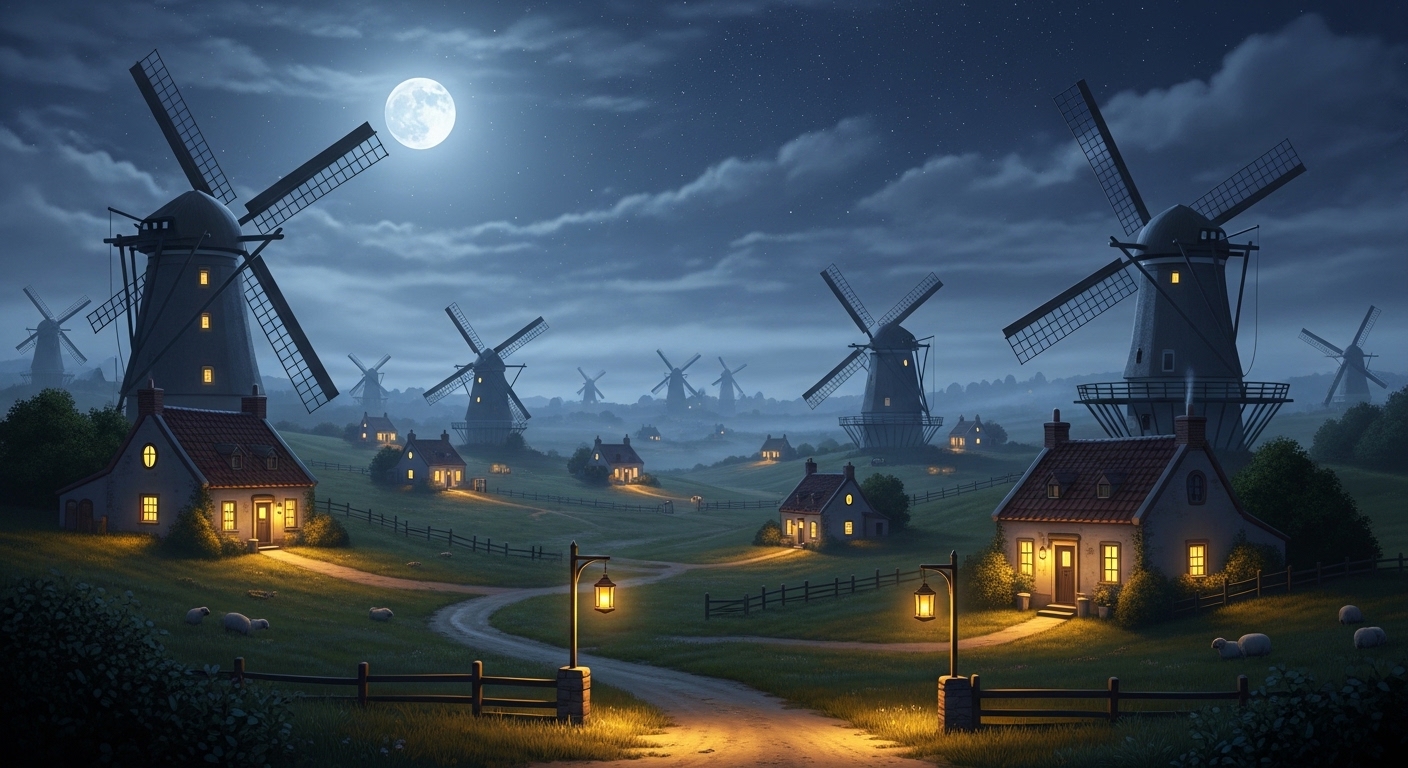
Some of the most fascinating places in the world reveal themselves only when most people are asleep. Among them are windmill villages that grind only at night, quiet rural settlements where massive wooden blades remain still all day and come alive only after sunset. While modern cities glow brighter at night, these villages move in the opposite rhythm, choosing darkness as their working hour.
At first glance, a windmill village during the day feels like a museum. The structures stand tall but silent, almost decorative. Tourists take photos, birds circle lazily, and nothing seems to move. But when the sun dips below the horizon, something remarkable happens. The air shifts, the wind changes direction, and suddenly the old machinery awakens. Gears creak, sails turn, and flour begins to grind under moonlight.
This hidden routine raises an interesting question. Why would entire villages choose to operate only at night? Is it tradition, necessity, or something deeper connected to nature itself?
In this WentWorld.com journey, we explore the rare phenomenon of windmill villages that grind only at night. We look at how these traditions began, where you can still witness them today, and what it feels like to stand in the dark listening to machines that are centuries old.
The Forgotten Logic of Night Grinding
The idea of working only at night may seem strange in a world built around daylight productivity. But for traditional windmill villages, night grinding was often the smartest solution.
In many regions, especially in coastal or desert-adjacent areas, wind patterns change dramatically after sunset. During the day, heat creates unstable air currents that shift direction frequently. At night, cooler air produces steadier winds, ideal for consistent grinding.
Another reason was social. In agricultural communities, daytime hours were reserved for farming, trading, and household labor. Milling was a secondary task, often handled overnight so daily life remained uninterrupted.
There was also a practical advantage. Night grinding reduced dust exposure for villagers and minimized fire risks caused by flour particles floating in warm air.
Over time, these practical decisions turned into tradition. Entire villages adopted nocturnal schedules, creating a cultural identity tied to moonlight labor.
Kinderdijk, Netherlands
One of the most famous windmill regions in the world is Kinderdijk in the Netherlands. While today the mills are mostly preserved for heritage, some still operate during evening hours for demonstration and water management.
Kinderdijk was built as part of an advanced flood-control system. The mills regulate water levels rather than grind grain, but historically many Dutch villages used similar night-only systems for flour production.
Standing near these mills after dark is an entirely different experience. The crowds vanish. The canals become black mirrors. The sound of rotating sails echoes softly across the fields.
The Netherlands tourism board provides historical context through holland.com, but nothing compares to witnessing a working mill under starlight.

Campo de Criptana, Spain
In central Spain lies Campo de Criptana, a village famous for its white windmills that inspired Miguel de Cervantes’ Don Quixote.
While modern visits happen during daylight, historical records show that many mills in this region traditionally operated after sunset. The dry Castilian plains produced stronger, more predictable winds at night, perfect for grinding wheat.
Local families would deliver grain before dusk and return at dawn to collect flour. The entire village economy moved quietly through darkness.
Spain’s tourism authority documents these traditions on spain.info, but again, most travelers never experience the true nocturnal atmosphere.
Mykonos, Greece
Mykonos is known today for beaches and nightlife, but its iconic windmills once formed the backbone of the island’s food supply.
These windmills were strategically placed to capture the strong Aegean winds, which intensified during evening hours. Fishermen worked at sea during the day, and milling took place overnight so fresh bread could be baked by morning.
Although the mills no longer grind regularly, some cultural festivals recreate the night operations, offering rare glimpses into the island’s original rhythm.
Greece’s heritage sites are documented by visitgreece.gr.
Why Night Mills Feel So Different
Watching a windmill during the day feels educational. Watching one at night feels emotional.
In darkness, the machines seem alive. Shadows stretch across the fields. The steady rotation creates a hypnotic rhythm that feels older than modern timekeeping.
There is also a strange intimacy to night grinding. With fewer people around, the experience becomes personal. You hear sounds normally drowned out by daylight noise: wooden joints, shifting gears, the soft rush of air through canvas sails.
Have you ever stood in complete darkness listening to something that has been working the same way for hundreds of years? It changes how you think about progress.
Modern Villages Keeping the Tradition Alive
While most windmills are now symbolic, a few villages still maintain limited night operations for cultural preservation and artisanal flour production.
In parts of Portugal’s Alentejo region, small cooperatives operate windmills after sunset to align with traditional methods and avoid daytime tourism crowds.
Similarly, some rural communities in Morocco maintain night grinding due to desert heat, where daytime milling would be impractical.
Airlines like Iberia and Royal Air Maroc now make these once-isolated regions more accessible.

The Environmental Advantage of Nocturnal Milling
Windmill villages that grind only at night unknowingly practiced sustainable energy centuries before modern environmental movements.
They optimized wind efficiency, minimized fuel consumption, and worked in harmony with natural cycles. No electricity. No emissions. Just air and wood.
In today’s world of climate concerns, these systems feel surprisingly modern.
Organizations like UNESCO have recognized many windmill landscapes as cultural heritage sites due to their sustainable design.
Why These Places Matter Emotionally
Windmill villages that grind only at night represent something rare: a community choosing patience over speed.
They remind us that not everything needs to happen immediately. Some processes benefit from waiting for the right moment rather than forcing results.
In a digital world obsessed with constant availability, these villages quietly suggest an alternative philosophy: work when nature allows, rest when it doesn’t.
Would modern life feel different if we allowed ourselves similar rhythms?
Planning a Visit Without Ruining the Magic
If you ever visit a windmill village with night operations, respect is essential.
Avoid artificial lighting. Keep noise minimal. Do not interrupt millers during work hours. These traditions survive because they remain functional, not performative.
Many communities allow limited night viewing only during special seasons. Always confirm locally rather than relying solely on online schedules.
The goal is not entertainment, but preservation.
Why WentWorld Keeps Seeking These Stories
At WentWorld.com, we believe the most powerful travel stories are hidden in routines, not landmarks.
Windmill villages that grind only at night are not famous because they do not seek attention. They exist quietly, following rhythms older than tourism.
And perhaps that is exactly why they matter.
We invite you to reflect. Have you ever experienced a place that worked on a different schedule than the rest of the world? Did it change how you viewed time itself?
Share your experiences with us, and let us know which hidden traditions you think deserve more attention.
If stories like this inspire your curiosity, follow WentWorld.com on our social media platforms and continue discovering the world’s most quietly extraordinary places.
Catch up on the top stories and travel deals by subscribing to our newsletter!









Leave a Reply
You must be logged in to post a comment.