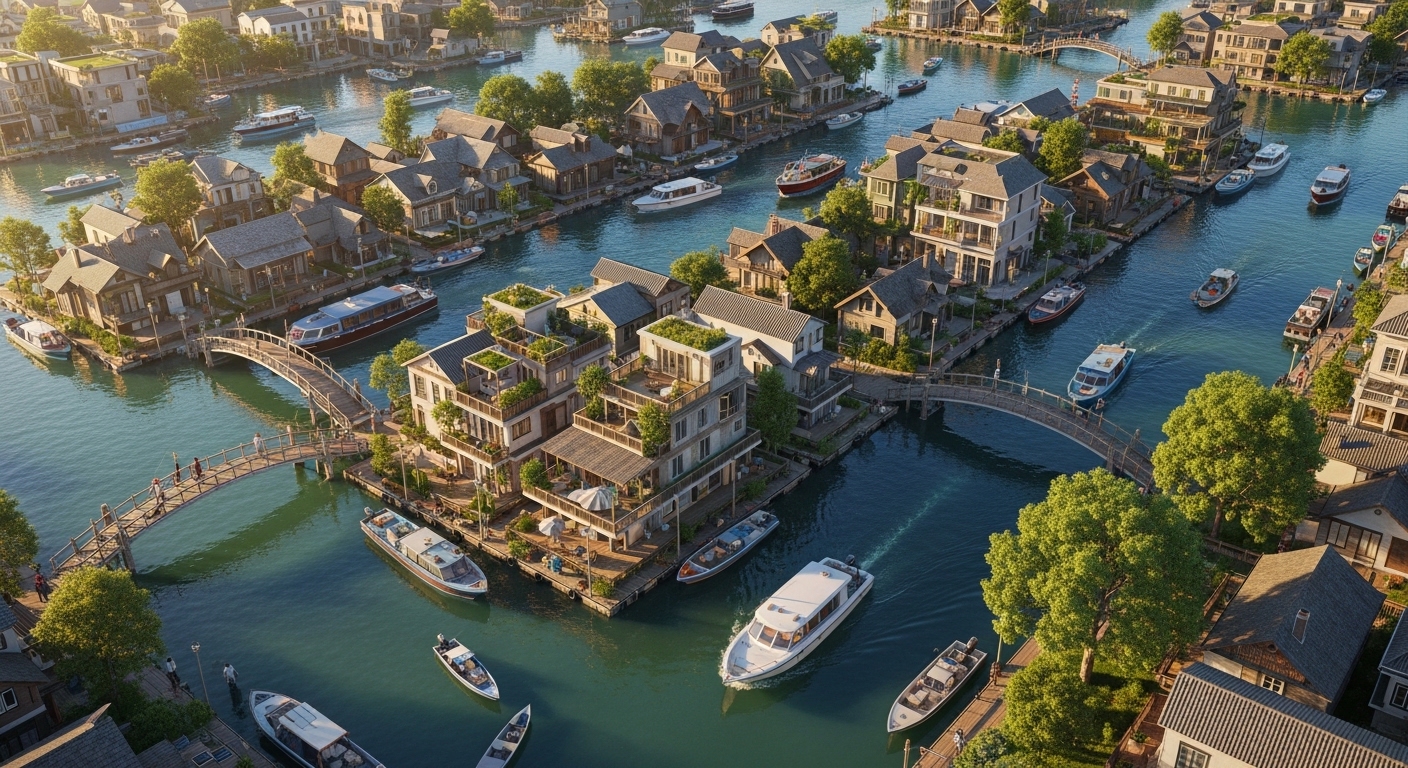
There is something quietly fascinating about boardwalk cities built over marsh—no streets required. These places challenge almost everything we associate with urban life. Instead of traffic jams and crowded highways, movement happens slowly, often by foot or boat. Rather than concrete roads, there are wooden walkways, water channels, and stilted homes. As a result, daily life feels calmer, more intentional, and deeply connected to the environment.
At first glance, these cities seem almost imaginary. Houses appear to float above water. Shops connect through narrow planks rather than sidewalks. Children walk to school over bridges instead of streets. Yet for millions of people worldwide, this lifestyle is completely normal. In fact, it has existed for centuries.
Boardwalk cities built over marsh—no streets required—exist because humans learned to adapt instead of dominate. Where land was too soft for roads, people built above it. Where flooding was unavoidable, they embraced elevation. Consequently, these cities are not accidents of poor planning; rather, they are examples of extraordinary environmental intelligence.
Have you ever wondered what a city feels like when movement is quiet and everything happens at walking speed?
Why These Cities Exist in the First Place
Marshlands are some of the most difficult environments for traditional urban development. The soil is unstable, constantly shifting, and saturated with water. Because of this, roads crack, foundations sink, and drainage systems fail repeatedly.
However, instead of forcing infrastructure into unsuitable land, some cultures developed alternative solutions. Rather than building outward, they built upward. Wooden walkways replaced roads. Boats replaced cars. Over time, elevation replaced excavation.
Interestingly, these choices were not driven by modern sustainability movements. Instead, they emerged purely from survival needs. Nevertheless, today they appear remarkably futuristic.
Is it possible that some of the most sustainable urban designs were created long before the idea of sustainability even existed?
Ganvie, Benin – The Venice of Africa
One of the most famous examples of boardwalk cities built over marsh—no streets required—is Ganvie in Benin. Located on Lake Nokoué, Ganvie is home to more than 20,000 residents who live almost entirely on water.
Originally, the city was founded as a refuge. Local communities escaped slave raids by settling on the lake, since their enemies believed the water was spiritually forbidden. Over time, what began as survival evolved into a permanent settlement.
Today, stilt houses, floating markets, and wooden walkways form a fully functioning urban system. Children travel by canoe. Shopping happens by boat. Even schools and churches stand above water on wooden pillars.
Not surprisingly, UNESCO has recognized Ganvie as a culturally significant site due to its rare architectural adaptation.
What would daily life feel like if every errand required paddling instead of driving?

Kampong Ayer, Brunei – A City on Stilts
Meanwhile, in Southeast Asia, Kampong Ayer offers another striking example. Often described as the world’s largest water village, Kampong Ayer is actually a network of dozens of communities connected by more than 30 kilometers of wooden boardwalks.
Over 13,000 people live here, including families, workers, and students. Schools, mosques, hospitals, and police stations all stand on stilts above the Brunei River.
Although the city looks ancient, it has modern infrastructure. Electricity, internet, and sanitation are fully integrated. However, despite these advancements, there are still no streets. Movement depends entirely on footbridges or water taxis.
Brunei’s tourism authority, tourism.gov.bn, highlights Kampong Ayer as a living cultural heritage site.
Can you imagine commuting to work by crossing wooden bridges instead of sitting at traffic lights?
Belén, Peru – Floating Amazonian Life
In contrast to Brunei’s organized layout, Belén in Peru offers a much more fluid experience. Located in the Amazon basin, this district of Iquitos literally rises and falls with river levels.
During the dry season, wooden walkways connect homes and shops. However, during the rainy months, entire neighborhoods float. Boats replace boardwalks completely.
Rather than resisting flooding, residents adapt to it. Homes are built on stilts or floating platforms. Markets operate on water. Daily routines shift according to river cycles.
Research published by National Geographic often cites Belén as a powerful example of human resilience.
Would you feel comfortable living in a city where the ground disappears for half the year?
Giethoorn, Netherlands – The Village Without Roads
Moving to Europe, Giethoorn provides a quieter, more romantic version of streetless living. Located in the Netherlands, this village replaced roads with canals centuries ago.
Although Giethoorn is not tropical, it was built on reclaimed wetland. Therefore, traditional roads were impractical. Instead, waterways and wooden bridges became the primary infrastructure.
Today, tourists move through the village in silent electric boats. Locals walk or bike along narrow boardwalks lined with gardens and cottages.
Travel platforms such as Lonely Planet regularly describe Giethoorn as one of the most peaceful places in Europe.
Does silence become a luxury when urban life slows down this much?
Life Without Streets: How Daily Routines Change
In boardwalk cities built over marsh—no streets required—daily routines feel fundamentally different.
First of all, movement becomes intentional. There is no rushing to beat traffic. Instead, people walk, paddle, or wait. As a result, time feels slower.
Secondly, social interaction increases naturally. Narrow walkways force eye contact. Boats pass close together. Therefore, community becomes unavoidable.
Moreover, children develop remarkable balance and spatial awareness. Elderly residents maintain mobility longer due to constant walking.
Is modern loneliness partly caused by how isolated our road-based cities have become?
The Environmental Advantage
From a sustainability perspective, boardwalk cities built over marsh—no streets required—are surprisingly efficient.
They require minimal land excavation. They produce fewer emissions due to reduced vehicle use. Additionally, they adapt to flooding instead of fighting it.
Urban planners increasingly study these models. For instance, research from the World Bank explores floating infrastructure as a future climate solution.
As sea levels rise, these designs may become not just interesting, but necessary.
Could the future of coastal cities resemble wooden bridges more than asphalt highways?

The Psychological Effect of Water-Based Cities
Living surrounded by water changes how people think and feel. Studies in environmental psychology consistently show that water reduces stress and improves emotional balance.
In boardwalk cities, water is not an escape. Instead, it becomes part of identity. Your street is water. Your backyard is water. Your skyline reflects off water.
Consequently, residents often describe stronger mental clarity and slower emotional rhythms.
Is it possible that modern burnout is partly caused by concrete environments disconnected from natural flow?
Challenges and Realities
Of course, these cities are not perfect. Infrastructure maintenance is expensive. Wooden structures decay. Emergency access is limited.
Furthermore, in poorer regions, sanitation and healthcare become serious challenges. Flooding spreads disease. Climate change increases unpredictability.
Yet despite these difficulties, people continue to live in these environments because they offer something rare: belonging shaped by geography, not architecture.
What These Cities Teach the World
Ultimately, boardwalk cities built over marsh—no streets required—teach us that cities do not need to dominate nature to succeed.
Instead, they show that adaptation can create beauty, resilience, and community.
Progress does not always mean taller buildings and wider roads. Sometimes progress looks like wooden bridges, quiet mornings, and movement shaped by tides.
As WentWorld.com continues exploring unconventional urban spaces, we invite you to reflect on your own city. Does it feel designed for people, or for vehicles?
Have you ever visited a place without streets? Did it change how you felt about urban life?
We would love to hear your experiences and perspectives. Share your thoughts with us and tell us which water-based city surprised you the most.
Follow WentWorld.com on our social media platforms to stay inspired by places that redefine what cities can be.
Catch up on the top stories and travel deals by subscribing to our newsletter!