Before glass towers and steel skylines, there were mudbrick masterpieces—earth-born wonders molded by hand and baked by the sun. These ancient, eco-friendly creations didn’t just provide shelter; they told the story of civilization’s earliest bond with the earth itself. From the ochre walls of Mali’s mosques to the adobe villages of the American Southwest, mudbrick architecture has shaped some of the world’s most enduring cultural landscapes.
Ever wondered how structures made of nothing more than soil, water, and straw could last for centuries? Or why, in an age of modern construction materials, people are returning to these simple techniques? Welcome to the world of mudbrick masterpieces—a living reminder that sustainability isn’t a trend; it’s a timeless tradition.
In this journey through global earthen architecture circuits, we’ll travel from Africa to Asia, South America to the Middle East, exploring communities that have perfected the art of turning dirt into design. Along the way, we’ll uncover not just how these structures are made, but why they still matter in today’s climate-conscious world.
From the Ground Up: The Art of Mudbrick Making
Let’s start at the source—the mud itself. Mudbricks, or adobe, are typically made by mixing earth (rich in clay) with water and organic materials like straw, grass, or dung. The mixture is poured into rectangular molds and left to dry in the sun. That’s it—no heavy machinery, no toxic chemicals, no carbon emissions. Just patience and the power of the sun.
In many cultures, brick-making is a communal activity. Neighbors gather to shape, dry, and stack bricks, turning what might seem like construction into a festival of collaboration. Once the bricks are ready, artisans stack them with precision, sometimes coating them with plaster or limewash to resist erosion.
These handmade wonders might seem fragile compared to concrete, but when built correctly, they can last for centuries—especially in dry or semi-arid climates. That’s why we still see entire cities made of mudbrick standing proud today.
Djenné, Mali: The Great Mosque and a Legacy of Clay
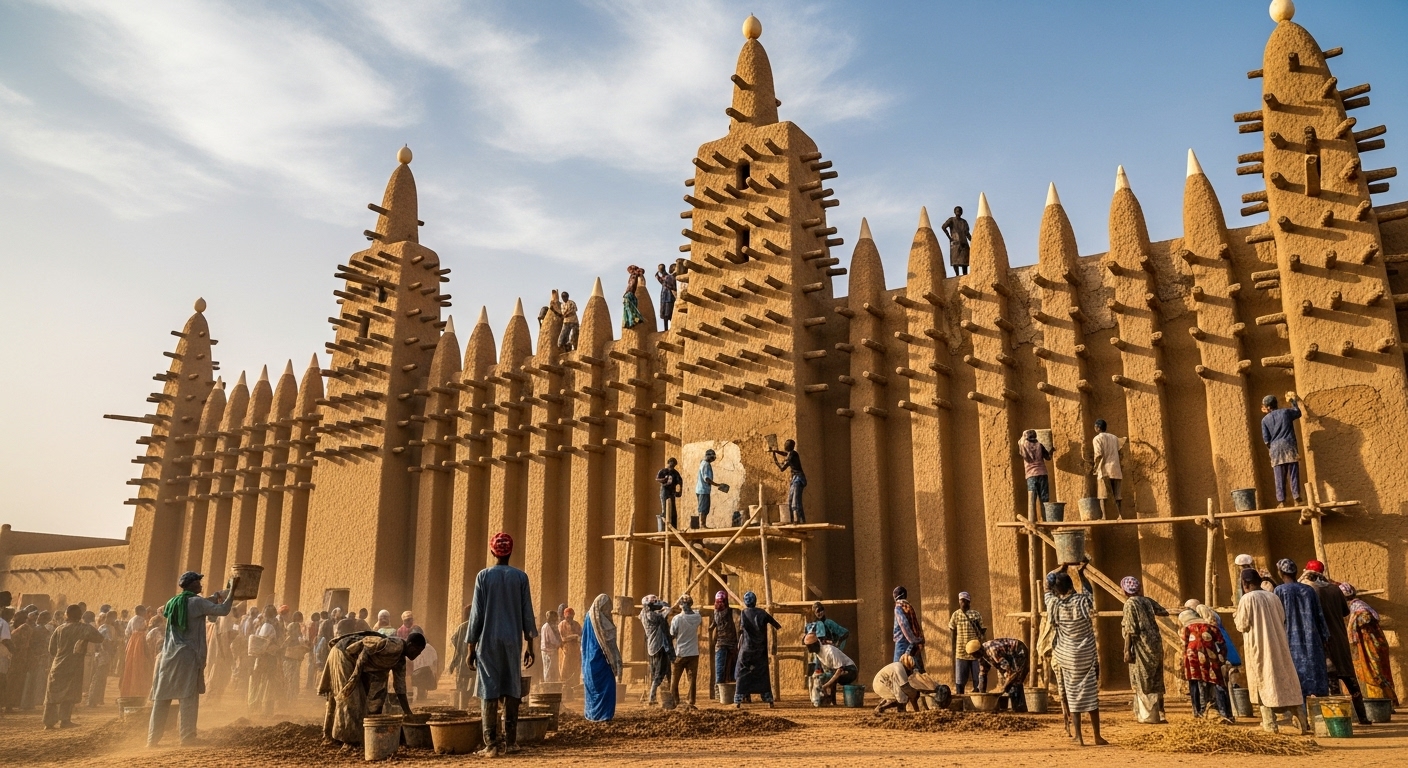
At the heart of Mali’s ancient city of Djenné stands the world’s largest mudbrick building—the Great Mosque of Djenné. This UNESCO World Heritage Site is more than a religious structure; it’s a symbol of community, artistry, and devotion. Built in 1907 on the site of an older mosque, it is reconstructed every year during the Crépissage de la Grande Mosquée—a festival where locals gather to replaster the walls with fresh mud to maintain its strength and beauty.
Watching hundreds of townspeople work in rhythm, slathering thick layers of mud onto the massive walls, is a sight to behold. It’s not just maintenance—it’s tradition, pride, and identity rolled into one. The Great Mosque of Djenné is truly one of the world’s most breathtaking mudbrick masterpieces.
Shibam, Yemen: The World’s Oldest Skyscraper City
Nicknamed “the Manhattan of the Desert,” Shibam in Yemen is a jaw-dropping example of vertical mudbrick engineering. Its multi-story towers, some rising up to 11 stories high, were built centuries ago from sun-dried bricks. In a land often plagued by floods, these tall structures allowed residents to build upward rather than outward.
Shibam’s skyline looks almost modern from afar, yet every tower is made from earth and straw. Wooden beams jut out at intervals, both for decoration and for use as scaffolding during repairs. It’s hard not to marvel at how ancient architects managed such architectural precision using only simple tools and natural materials.

Today, conservationists are working hard to preserve Shibam’s delicate balance between tradition and modernity. It stands as one of humanity’s boldest mudbrick masterpieces—a city where clay and creativity meet skyward ambition.
Chan Chan, Peru: The Lost City of the Chimú
Across the Atlantic, in northern Peru, lies Chan Chan—the largest adobe city in the Americas. Once the capital of the Chimú civilization, this vast labyrinth of plazas, temples, and royal compounds was built entirely from mudbrick. The walls are decorated with intricate geometric patterns and animal motifs, still visible after more than 600 years of weather and wind.
Chan Chan’s builders were masters of form and function. They created massive enclosures to protect from the harsh desert climate and designed water reservoirs and canals to sustain life in this arid landscape. Walking through Chan Chan feels like stepping into a giant earthen maze that whispers stories of a lost empire.
Ait Benhaddou, Morocco: The Fortified Clay City
Few places capture the cinematic allure of mudbrick masterpieces quite like Ait Benhaddou. Perched along the ancient caravan route between the Sahara and Marrakech, this ksar (fortified village) is a golden-brown wonder of towers, walls, and winding alleys. You may recognize it from films like Gladiator and Game of Thrones—but its real story is even more fascinating.
For centuries, traders and travelers passed through Ait Benhaddou, finding rest and refuge within its sun-baked walls. The structures, built from a mix of clay, straw, and water, are maintained through collective community effort. Even today, a few families still live within the old ksar, keeping its spirit alive.
Visiting Ait Benhaddou isn’t just about admiring the architecture; it’s about feeling time slow down. The silence, broken only by the occasional call to prayer or bray of a donkey, connects you to something ancient and grounding.
Taos Pueblo, USA: Living Tradition in Adobe
In New Mexico, USA, the Taos Pueblo community continues to inhabit their traditional multi-storied adobe homes that have stood for over a thousand years. Recognized by UNESCO for its cultural and historical value, Taos Pueblo remains one of the oldest continuously inhabited communities in North America.
The structures are made from adobe—mud mixed with straw—and plastered annually by residents to keep them strong. Inside, the air is cool in the summer and warm in the winter, thanks to the natural insulation properties of earth. Every beam, every wall, carries centuries of ancestral memory. Taos Pueblo is proof that mudbrick masterpieces aren’t just relics—they’re living, breathing homes.
Beyond Aesthetics: Why Mudbrick Still Matters
At first glance, building with mud might seem outdated. But when you look closer, it becomes clear that these ancient techniques offer answers to modern problems. Mudbrick architecture is naturally sustainable—it uses local materials, requires minimal energy, and produces virtually no waste. It’s also thermally efficient, keeping interiors comfortable without air conditioning or heating.
In a time when climate change and urban overdevelopment dominate headlines, the lessons from these mudbrick masterpieces are more relevant than ever. Architects around the world are rediscovering adobe and rammed earth as viable materials for contemporary construction. From eco-resorts in Africa to modern villas in Australia, the future of design may be found in the oldest building material of all—mud.
Famous Modern Mudbrick Projects
Modern architects like Hassan Fathy from Egypt and Anna Heringer from Germany have championed the revival of earthen construction. Fathy’s “New Gourna Village” was an ambitious attempt to reintroduce traditional mudbrick techniques to modern communities, combining aesthetics with affordability. Heringer’s work in Bangladesh and Africa shows how mud can be both elegant and empowering, especially in rural settings.
These innovators remind us that heritage and progress aren’t opposites—they’re partners. Every time a new generation molds clay into form, they’re continuing a dialogue that began thousands of years ago.
Exploring the World’s Mudbrick Circuits
If you’re fascinated by earthen architecture, consider planning a “mudbrick circuit” of your own. Here’s a suggested route for travelers who want to see these living legends firsthand:
- Africa: Start in Djenné, Mali, to witness the Great Mosque and its annual replastering festival.
- Middle East: Head to Yemen’s Shibam to see the vertical clay towers of the desert skyline.
- North America: Visit Taos Pueblo in New Mexico to experience adobe architecture still alive today.
- South America: Walk the sandy ruins of Chan Chan, Peru, and feel the echoes of a lost civilization.
- North Africa: End in Morocco’s Ait Benhaddou, where every turn feels like stepping into a film set from centuries past.
Each stop reveals a unique expression of human ingenuity—how different cultures, separated by oceans and centuries, arrived at the same solution: build with the earth beneath your feet.
Lessons from the Earth: The Future of Mudbrick Architecture
As technology races ahead, it’s easy to forget that some of the smartest solutions are also the simplest. Mudbrick construction proves that sustainability doesn’t require futuristic materials—it requires understanding and respect for natural processes.
Architects and environmentalists are now studying traditional earthen techniques to reduce carbon footprints and promote local craftsmanship. Universities are offering courses in natural building methods. Even luxury hotels are embracing adobe aesthetics for their organic appeal.
Maybe the future of architecture lies not in building higher, but in building wiser—learning from the mudbrick masterpieces that have already stood the test of time.
Imagine waking up inside a cool, earthen-walled room as the morning light filters through a carved wooden window. The scent of earth and straw fills the air. No hum of air conditioning, no sterile walls—just natural comfort. Sounds peaceful, doesn’t it?
So here’s a question for you: would you stay in a mudbrick home or hotel on your next adventure? Maybe even help build one? Let us know your thoughts below! We’d love to hear your take on earthen architecture and whether you think it deserves a bigger place in modern travel experiences. And if you love discovering hidden corners of culture and architecture, make sure to follow WentWorld on social media for more fascinating stories, eco-travel ideas, and global adventures.
Catch up on the top stories and travel deals by subscribing to our newsletter!