
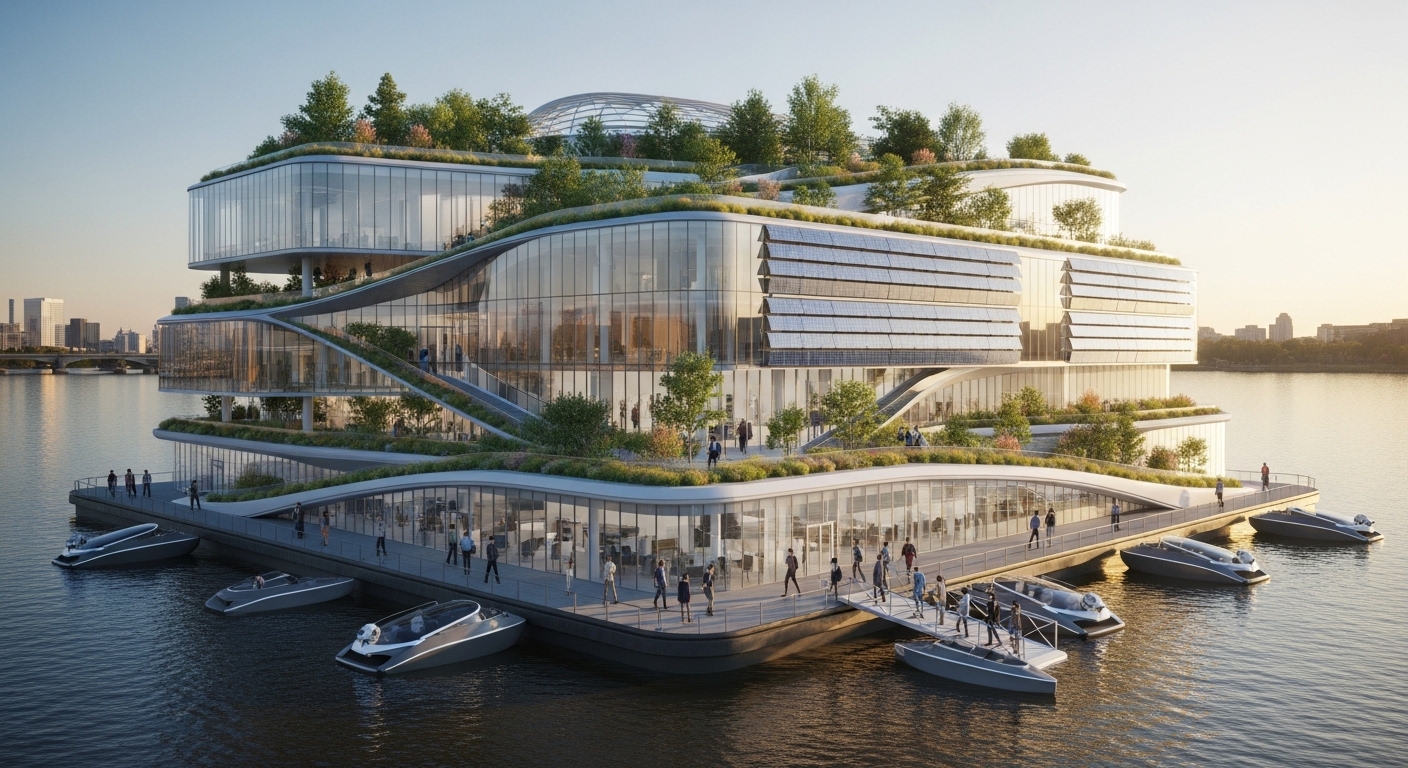
Floating courthouses on migrating rivers may sound like a futuristic experiment, yet the idea is quietly gaining relevance in a world shaped by climate change, shifting populations, and unstable geography. Instead of fixed buildings rooted in land that may disappear, this concept imagines justice as something that moves, adapts, and travels with people.
For centuries, courts have symbolized permanence. Stone buildings, rigid boundaries, and clearly defined districts represented stability. However, today’s reality looks very different. Rivers change their course. Communities migrate. Entire settlements disappear or reappear within decades. Consequently, traditional justice systems struggle to keep up.
So what happens when geography becomes fluid, but institutions remain static? More importantly, what if the solution is not to fight nature, but to move with it?
This is where floating courthouses on migrating rivers enter the conversation. Not as fantasy, but as a practical response to real-world problems that millions of people face every year.
Why Rivers Challenge Traditional Justice Systems
Rivers are living systems. Unlike roads or city blocks, they evolve constantly. Over time, they erode banks, create new channels, and abandon old ones. As a result, communities built near rivers often face uncertainty.
In regions such as the Brahmaputra River basin, entire villages shift every few years. Families lose land, documents, and access to public services. Meanwhile, legal boundaries remain fixed on maps that no longer match reality.
Because of this mismatch, courts become physically inaccessible. People must travel long distances by boat, road, or foot just to file basic legal claims. Eventually, many give up entirely.
Therefore, justice becomes a privilege of location rather than a universal right.
The Core Idea Behind Floating Courthouses
Instead of forcing people to chase the law, floating courthouses on migrating rivers reverse the model. Justice travels to people.
In practice, this means creating floating legal platforms that operate along river systems. These structures can anchor near communities for weeks or months, then move as populations shift.
Rather than serving one fixed district, a floating courthouse serves an entire river corridor.
As a result, access improves, delays decrease, and vulnerable populations gain representation without leaving their environment.

Where This Concept Makes the Most Sense
Some regions are almost ideal for floating courthouses.
For example, the Amazon River stretches across thousands of kilometers, with countless communities reachable only by boat. Similarly, the Mekong River connects multiple countries and cultures, yet legal access remains uneven.
Even in developed nations, rivers like the Mississippi River have historically reshaped borders and jurisdictions.
In all these cases, floating courthouses on migrating rivers are not luxuries. Instead, they represent logical infrastructure.
How a Floating Courthouse Would Function
From a design perspective, these structures resemble floating hospitals or research vessels.
Typically, a floating courthouse would include:
- A main courtroom hall.
- Private mediation rooms.
- Digital record systems.
- Satellite internet access.
- Renewable energy sources such as solar panels.
Technically speaking, some models could function as ships. Others may operate as modular platforms towed into position.
Judges and staff would rotate on scheduled routes, much like mobile medical teams.
In this way, justice becomes a service rather than a destination.
The Social Impact of Mobile Justice
Perhaps the strongest argument for floating courthouses on migrating rivers lies in social equity.
In many regions, people avoid courts not because they distrust the system, but because they cannot reach it.
Travel costs, time off work, and dangerous journeys discourage participation.
However, when courts arrive by river, these barriers collapse.
As a result, people file claims, resolve disputes, and register documents more easily.
Over time, this strengthens trust between communities and institutions.
Historical Roots of Mobile Courts
Interestingly, mobile justice is not a new idea.
In medieval Europe, judges traveled from town to town. In colonial territories, administrative boats often served as legal hubs.
Even today, some countries operate mobile courts using buses or temporary structures.
Therefore, floating courthouses on migrating rivers are simply the water-based evolution of an old concept.
Architecture That Respects Nature
Designing floating courthouses requires environmental sensitivity.
These structures must not disrupt river ecosystems. They must avoid pollution and respect natural water flow.
Many proposed designs use principles from eco-resorts and floating research stations.
Some even include green roofs, floating gardens, and wildlife-friendly lighting.
Consequently, the courthouse becomes part of the landscape rather than an intrusion.
Legal and Political Challenges
Of course, floating courthouses on migrating rivers raise difficult legal questions.
Which jurisdiction applies if a court moves? How are borders defined on water?
Fortunately, similar challenges already exist in maritime law.
With proper frameworks, these issues can be addressed.
Ultimately, legal systems must adapt if they wish to remain relevant.
Technology Makes It Feasible
Without modern technology, this concept would remain unrealistic.
However, digital records, biometric identification, and satellite internet make remote justice possible.
A floating courthouse no longer needs massive archives.
Instead, it needs connectivity.
As long as the system stays online, justice can operate anywhere.

Psychological Impact on Communities
Beyond logistics, there is a deep psychological dimension. For displaced communities, institutions often feel distant and unreliable.
However, when a courthouse arrives regularly by river, it becomes familiar.
Over time, justice transforms from an abstract concept into a visible presence.
Tourism and Public Engagement
Interestingly, floating courthouses may also become educational landmarks. Students could visit. Journalists could document new forms of governance.
In some cases, these structures might even become symbols of progressive urban design.
The Future of Floating Governance
Floating courthouses on migrating rivers may be only the beginning. In the future, schools, hospitals, and administrative centers could also float. As climate change accelerates, permanence becomes less reliable. Therefore, institutions that learn to move may survive longer.
Final Thoughts on Floating Courthouses on Migrating Rivers
This concept is not about novelty. It is about necessity. The world is becoming more fluid. Geography is no longer stable.
Floating courthouses on migrating rivers accept that reality. They bring justice to people, rather than forcing people to chase justice. So the real question remains:
Should institutions stay fixed while communities move?
Or should institutions evolve with human mobility?
We would love to hear your thoughts. Would you trust a floating courthouse? Do you believe mobile justice is the future? Share your ideas with us.
And if you enjoy exploring visionary travel and urban concepts, make sure to follow WentWorld on social media for more stories that challenge how we see the world.
Catch up on the top stories and travel deals by subscribing to our newsletter!






Leave a Reply
You must be logged in to post a comment.