
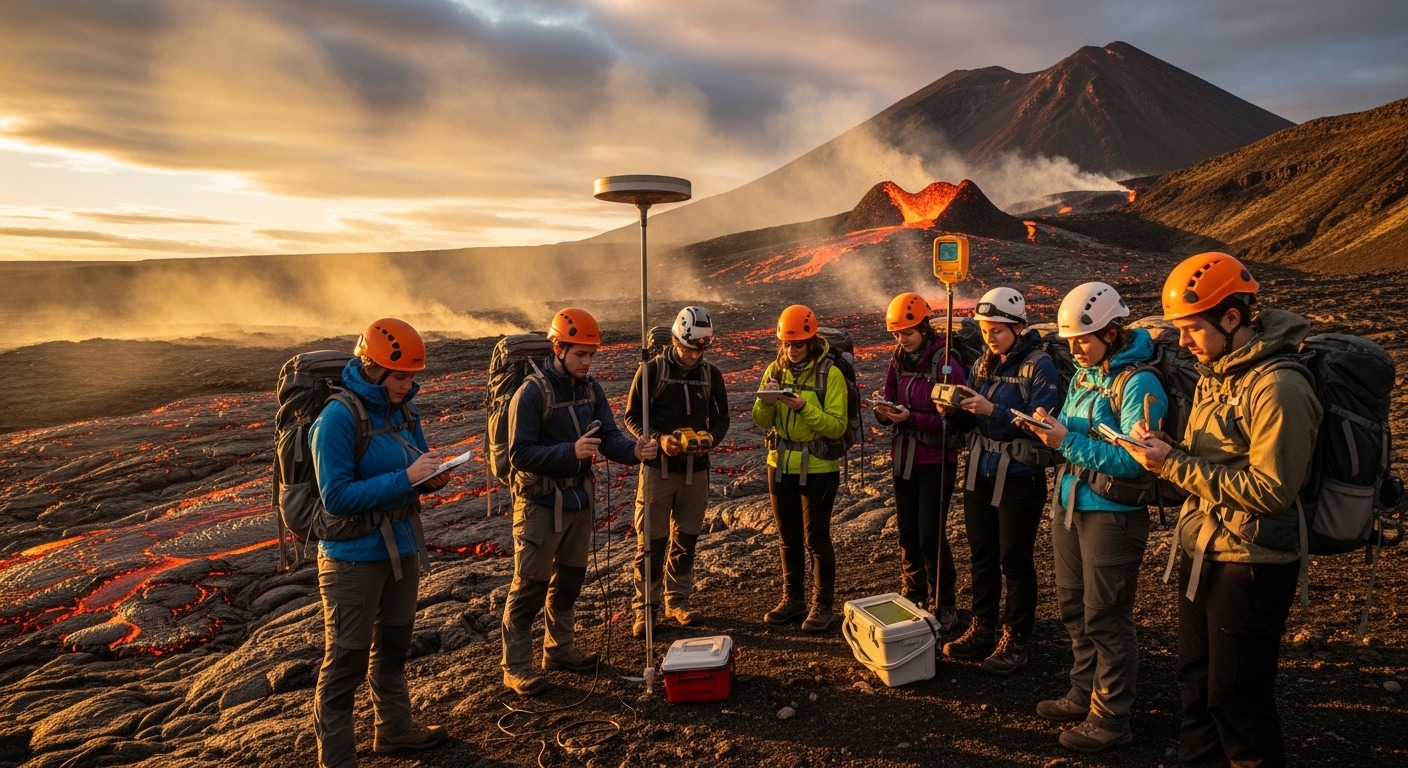
Learning usually happens in quiet classrooms, far from danger, far from unpredictability. However, for students studying in volcano schools teaching science on active slopes, education unfolds in one of the most intense natural environments on the planet. Instead of diagrams, they observe real lava fields. Instead of simulations, they feel seismic vibrations under their feet.
In these schools, the Earth is not just a subject. It is a living, breathing teacher. Moreover, science is no longer theoretical; it becomes something tangible, emotional, and deeply personal. As a result, students grow up understanding nature not as a distant concept, but as a powerful force shaping their daily lives.
So the real question becomes: would learning feel more meaningful if the world itself was your classroom?
Why Volcano Schools Exist in the First Place
At first glance, building schools near active volcanoes sounds irresponsible. After all, volcanoes represent risk, instability, and danger. Yet for millions of people worldwide, volcanic landscapes are not optional. They are home.
In many regions, volcanic soil is extremely fertile. Consequently, communities depend on these lands for agriculture and survival. Over time, rather than relocating, people adapted. Education followed that adaptation.
Instead of avoiding volcanoes, educators transformed them into learning laboratories. Therefore, volcano schools teaching science on active slopes were born out of necessity, resilience, and long-term coexistence with geological forces.
Rather than fear, students are taught understanding. Instead of panic, they learn preparedness. Knowledge becomes the first line of defense.
How Science Becomes Real in These Classrooms
Traditional education often struggles with relevance. Students memorize facts without knowing why they matter. In contrast, volcano schools remove that problem entirely.
Here, physics explains lava velocity. Chemistry reveals volcanic gas reactions. Geography maps evacuation routes. Meanwhile, biology studies ecosystems recovering after eruptions.
As a result, every subject connects directly to survival, safety, and real-world impact. Learning feels urgent. Concepts stick because they are lived, not memorized.
Have you ever wondered how differently you would learn if mistakes carried real consequences?
Mount Etna and the Living Curriculum of Italy
On the slopes of Mount Etna in Sicily, education and geology merge seamlessly. Etna is one of the most active volcanoes in the world. Still, thousands of students attend schools in its shadow.
Rather than ignoring the volcano, teachers integrate it into lessons. Students collect ash samples. They analyze rock layers. They monitor gas emissions alongside professional scientists.
Furthermore, local universities collaborate with schools, allowing students to work with real-time volcanic data. In this environment, science stops being abstract and becomes vocational knowledge.
Here, volcano schools teaching science on active slopes are not experiments. They are everyday reality.

Indonesia’s Mount Merapi: Where Education Saves Lives
Indonesia sits on the Pacific Ring of Fire, making it one of the most volcanically active regions on Earth. Near Mount Merapi, entire cities exist within potential eruption zones.
As a result, schools play a critical role in disaster preparedness. Students practice evacuation drills regularly. They learn how to read warning signals. They understand which gases indicate danger.
At the same time, lessons blend science with daily life. Geography includes lava flow history. Chemistry explains toxic gases. Social studies discuss past eruptions and community recovery.
In this context, volcano schools teaching science on active slopes function as survival centers, not just educational institutions.
Hawaii’s Lava Classrooms
In Hawaii, schools near Hawaiʻi Volcanoes National Park provide some of the most immersive science education in the world.
Students observe lava flows safely from designated points. They study air quality impacts from volcanic smog. Additionally, they work with seismic data collected by USGS scientists.
Learning here feels cinematic. The classroom walls extend into black lava fields and steaming vents. Every lesson connects directly to the land.
Consequently, students develop strong environmental awareness and practical problem-solving skills.
Psychological Effects on Students
Growing up near constant geological risk reshapes how students think. Rather than developing fear, many develop calm awareness.
They learn to live with uncertainty. They understand that change is inevitable. Moreover, they become comfortable making decisions under pressure.
Researchers have noted that students from volcanic regions often show higher resilience and adaptability. Living with risk trains the brain to process uncertainty logically rather than emotionally.
Would growing up near danger make you more anxious, or would it make you stronger?
Safety Systems and Early Warning Education
One of the most important roles of volcano schools is early warning education. Students learn to interpret seismic graphs. They understand alert levels. They know evacuation protocols by heart.
International organizations like UNESCO actively support disaster education programs in volcanic regions.
During real eruptions, schools often transform into emergency centers. Teachers become coordinators. Students help distribute information. Education becomes action.
In many cases, lives are saved because knowledge spreads faster than fear.

Cultural Identity and Volcanic Belief Systems
In many societies, volcanoes are not just physical structures. They are spiritual entities.
In Japan, schools near Mount Aso teach students both scientific and cultural interpretations of volcanic activity.
Children learn myths, rituals, and historical narratives connected to eruptions. Science coexists with tradition.
This combination creates a unique worldview where volcanoes are seen as ancestors, guardians, and teachers.
Are Volcano Schools the Future of Education?
Volcano schools teaching science on active slopes represent a radical educational philosophy. Instead of isolating students from reality, they immerse them in it.
Rather than removing danger, they teach how to manage it. Instead of abstract lessons, they deliver lived experience.
Imagine similar schools focused on glaciers, coral reefs, rainforests, or flood zones. Education would shift from memorization to adaptation.
Learning would no longer be preparation for life. It would become life itself.
Why These Schools Matter More Than Ever
In a world facing climate change, rising disasters, and environmental instability, volcano schools offer a blueprint for future learning.
They teach that knowledge reduces fear. They prove that preparation saves lives. They show that understanding nature is more powerful than resisting it.
Most importantly, they remind us that education should evolve alongside the planet, not remain disconnected from it.
We would love to hear your thoughts. Would you feel comfortable sending your child to a school built near an active volcano? Or do you think this kind of environment creates stronger, more capable individuals?
If stories like this inspire your curiosity about how humans adapt to extreme environments, follow WentWorld.com on our social media platforms and explore more journeys where education meets the edge of nature.
Catch up on the top stories and travel deals by subscribing to our newsletter!



Leave a Reply
You must be logged in to post a comment.