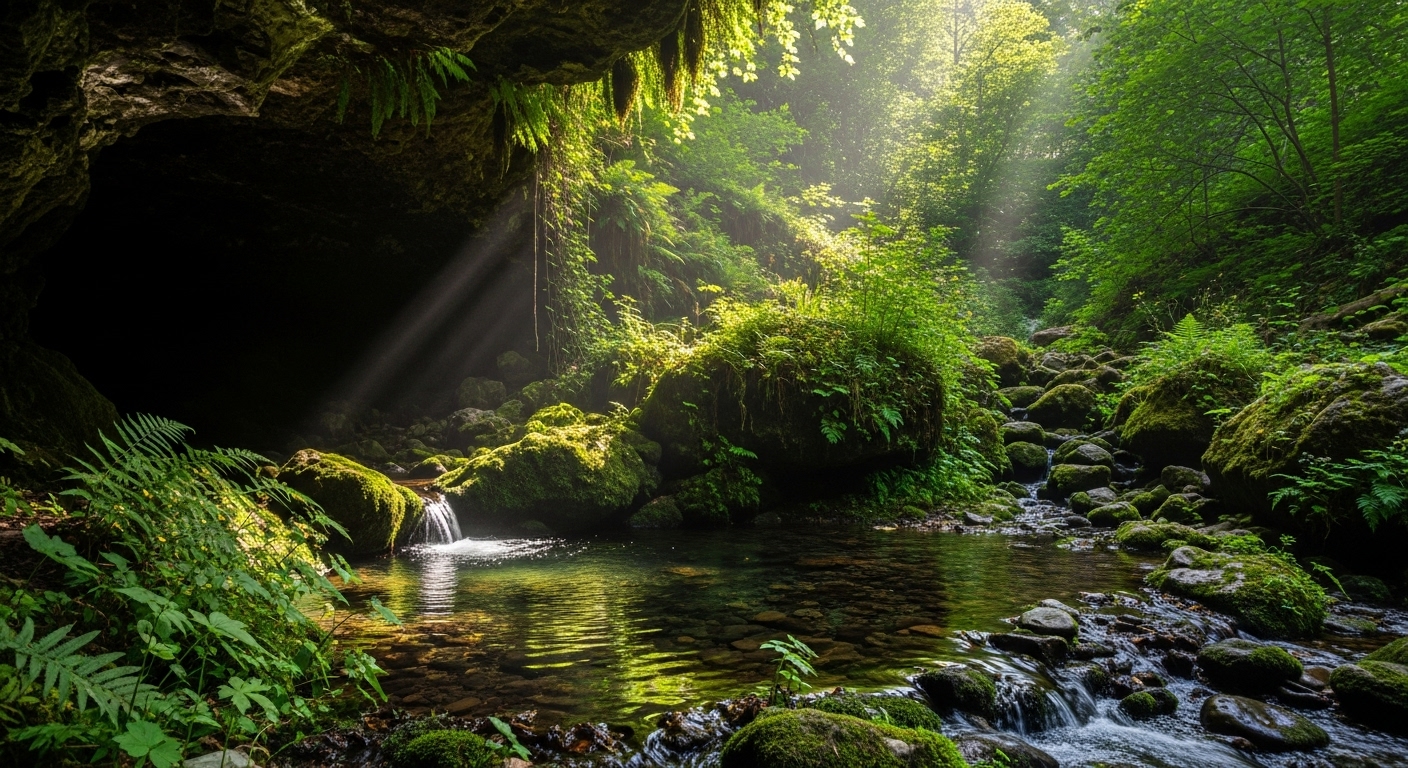
Some rivers announce themselves loudly, cutting valleys and shaping cities. Others choose a quieter path. Rivers that vanish underground and reappear challenge the idea that waterways must always remain visible. These rivers disappear into rock, soil, or sinkholes, travel unseen for kilometers, and then emerge again as if nothing happened.
Rivers that vanish underground and reappear create some of the most intriguing landscapes on Earth. One moment, water flows openly across land. The next, it slips beneath the surface, leaving a dry riverbed behind. Travelers often reach these places expecting a dramatic waterfall or canyon, only to find absence instead. That absence becomes the story.
Have you ever followed a river only to watch it disappear in front of you?
What causes rivers to vanish underground
Rivers that vanish underground and reappear typically flow through karst landscapes. These regions contain soluble rock such as limestone, gypsum, or dolomite. Over time, water dissolves these rocks, creating caves, fissures, and underground channels.
When a river reaches one of these openings, gravity takes over. Water drains downward into cave systems rather than continuing across the surface. In some cases, entire rivers vanish suddenly. In others, the process happens gradually, with flow thinning until nothing remains above ground.
This geological process unfolds slowly, but its results feel sudden when witnessed in person.
How underground rivers travel unseen
Once below the surface, rivers that vanish underground and reappear follow complex networks of tunnels and chambers. These underground routes may twist sharply, descend steeply, or spread into wide caverns.
Flow speed often increases underground due to confined spaces. Water pressure shapes the cave system continuously, expanding passages and creating new routes.
Eventually, the river finds an exit point, often where rock layers change or where pressure forces water back to the surface.
Why reappearance points feel so dramatic
The moment rivers that vanish underground and reappear emerge is often visually striking. Springs burst from cliff faces. Pools fill suddenly. Entire streams seem to appear from nowhere.
These reemergence points frequently support lush vegetation and wildlife, creating sharp contrast with surrounding dry terrain.
Travelers often describe these sites as feeling secretive, as though the landscape briefly reveals hidden workings.
The Lost River, Indiana
The Lost River in Indiana offers one of the most studied examples of rivers that vanish underground and reappear. It disappears multiple times along its course, traveling through extensive cave systems beneath the surface.
For long stretches, the riverbed appears dry, even during wet seasons. Then, unexpectedly, water resurfaces miles away.
Scientific documentation is available through the US Geological Survey.
Ponor River systems in the Balkans
The Dinaric Alps contain many rivers that vanish underground and reappear. Known locally as ponor rivers, these waterways sink into swallow holes and reemerge as powerful springs.
Seasonal changes strongly affect their behavior. During heavy rain, some underground routes overflow, temporarily restoring surface flow.
These rivers shape both surface valleys and underground cave networks.
Regional geological insight can be found at European Geosciences Union.
The Timavo River, Italy and Slovenia
The Timavo River flows from Slovenia into Italy, disappearing underground for much of its journey. Ancient Romans documented its mysterious behavior centuries ago.
After traveling beneath the Karst Plateau, the river resurfaces near the Adriatic Sea as a series of powerful springs.
This long underground journey makes the Timavo one of Europe’s most famous disappearing rivers.
Historical context is preserved through Encyclopaedia Britannica.
Why karst landscapes dominate these phenomena
Rivers that vanish underground and reappear favor karst regions because soluble rock erodes easily. Rainwater becomes slightly acidic as it absorbs carbon dioxide, accelerating dissolution.
Over time, vast underground drainage systems form, capable of carrying entire rivers.
Surface features like sinkholes, disappearing streams, and dry valleys signal the presence of these hidden systems.

How these rivers affect local ecosystems
Even while underground, rivers that vanish underground and reappear continue supporting ecosystems. Aquatic species adapt to darkness, reduced nutrients, and cooler temperatures.
At reemergence points, water delivers minerals and nutrients that promote plant growth.
These areas often become biodiversity hotspots.
Why travelers find disappearing rivers so compelling
Disappearing rivers defy expectations. They remove certainty from the landscape.
Rivers that vanish underground and reappear invite curiosity. Where did the water go? How long will it stay hidden? Where will it return?
These unanswered questions turn simple walks into explorations.
Best ways to experience disappearing rivers
Observation works better than chasing flow. Visiting both disappearance and reappearance points reveals the full journey.
Local guides often provide insight into seasonal changes.
Patience matters. Water may vanish or return depending on rainfall.
Why WentWorld highlights places like this
WentWorld explores landscapes shaped by unseen processes. Rivers that vanish underground and reappear remind us that much of the world operates below the surface.
They show how absence can be as meaningful as presence.
If you’ve followed a river that disappeared beneath your feet, we’d love to hear about your experience.
Follow WentWorld on social media to discover more places where the Earth quietly hides its most fascinating movements.
Catch up on the top stories and travel deals by subscribing to our newsletter!