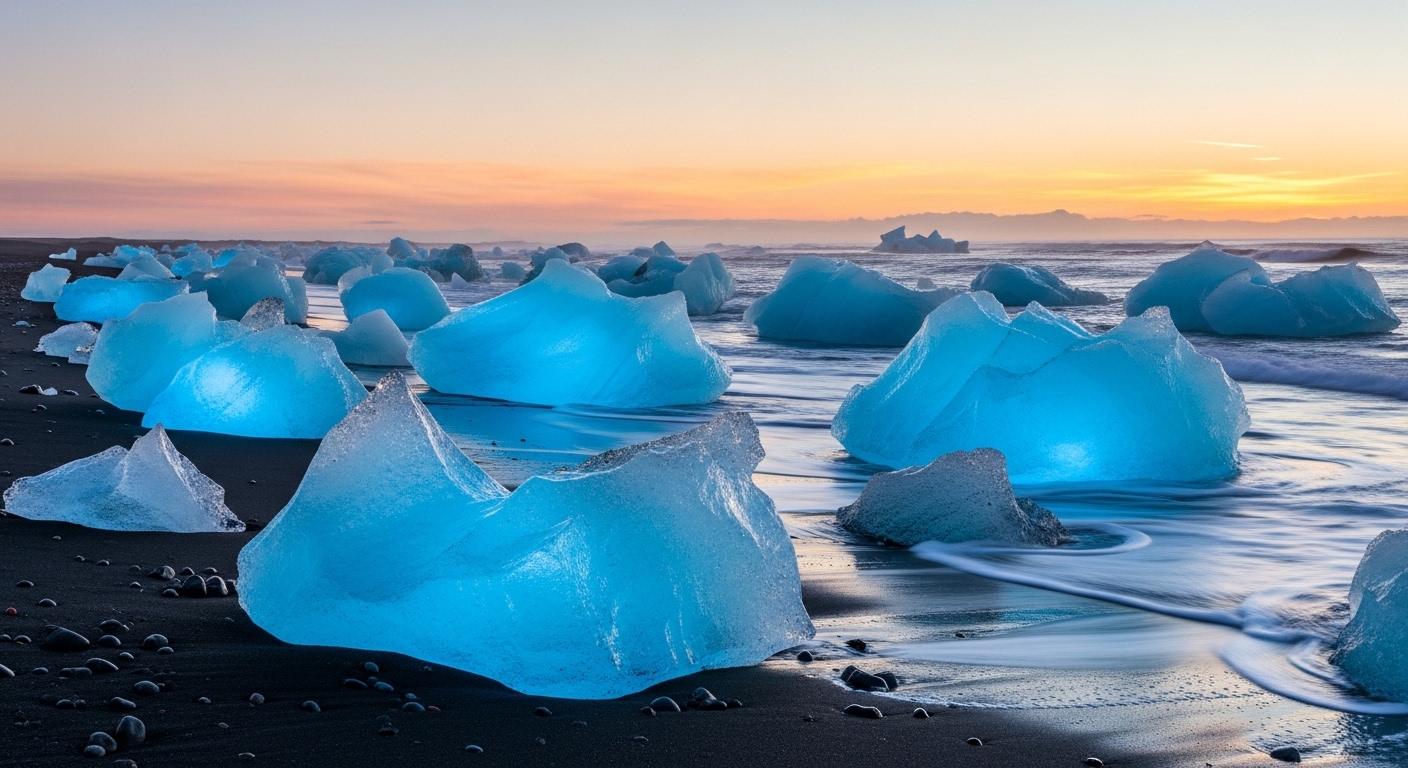
There is something hauntingly beautiful about iceberg graveyards, beaches where massive blue giants drift for the last time before melting into the sea. These are not just coastlines with ice; they are places where time seems to slow down, where silence replaces sound, and where nature puts on one of its most emotional performances. Standing before a resting iceberg feels less like sightseeing and more like witnessing a farewell.
Icebergs are born from glaciers, but they often find their final resting place far from where they began. After traveling thousands of kilometers across open oceans, shaped by waves and wind, they eventually reach warmer waters and shallow shores. There, they settle. They crack. They dissolve. And for a brief period, they turn beaches into surreal landscapes of glowing blue and ghostly white.
In this WentWorld.com journey, we explore iceberg graveyards, the rare beaches where these frozen giants come to rest. We will look at where they exist, why they form, and what it feels like to walk among them. More importantly, we will ask why these fragile places matter so deeply in a changing world.
What Exactly Are Iceberg Graveyards?
Iceberg graveyards are coastal regions where large numbers of icebergs accumulate and slowly melt. These areas are usually located near cold ocean currents that carry icebergs from polar regions into lower latitudes. As the water becomes warmer and shallower, the icebergs lose buoyancy and begin their final phase.
Unlike glaciers or polar ice sheets, iceberg graveyards are temporary. An iceberg may remain on a beach for days, weeks, or sometimes months, but it will always disappear. This temporary nature gives these places a unique emotional weight. You are not just seeing something beautiful; you are witnessing something that will soon be gone.
Have you ever visited a place knowing it might not look the same next year, or even next month? Iceberg graveyards exist in that constant state of transformation.
The Science Behind Iceberg Journeys
Icebergs begin their lives as part of massive glaciers in places like Greenland and Antarctica. Over time, pieces break off in a process known as calving. These fragments can range from small chunks to enormous floating mountains of ice.
Once free, icebergs are carried by ocean currents. In the North Atlantic, for example, many icebergs travel south via the Labrador Current. Eventually, they encounter warmer waters, which accelerate melting. As the ice thins, the iceberg becomes unstable and often drifts into coastal areas.
This process is influenced by climate conditions, sea temperature, and wind patterns. According to research from NOAA, rising ocean temperatures are changing both the speed and paths of iceberg movement. This means some iceberg graveyards may become more common, while others may vanish entirely.

Jökulsárlón and Diamond Beach, Iceland
One of the most famous iceberg graveyards in the world lies in Iceland, near the Jökulsárlón glacial lagoon. Here, icebergs break off from the Breiðamerkurjökull glacier and float through a lagoon before washing up on the nearby black sand shoreline known as Diamond Beach.
The contrast is unreal. Jet-black volcanic sand. Translucent blue ice. Sunlight reflecting through frozen arches and cracks. Each iceberg looks like a sculpture carved by nature itself.
Early mornings at Diamond Beach are particularly magical. The light is soft, the crowds are minimal, and the ice glows in shades of sapphire and silver. Icelandair and other regional airlines have made this destination accessible, but it still feels like stepping into another world.
Newfoundland, Canada
Newfoundland is another legendary iceberg graveyard, especially during spring and early summer. Icebergs from Greenland drift south and gather along the rugged coastline, creating scenes that feel almost polar despite the temperate surroundings.
Towns like Twillingate and St. Anthony are known for “iceberg season,” when locals and visitors track incoming ice using satellite maps and forecasts. The sight of a massive iceberg resting near colorful fishing villages creates a powerful visual contrast.
Tourism organizations like Newfoundland and Labrador Tourism highlight iceberg watching as a core experience, yet each encounter remains unpredictable. No two icebergs ever look the same.
South Georgia Island
Far from major tourist routes, South Georgia Island in the South Atlantic hosts some of the most dramatic iceberg graveyards on Earth. Icebergs from Antarctica drift into these waters and often ground themselves along remote beaches.
Here, blue giants rest among colonies of penguins and seals. The scale is overwhelming. Ice cliffs tower above black volcanic shores, cracking and groaning as they melt.
Few travelers ever reach South Georgia, but organizations like National Geographic have documented its raw beauty extensively. These beaches feel untouched, almost prehistoric.
The Emotional Experience of Walking Among Ice Giants
Walking through an iceberg graveyard is not like visiting a typical beach. There is no warmth, no casual atmosphere. Instead, there is silence, broken only by the occasional crack of ice shifting under the sun.
Many travelers describe a sense of reverence, similar to standing in a cathedral. The icebergs feel alive, even as they are slowly dying. You become aware of time in a different way, watching something ancient dissolve before your eyes.
Have you ever felt emotionally connected to a landscape? Iceberg graveyards often create that kind of connection, not through excitement, but through stillness.
Why Iceberg Graveyards Are Changing
Iceberg graveyards are becoming more unpredictable due to climate change. Rising global temperatures affect glacier calving rates, ocean currents, and melting speeds. Some regions are seeing more icebergs than ever before, while others are losing them entirely.
According to data from NASA Climate, polar ice loss has accelerated significantly over the past few decades. This means more ice is entering the oceans, but also melting faster once it arrives.
In the long term, this could mean fewer stable iceberg graveyards and more chaotic, short-lived appearances. The very places that inspire awe today may disappear tomorrow.

Photography and the Illusion of Permanence
Iceberg graveyards are a dream for photographers. The textures, colors, and lighting conditions create endless visual possibilities. Yet photographs often create an illusion of permanence that does not exist.
An iceberg captured today may be gone by tomorrow. A beach covered in ice one week may be empty the next. This fleeting quality is part of the story, but it is easy to forget when scrolling through curated images online.
Have you ever returned to a place expecting it to look the same, only to find it completely changed?
Traveling Responsibly in Fragile Environments
Iceberg graveyards are delicate ecosystems. The melting ice influences local marine life, water temperature, and even sediment patterns. Disturbing these areas can have lasting consequences.
Organizations like World Wildlife Fund emphasize responsible tourism in polar and subpolar regions. This includes keeping distance from icebergs, avoiding climbing on them, and minimizing environmental impact.
Respecting these landscapes ensures that future generations can experience the same sense of wonder.
Why These Beaches Stay With Us
Iceberg graveyards stay with us because they represent something larger than travel. They symbolize impermanence, fragility, and beauty coexisting in the same space.
They remind us that nature does not exist for our entertainment. It exists on its own terms, following rhythms far older than humanity. We are simply observers, passing through.
As WentWorld.com continues to explore rare destinations, iceberg graveyards stand out as places that do not just impress, but transform. They ask us to slow down, to feel, and to reflect.
Have you ever witnessed an iceberg in person? Or visited a place that felt temporary and timeless at once? We would love to hear your stories and reflections.
If you enjoy discovering extraordinary corners of the world, follow WentWorld.com on our social media platforms for more journeys that celebrate the planet’s most emotional landscapes.
Catch up on the top stories and travel deals by subscribing to our newsletter!