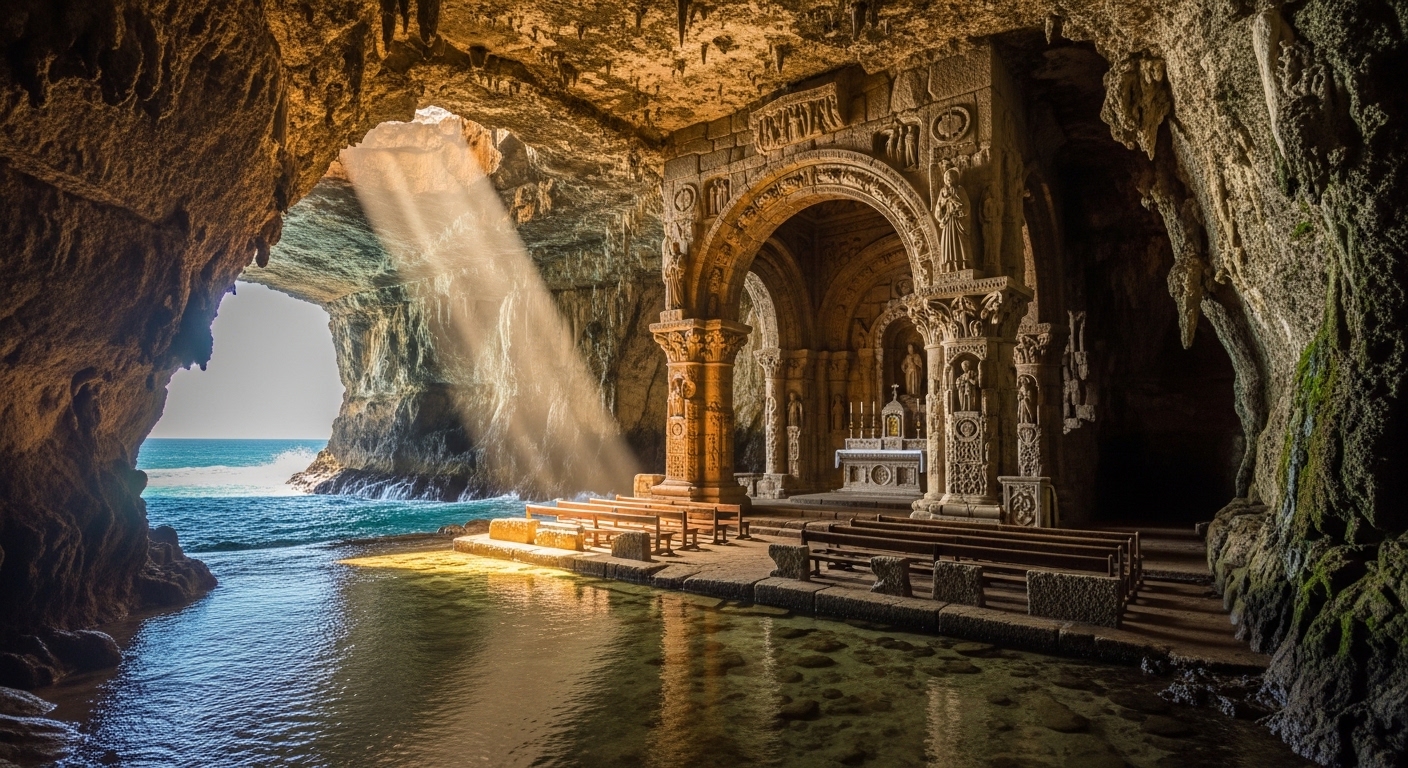
Most destinations promise accessibility. However, sea-cave chapels with tide timetables demand surrender. Instead of controlling schedules, travelers must adapt to lunar cycles, shifting shorelines, and unpredictable tides. As a result, these spiritual spaces feel less like tourist attractions and more like negotiated experiences between humans and nature.
Rather than checking opening hours, visitors consult tide charts and moon phases. Consequently, entry becomes an act of patience. Eventually, when the sea retreats, narrow stone paths emerge, guiding travelers into echoing chambers shaped by centuries of erosion. Meanwhile, the approaching tide reminds everyone that time inside remains limited.
Notably, this rhythm transforms ordinary travel into ritual. For that reason, sea-cave chapels with tide timetables occupy a rare category of sacred architecture where geography writes the rules and belief follows behind.
What Makes Sea-Cave Chapels Unique
Unlike conventional places of worship, these chapels rely entirely on environmental permission. In contrast to churches built on hills or plazas, sea-cave chapels exist inside living coastlines. Therefore, waves carve walls, salt polishes floors, and tides determine visiting hours.
Historically, monks and coastal communities chose isolation over convenience. Consequently, they carved altars into rock faces and placed symbols where light filtered only at certain angles. Over time, erosion reshaped these spaces, but spiritual use persisted.
Ultimately, what survives today feels less like architecture and more like dialogue between stone and belief.
The Role of Tide Timetables
Without tide awareness, visits become dangerous. Therefore, local communities maintain detailed charts based on lunar cycles. Meanwhile, fishermen and lighthouse keepers often provide the most reliable guidance.
Because tides change daily, no visit remains identical. As a result, pilgrims often describe each journey as unique, even when returning to the same chapel.
Interestingly, surrendering to tides creates emotional impact. Instead of consuming space, visitors participate in it.

St Govan’s Chapel – Wales
Along the cliffs of Pembrokeshire, St Govan’s Chapel represents one of Europe’s most photographed sea-cave chapels with tide timetables. Although stone walls protect the structure, surrounding paths flood during high tide.
Legend suggests Saint Govan hid from pirates when the cliff opened to shelter him. While historians debate the tale, spiritual significance remains strong.
Meanwhile, modern visitors track conditions through Visit Wales before descending the steep stone steps.
San Juan de Gaztelugatxe – Spain
Off Spain’s northern coast, San Juan de Gaztelugatxe sits on a wave-battered islet. Although not technically a cave, access mirrors the same dependency on tides.
Because waves often submerge the connecting bridge, authorities close the path during storms. Therefore, pilgrims must wait for safe conditions.
Further information appears on Spain’s tourism authority.
Santa Cristina’s Grotto – Italy
In southern Italy, Santa Cristina’s Grotto hides inside a narrow limestone inlet. At low tide, a rocky corridor emerges. At high tide, the entrance disappears entirely.
Historically, fishermen gathered here before long voyages. Consequently, prayers blended with practical survival rituals.
Today, heritage listings remain available via Italia.it.
Sea-Cave Shrines of Kerala – India
India’s Malabar Coast hosts several tide-locked cave shrines. Notably, these spaces remain active rather than preserved.
During monsoon season, waves seal entrances for months. Therefore, worship pauses until nature allows return.
Regional documentation appears on Incredible India.

Why These Places Still Matter
Modern travelers often seek ease. However, sea-cave chapels with tide timetables attract people craving meaningful difficulty.
Because access feels earned, presence becomes deeper. Consequently, visitors describe heightened awareness, emotional clarity, and quiet humility.
In contrast to theme parks and landmarks, these chapels refuse consumption. Instead, they demand participation.
The Emotional Geography of Temporary Sacred Space
Knowing that the ocean will soon reclaim your path alters behavior. Therefore, conversations quiet. Movements slow. Awareness sharpens.
Eventually, silence replaces thought. As a result, many visitors describe experiences closer to meditation than sightseeing.
Few modern structures replicate that emotional architecture.
Safety and Ethical Travel
Although visually compelling, sea-cave chapels with tide timetables require discipline.
- Always check local tide forecasts.
- Never push entry windows.
- Avoid solo visits.
- Respect cultural artifacts.
- Leave nothing behind.
Above all, treat these spaces as living heritage, not photo opportunities.
The Future Under Rising Seas
Climate change threatens many coastal chapels. Consequently, erosion accelerates while access windows shrink.
Some sites already suffer permanent submersion. Others may vanish within decades.
Therefore, every visit becomes documentation as well as experience.
If a sacred place required the moon’s permission, would you value it more?
We invite you to share your thoughts. Have you experienced travel shaped by tides or seasons? Would you plan a journey around natural rhythms instead of convenience?
Follow WentWorld.com on our social media platforms for more disappearing destinations, rare heritage, and stories where geography still controls the journey.
Catch up on the top stories and travel deals by subscribing to our newsletter!